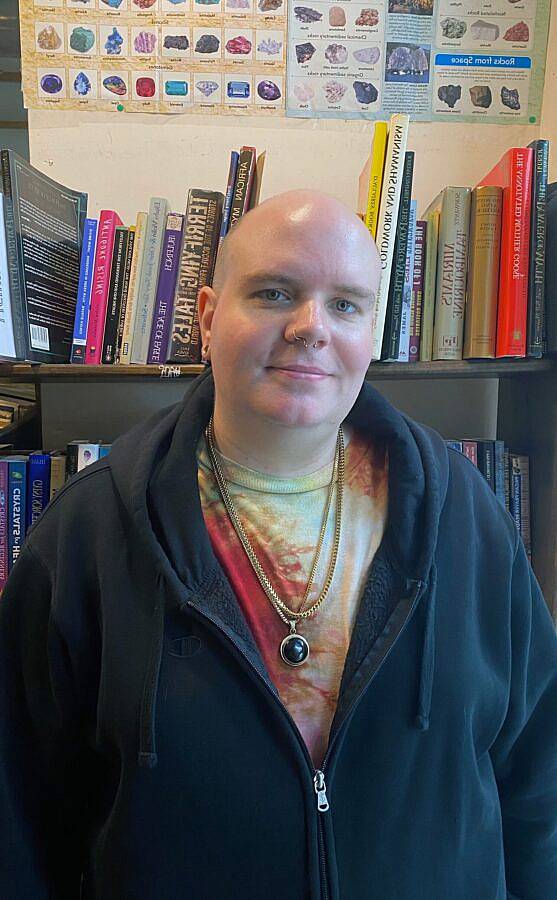
Tell us a bit about who you are and what you do.
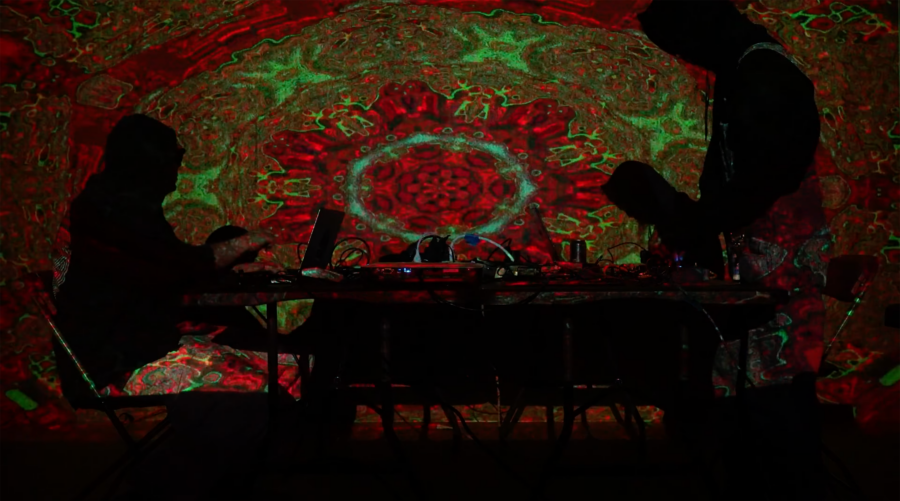
My name is Syd Ross, and I make art and music under the stage name Omnia Sol. I am an audiovisual performer, video artist, filmmaker and VJ. In 2025 I started an experimental video art television show called Heavy Shell TV for CAN TV19. Along with my solo music and sound art I am also a part of the audiovisual band veryveryvery with Ian Kang, Lee Yun, Ravinda D Wibowo, Do Trong Quy, Yiyisogreen, and Mengjun Duan. I am also a printmaker currently working primarily in Risography to make zines and animations. I am extremely influenced by glitch art both in terms of aesthetic and philosophy.
You have said that “the glitch artist wants to show you the static.” Would it be fair to consider this the thesis of the Omnia Sol project? Why does the static matter to you?
I think static or visual noise is so important to my artistic endeavors for a variety of reasons. Even when I was focused on woodblock printmaking, the “chatter” or visual noise from textures made during the carving process was always my favorite. I think the “no signal” or blue or black screen in contemporary video equipment really hides the creative potential of technology that static and glitch accentuate. In later models of CRTs you have to actually find a remote to turn off what analog glitch artists call “the blue screen of death” by turning off visual noise reduction, which was put in specifically to censor glitch, because TV companies thought their customers found static unpleasant. I love using CRTs, specifically with circuit bent video gear, because CRTs can handle any video signal you send it, no matter how glitchy, shredded, or chaotic. There is definitely a metaphor with the removal or hiding of glitch being similar to the societal treatment of marginalized communities. Image technology being denoised with blue screens is the same as the right trying to pretend that if they make life unlivable for trans people that we will just cease to exist. But like in the film “I Saw The TV Glow,” with CRTs you can still see the TV glow even if you shut it off. So static to me emphasizes our existence since the beginning of time and is a way to accentuate our shine.
Do you differentiate your practice when working in different mediums? Does something like this even matter?
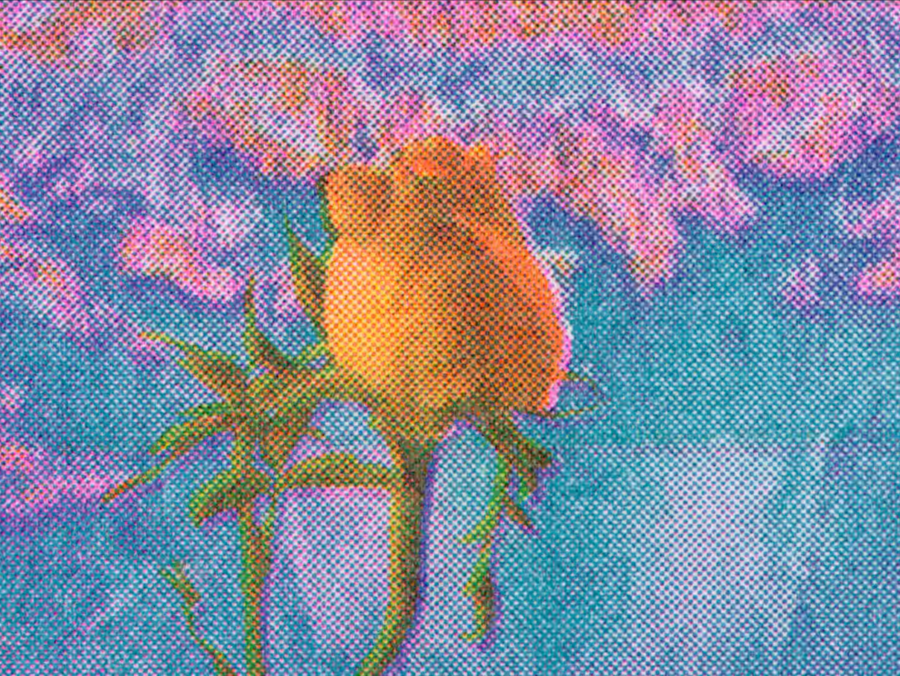
I don’t think I could differentiate it if I tried at this point. When I am printmaking, I take digital images of glitch and bring them back into the analog world with ink and paper. Even when I was primarily painting and drawing my comic series ZZZZZZ, I was still creating a form of analog glitch art with moire patterns that tweak out any camera that tried to document them. My audiovisual performances are somewhat different from my VJ gigs but I still try to curate the experience in a way where my vision comes through.
Do you begin a work with a mental image, a composition plan, a mood, an atmosphere, or a state of mind that you want to evoke?
I definitely work with a specific mood and state of mind with each project or performance. I work in what I call plunderoptics, which is the reuse and remixing of visual sources to create new meaning. I put in a lot of prep work to curate my source material before I glitch it, and the actual signal flow and aesthetic design changes completely from project to project. With my show MARS EXPO, since the god of war Mars was such an integral part of conceptualizing the show, I tried to find clips from anime and tokusatsu footage that I felt really emphasized the themes of class war, retrofuturism, and space exploration. After I have assembled and curated the clips for a performance, the glitching itself is based in real-time improvisation. Although my band veryveryvery primarily makes breakcore and ambient soundscapes, I think conceptually we draw a lot of inspiration from free jazz with our use of improvisation.
How do you see your work evolving in parallel to things that are going on around you?
Having a network of friends and collaborators that also work in experimental video has been quintessential to my practice. There is so much we can all learn from each other. Making visuals for live events has definitely made me a stronger artist and a better curator of moving images. A lot of times, the themes of my work are a reflection of what I’m going through emotionally or personally at the time of making it. Making art really is an amazing therapy and I couldn’t live without it.
Who do you think is making important work right now?
There are way too many artists for me to mention right now. As far as raves and electronic music is concerned, care_online and Mages Guild are putting out amazing music and putting together amazing shows. Cameron Worden is one of my favorite filmmakers and film curators working in Chicago and if you get the opportunity to see his work projected you need to. Digital Devil Saga is a life changing experience. I think Taylor Dye’s work as a video artist and curator of Eyewash Video Magazine and the microcinema Eyewash Station is a super important staple to the Chicago video art and film ecosystem. MIKE VIDEOPUNK from NYC is really doing amazing expanded cinema work with live remixing and rescoring of films. Also I am biased since they’re in my band but I think Lee Yun and Ian Kang are two names to keep an eye on. They both have such a dedication to interactivity and play within audiovisual systems and it has really transformed the way I think about and create art.
What is one of the bigger challenges you and/or other artists are struggling with these days and how do you see it developing?
The economy is definitely horrible for the mass majority of people right now. I think for musicians, VJs, and audiovisual performers the biggest difficulty is getting booked and getting paid. Especially when you’re starting out it can feel really hopeless but I think it’s extremely important to keep a DIY or DIT (Do It Together) state of mind. Start putting together shows with your friends. If you’re an aspiring filmmaker in Chicago, look into awesome microcinemas like Eyewash Station to get your work screened. I think we definitely need to think bigger than the current gallery and film festival systems. Obviously I’m biased as a performer but I think events, happenings, and mutual aid are a way forward.
Are there any areas, techniques, or materials that you’re interested in exploring further in your practice?
I definitely want to continue to explore risography and make more flicker films with flatbed scanners. I really want to get one of my video works actually printed on 16 or 35mm filmstock as see it projected in an actual movie theater setting. I am definitely going to continue making Heavy Shell TV and working with veryveryvery. I really feel as though the TV show and audiovisual performance is what I was called here to do.
What are some of the best or worst reactions you have gotten to your work?
My work is at times very visually and sonically abrasive, which is not for everyone. I always put flashing lights warnings at the beginning of my works. I think the worst reaction to my work is thinking that you need to be on drugs to enjoy or understand it. It’s more like Rothko where you really need to sit with it and let the colors wash over you, which I recommend as a sober experience. I think one of the most rewarding reactions is getting to talk to people while I’m VJing about what I’m doing and how I am creating my video. I love to talk process and tech.
Can you share a reaction to your work that lingers with you?
There’s been a lot over the years, but I genuinely really enjoy it when I get confused comments on my videos not realizing that glitch and distortion are the goal in my image making. I’ve also had some of the patterns in my imagery compared to quilting and fiber arts which has really stuck out to me. My grandmother was a quilter and an amazing fashion designer but she would only make shirts and purses for herself and not to sell. The amount of time and love she put into her work made them priceless. I definitely want to live in that legacy and the work of fiber artists like Emilka Wolniewicz, whose works with projection mapping in her fiber art really inspires me.
What is something you’ve always wanted to do and are working towards achieving?
I definitely want to take my audiovisual performance on tour sometime soon. Even a short Midwest tour would be awesome. Since the majority of veryveryvery is international we’ve joked about doing a “world tour” of Chicago and then all of their home countries of Taiwan, Mainland China, Vietnam, and Indonesia. I need to get a passport but I am hoping to get the stars aligned to make that happen sometime in the next few years. Funding is always a huge hurdle especially with how this fascist administration has completely gutted grants. Crowd-funding for flights and lodging/eating as cheaply as possible might have to be the move.
What do you collect?
I used to be a huge collector of VHS tapes. It started with just any tape I could get my hands on, but I narrowed it down to specifically anime tapes and anything tokusatsu related. Some of my favorite tapes in my collection were Japanese Super Sentai and Juukou B-Fighter tapes. Since Japan used the NTSC color format they would still play in US VCRs which I always thought was really cool. Juukou B-Fighter, also known as Heavy Shell Beetle Fighter, is actually where Heavy Shell TV takes its name. I had to scale back my collection over the past year. In between multiple moves and needing money for rent and bills, the collection just became too much to manage, but I really miss my tapes and I hope to rebuild a smaller collection one day. Now I’ve started collecting something even seemingly more inconvenient in taking any and every CRT TV I can find. On the surface, this seems impractical with how big they are, but what keeps me collecting is knowing there will never be any more made, that they are so quintessential to the art I make, and that being able to engineer this older technology into TV walls and installations might turn out to be my most marketable skill. I just finished a gig engineering a TV wall for Free Street Theater and now I am working with street artist and photographer Wrath & Love for a show at the end of June that will feature some CRT installations and projections. If anyone reading this interview has a CRT they don’t want anymore, I will happily rescue it for them.
Interviewed by Seth Nguyen.