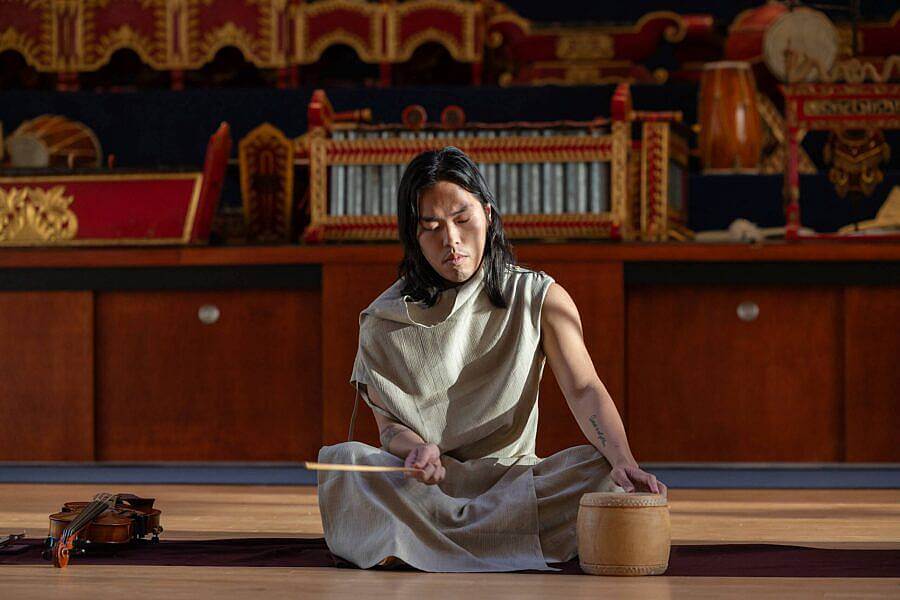
Tell us a little bit about who you are and what you do.
Dance Studies scholar André Lepecki recently describes what I do as “performance art haunted by the spirit of dance.” I really love how that simple description encapsulates the breadth of my performance practice. Basically, I’m a freak making freakish things with other freaky people.
Is there a moment you look back on as being formative to your identity as an artist?
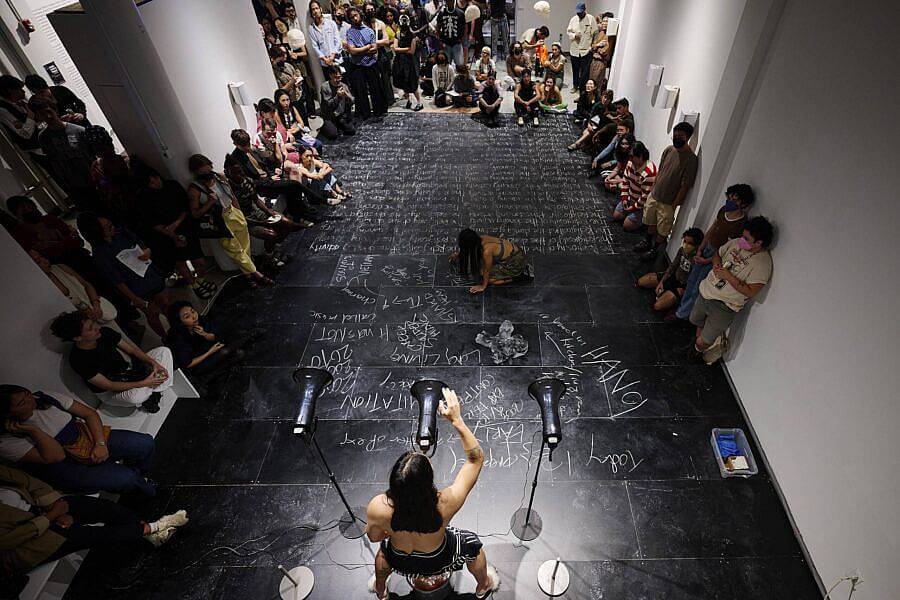
Witnessing the experimental band Đại Lâm Linh on Vietnamese national television haunts me until this day. They were relentlessly screaming and chanting (and singing quite beautifully!) as part of this pop music competition called Bài Hát Việt. It was so out of place, but it blew my mind in terms of what art could be. I now also think of this performance as a very honest eruption of the Vietnamese postwar psychosis, which nobody really wants to confront.
Do you begin a work with a mental image, a composition plan, a mood, an atmosphere, or a state of mind that you want to evoke?
There is no beginning and no ending for me. I rehearse with collaborators year-round, and we are always working on what feels like the same obsessions to me. A show is just a temporary crystallization of form, and then the ideas get to unravel again and I get to keep working. I would say one recurring atmosphere of my work is the oppressive monotony of high intensity.
When and how did you decide that you wanted to use movement to express your ideas?
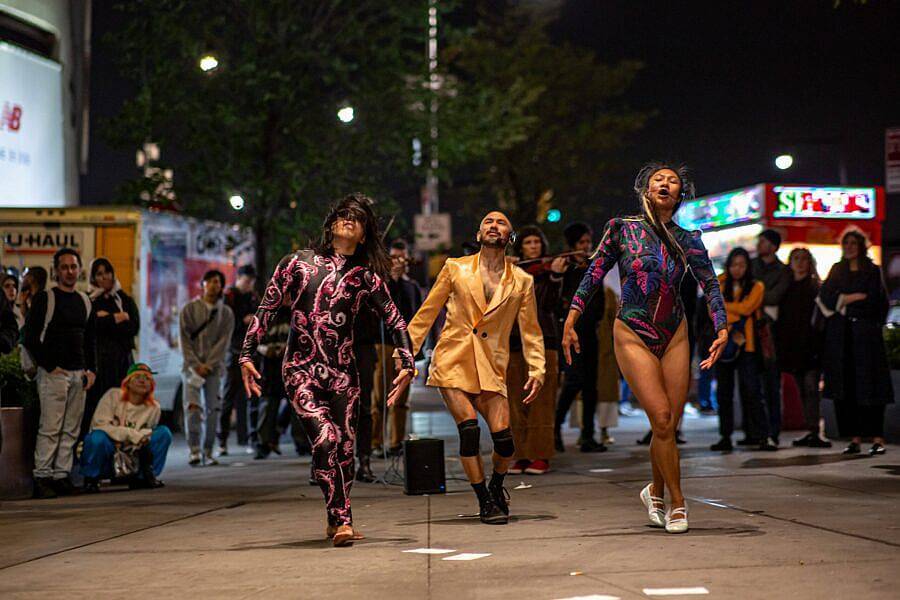
I don’t think I’m “using” movement per se; it’s not such a willful process. Movement comes to me and arouses my imagination because it is such a visceral medium. It is intensely sexual. The material elusiveness of movement further lends itself to explore what queerness feels like and how unspeakable histories live on through the body.
Who would you ideally want to collaborate with? What makes a good collaborator in your experience?
I really want to collaborate with my shaman, Mudang Jenn! I also want to be in more conversation with Vietnamese artists working in experimental performance since there are not many of us. To me, a meaningful collaborating relationship, among other things, needs a lot of arousal—we need to be mutually aroused by each other’s practice.
Experiments with Ca Trù at Roulette, NYC, 2026. Video courtesy of Roulette Intermedium.
Your recent solo exhibition, Song and Sex: Before the Revolution, is the culmination of your research and experimentation on hát ả đào, a form of traditional Northern Vietnamese chamber music that is critically endangered (also known as ca trù). Tell us more about this body of work. How do you see this work relating to your previous works on ritual possession?
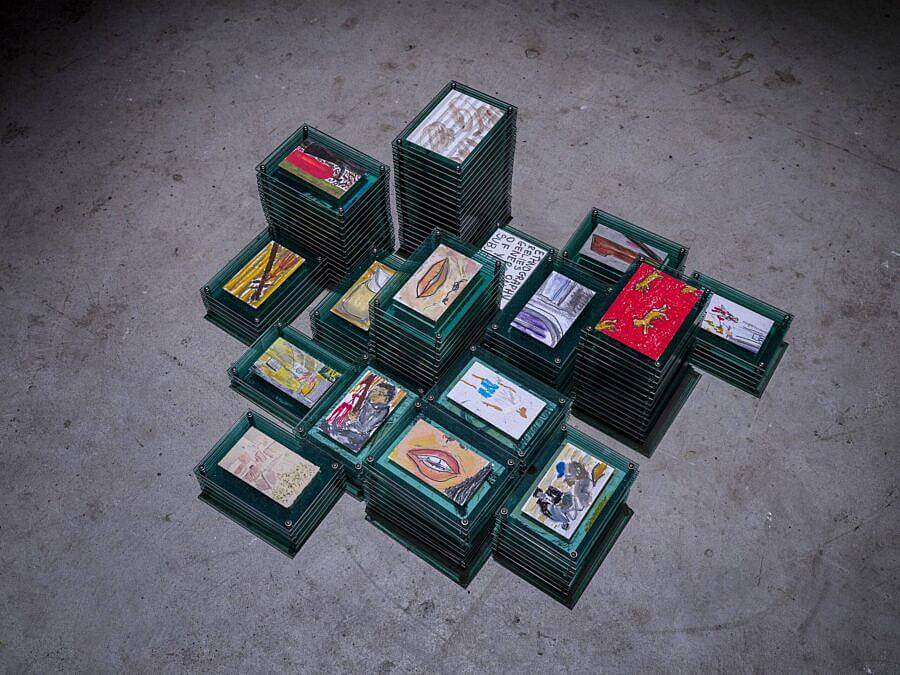
These are two very big questions!! Song and Sex: Before the Revolution was both an exhibition and a performance series. The exhibition component features 400+ drawings made by visual artist Kyle b. co., who documented my rehearsals/studying process with two Hanoi-based ả đào musicians—Vũ Thuỳ Linh and Phạm Đình Hoằng. The drawings are shown in several piles of framed-and-stacked drawings, so you only get to see two dozen drawings that are on top of the stacks. There is also a sound installation designed by Isaac Silber coming in from the basement of Participant’s gallery, with very subtle hints of ả đào vocal and lute ornamentations layered underneath the din of a crowd talking (taken from actual ả đào performances that I organized in NYC back in March 2026). A lot of the exhibition tries to contend with the ambivalence between sharing and concealment, which is integral to a folk form that historically is passed down within family and guild structure only.
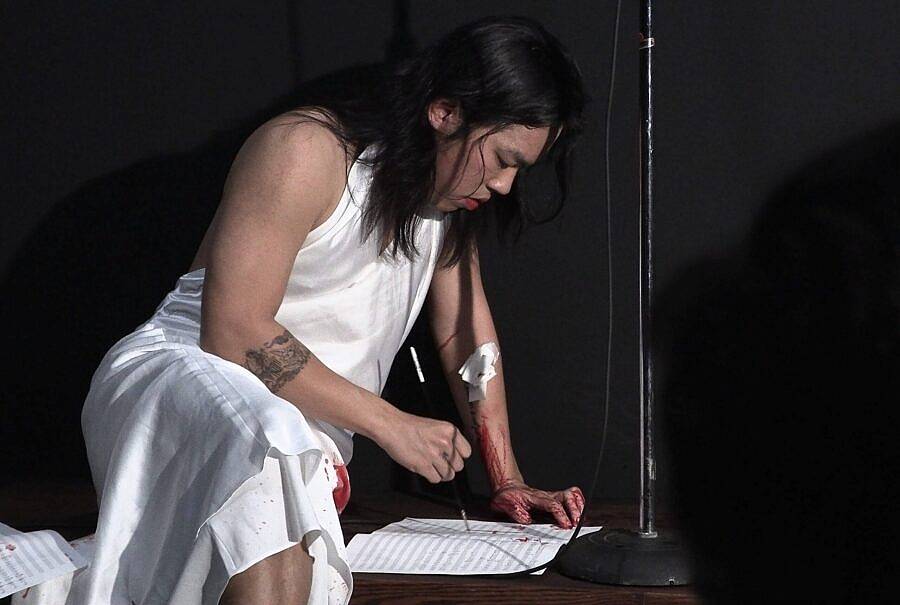
The performance series was epic! I did seven different performances for seven consecutive Sundays. Each performance was called a “resurrection.” Some were bloody, some were durational, some felt more like theater and entertainment—they were all very distinct from one another. These performances look almost nothing like actual ả đào, but I was holding onto certain formal and historical characteristics of the tradition: the strict commitment to rhythmical structure, the importance of poetry, the beauty of the songstress, the sexual perversity of how the form was practiced in the 20s and 30s in urban environment, just to name a few.
My ongoing work on ritual possession deeply informs the methodology of Song and Sex. I go into the research process with the full intent of offering my body up as an empty vessel, and let the learning process and the spirit of ả đào takes the work wherever it needs to go.
How does your creative community now compare to your creative community when you were younger?
It doesn’t change that much. I am blessed to work with many of the same collaborators from when I first started out. I do receive more material support now so I’m able to maintain a meaningful connection to the artistic weirdos in Vietnam. That’s a big shift.
Who are the artists/creatives/musicians that you have been inspired by lately?
I’ve been listening back to Gỗ Lim these days. They were a Hanoi punk band active in the early 2010s, but the frontwoman, Nga Nhí, passed away quite young. Their music helps me process the layers of suffocation that I felt growing up in Vietnam.
You have described your body of work as being about war, and your personal agenda is to get our generation [of Vietnamese people] to think about war. Why does this conversation matter to you? (Full disclosure, I am also in the camp of “we do not talk about it nearly enough,” and I want to understand what the stakes are for you in cultivating this discourse.)
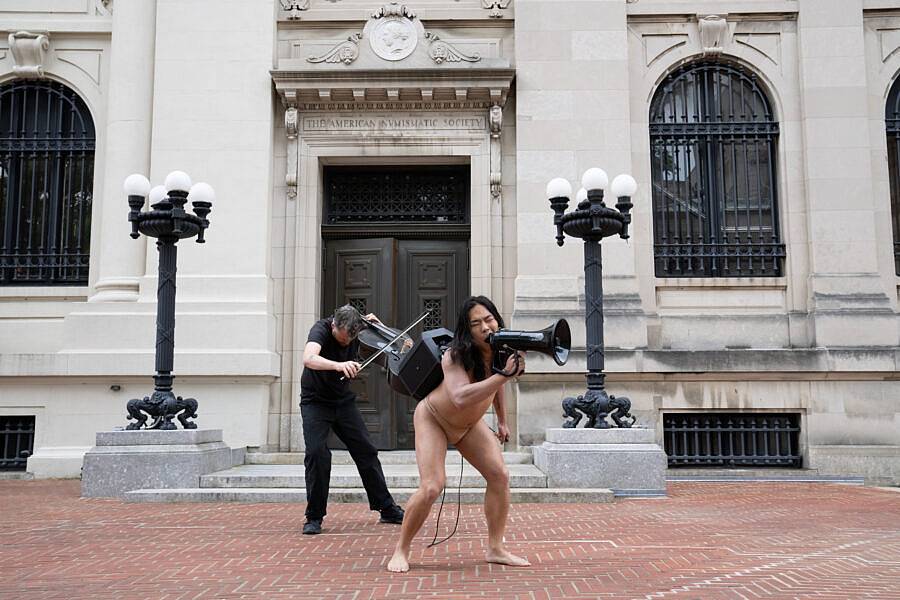
I grew up in Hanoi during a time where the whole country was fixated on economic development. Whenever war came up, it was mostly described in glorious terms, or recalled with a lot of suffering but in a nostalgic way. “You youngsters don’t know how hard life was” kind of narrative. But it never felt real to me because no one quite confronts the real violent afterlives of war, how it lingers in the collective psyche and penetrates every interpersonal exchange, every unit of social organization like the family, the school, the workplace, etc. I often quote Christina Sharpe’s description of antiblackness and extrapolates it to describe war as “the totality of the weather.”
My generation, I think, feels quite lost and psychically broken, I believe largely because we live in the wake of war while disavowing that reality altogether. Now, whenever I gather with old friends or peer artists, we spend a lot of time sharing these terrible stories of extreme childhood neglect and abuse, and realize that, “yeah, a version of that happens to me, too.”
Can you share a reaction to your work that has lingered with you?
This has happened to me several times now, both in Vietnam and in the US. Young, college-aged Vietnamese audience members would come up to me after a show wanting to talk but they cannot utter a single word. Instead, they start sobbing, and I would give them a long hug. It reminds me of the intense disorientation I felt when I first encountered experimental performance. I see a lot of myself in these young folks.
Are there any current or upcoming projects that you are excited about?
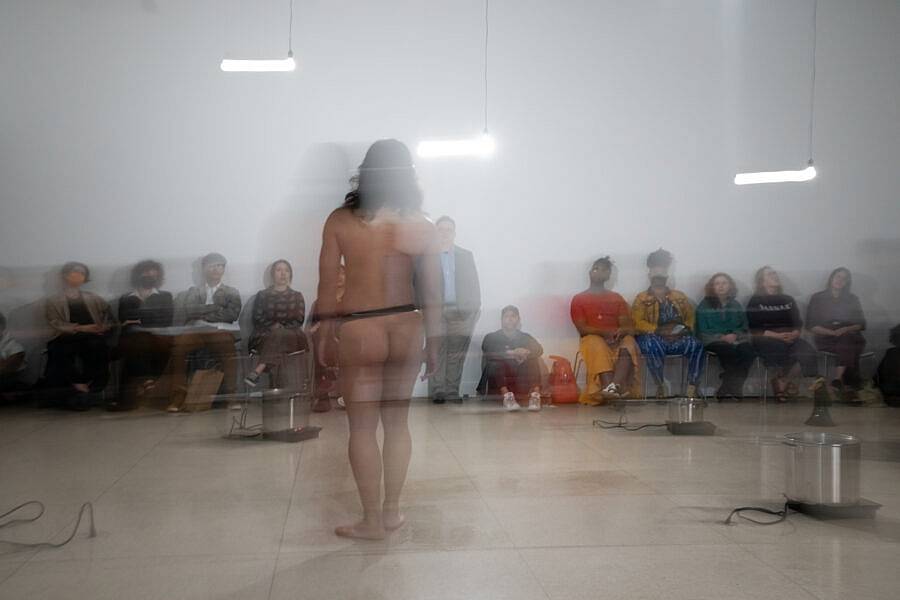
I’m working a new multi-year series where I try to “translate” historical performances from Vietnam into the US context, and vice versa. I am always perplexed how translation is often thought of exclusively to textual forms. The first performance will happen in Fall 2026 in NYC: I’m translating Vũ Đức Toàn’s Phượng Hoàng Vĩnh Cửu [Phoenix Forever] (2022), a piece where he biked into the Red River in Hanoi. The larger series is titled Study, Study More, Study Forever—a Lenin’s quote that is drilled into my head from young age.
What do you collect?
Last year, I started collecting second-hand couture dresses. I want to occasionally live out my diva fantasy!
Interviewed by Seth Nguyen. Artist portrait by Sandy Aldieri of Perceptions Photography.