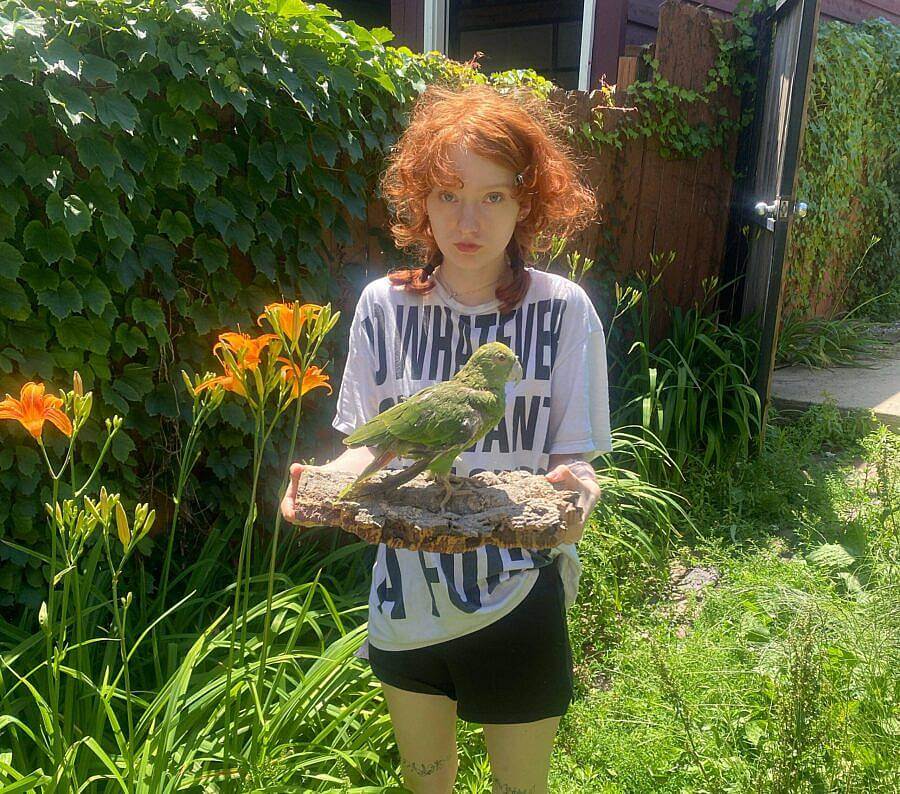
How did your interest in art begin?
When I was too young to read, there were lots of books in my house that were full of beautiful pictures. I would “play” with the pictures in my head, like imagine I was entering them and could look around all the corners and try on the elaborate historical costumes. I liked books with many pictures within one category, like a book with a page that had twelve different drawings of hats, and I would pick my favorite and then make other people pick their favorite too, and that image becomes yours. And I would draw pictures of pet shops and make my little sister pick the animal she wanted to adopt. I’m a middle child so I liked to be by myself and make my own stories sometimes, and drawing is a really immediate way to do that. I’ve been drawing since I was really, really young, so I don’t think I can disentangle the act of “drawing” from the act of “being myself”. I hope art will discover its interest in me too.
What/who is influencing your work right now?
This book I bought at Aeon called Lingerie in Vogue since 1910. I keep pulling it out before I go to my studio. And I read all the Claudine stories by Colette this summer, who’s one of my favorite writers. Claudine herself is that perfect human-animal I imagine in my figures. So sensitive and so cruel!
I talk a lot with friends about what we’re working on. From A-Z: Nicki Andres, Spencer Grogan, Viktoría Horpudottir, and Sharon Zhang are all artists with whom I have regular three hour painting talks with. I can’t overstate that influence nor can I leave it out. I think it’s really easy for me to spin out or lose sight of reality when I don’t have friends working beside me who are also excited to talk about the same things.
My favorite activity after drawing is walking around. So I’m happy for another summer in New York. People, places, and things la la la la la….
Who are some of your favorite artists?
Rita Ackermann, Sebastian Buerkner, Aya Takano, Margaret Keane, Christina Ramberg, Janiva Ellis, Jiří Trnka, Barbara Hammer. Connor Marie Stankard. Goya was my first favorite painter in high school. Andrea Zittel. Nobuhiko Kitamura. Justine Kurland, Marlene Dumas. Kelly Ficcara is a great illustrator. Junko Mizuno too. Vivienne Westwood. I’m really inspired by Bjork and Rihanna and the Beastie Boys. I’m going to forget someone. Marie Laurencin and Helen Frankenthaler. I’ll stop there so I have more to say later.
What were you like in high school?
Annoying!
What is something you’ve always wanted to do and are working towards achieving?
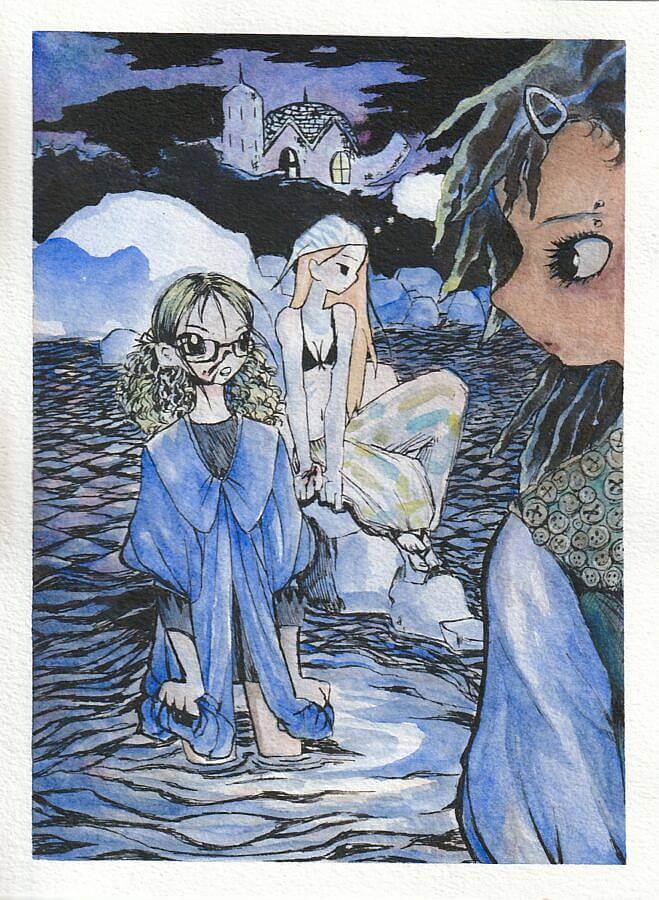
I really am trying to make a long-form narrative! People ask me about this a lot. I’ve made a lot of comics over the years, but I haven’t shared many. I’ve mostly written the next one, which is also kind of the first one anybody will see (unless you were following my work in high school… in which case, shhh). It’s just going to take a while. Words and pictures together at last!
What is one of the bigger challenges you and/or other artists are struggling with these days and how do you see it developing?
I just finished undergrad, so I do feel like my perspective of “these days” is limited. Maybe we’ve always been struggling with the same things. There are lots of horrors in the world. I hate war and imperialism and pain. What I’ll describe is not very big in the grand scheme of things, but it’s one challenge I can put into words.
I felt a lot of shame about what I was compelled to make, like I wish I didn’t need figures to express myself, and I wish I wasn’t interested in these high-appeal commercial images or these things I think are childish or embarrassing. But you are who you are, as much as I want to expand my thinking and my work, I think you can’t contrive changes in output without actual internal transformation. I’m not completely sure but I feel like if you’re contriving reasons to make work, there’s really no point. You’re kind of putting the cart before the horse. Or like, that’s a useful exercise for yourself but there’s no reason to involve other people. If there’s nothing vulnerable or secretive or true about myself or my perspective in what I’m drawing, it’s just a material study, or less. But I’m also not interested in making things that strictly indulge myself, and I hope other people feel their own fears or desires acted out in the images, or at least find them attractive. It’s slightly contradictory. That’s why it’s a struggle for me. ‘I have to be me to mean anything to you’ is the most concise way I can put it.
What do you collect?
I collect dolls, books, CDs, vintage shoes, mannequin/wigheads, and plastic bangles. Lucite, bakelite, and celluloid. And I collect postcards and letter sets, but I try to mail them out as much as possible. The bangles are my most active collection I think. I seek them out without prejudice/indiscriminately. I used to think books didn’t count as a collection, but I realized I have a kind of crazy amount. I always pick them up off the street and I like to go to secondhand bookstores and get a stack. My favorite is Aeon in NYC. When I lived in Chicago, I went to Myopic a lot. And I grew up in Portland, where we have Powells Books, the largest independent bookstore in the world, where you can spend an entire day and still come back again next week. Dolls are more like a case-by-case basis, once I have the one I want I’m set for the next year. My most recent is my 2004 Silver Snow Blythe. I’d like to collect more but it’s a very expensive habit.
Clothing appears to function as costume and beyond in your work. How do you think about fashion within the narrative and what it is referencing?
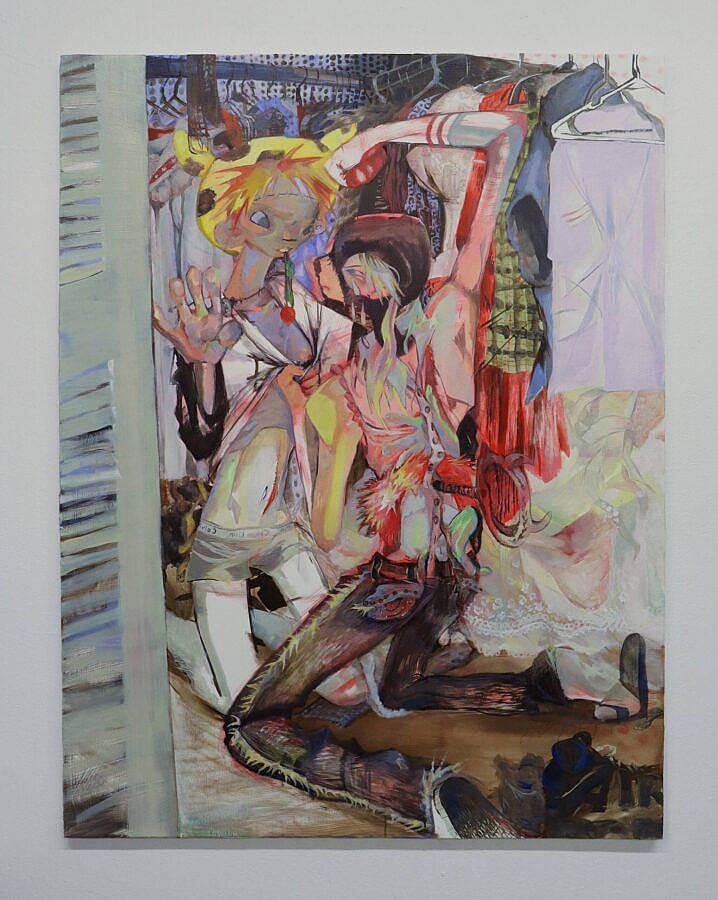
I’m very inspired by my friends and also by film. I love gay people. I love animals. And I love costumes– archetypal illustrations of different roles across fairy tales, mythology, and genre fiction. And the figures can try on these roles, and switch and start over. A lot of the time they’re naked, or as close to it as possible. I like to draw contemporary Highland dance costumes. I did competitive Highland dance for ten years, and there are a few very beautiful, simple costumes that are worn over and over again. The kilt (velvet vest with silver braid, white blouse, and a mens’ kilt), nationals dress (the feminine version with a petticoat), and the hornpipe outfit (ww2 british soldier costume). So these three archetypes are Scottish warrior, Scottish maiden, and a sailor. The different dances have different narratives, genders, and time periods you’re supposed to embody, but it’s always the same dancers rushing to get changed between songs. All of these archetypes are super simplified, flattened ideas about highland life, and highland dress, but the dancers portray them with total conviction that at least shows the truth of emotion and the will of the human body. That’s just an example. And then by combining articles of clothing that carry specific narratives, we can build a highly legible, more complex mode of expression. Clothing is the most accessible way for people to express themselves, and I feel like recognition is also a form of style, not just what you do directly but how you read other people’s dressing. It’s a way of explanation that I feel like most people can understand, so I feel like it brings people in. It’s also fun to paint.
Are there comic artists, graphic novels or manga that have shaped your visual thinking?
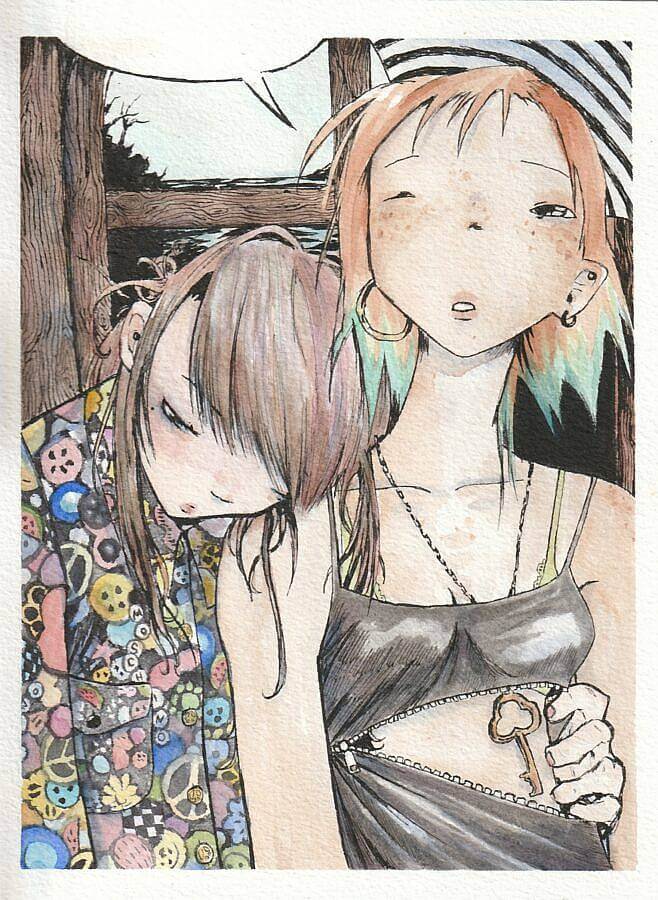
My favorite comic book artist is Humberto Ramos. We have the same birthday. His run on Amazing Spider-Man was one of the first comics I read as a kid where I really noticed the art, and he also did the cover for another omnibus I used to check out from the library all the time. I know a lot of comic readers don’t really like him because it’s stylized to the point of being kind of ridiculous but it really appealed to me. His style especially in the 90s was super youthful and fresh and expressive, and almost gross at times with how viscerally articulated and mismatched the contortions of the body are. And it’s this kind of cuteified human animal action hero (see “Impulse” 1995), shrimpy, big eyes, big hair. But still sinewy and boney underneath the appeal, and when they open their mouths they’re crowded with sharp, overdrawn teeth. No drawing is ever fully not-ugly and stretched like chewing gum. I copied a lot of things from him when I was younger, it’s still there I think.
Are there techniques from illustration or comics that you intentionally bring into painting?
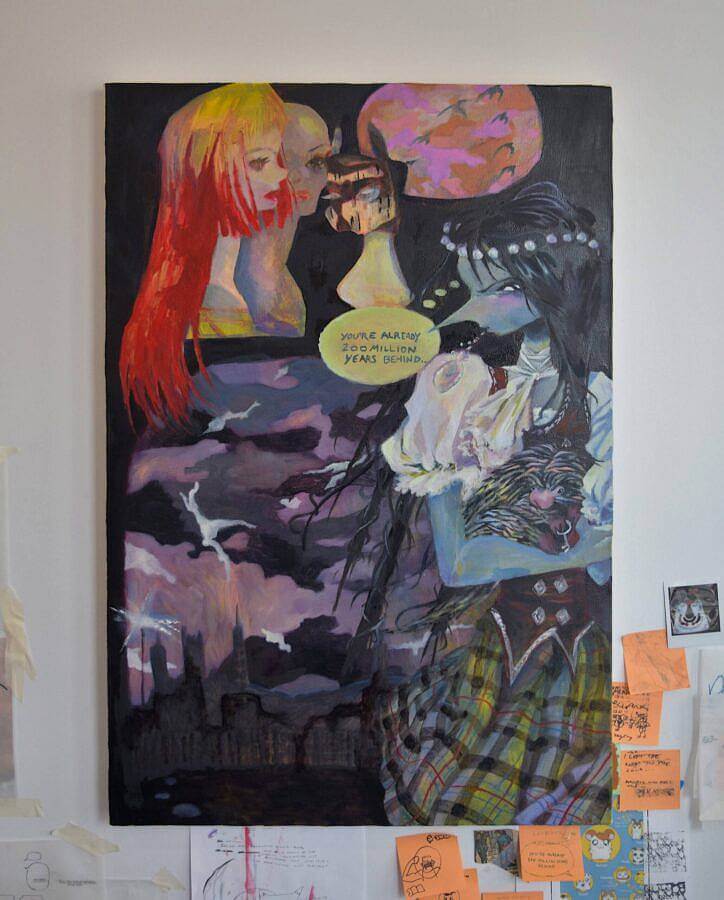
Usually when you read a comic you’re not starting from the beginning, you found issue #93 of the newest series of a character that’s been around for 50 years, so it’s always a struggle to catch up and understand the significance of what’s happening or who’s important. Which is a very exhilarating feeling, like listening to a stranger’s gossip where you don’t know anyone involved, and every text bubble is dripping with some heavy vagueness you can’t parse. Like who is Caitlin Fairchild? Do you like her or hate her? What happened at that cloning facility???? What’s going on??? I don’t know if this counts as a technique. Maybe more of an effect. But I think it’s magical. Entry to a new world wouldn’t start with an explanation of how to breathe. I try to make this happen in my paintings, like this is a part of a whole melodrama. And you can see this moment but there’s a lot more to imagine. You have to figure out the future and the past. The story starts with you, but it also started a million years ago.
And of course, line. And the specialness of black outlines that separate forms and keep figures contained in themselves. It’s so sad! They can’t ever touch, because there’s this hard black line where their fingers meet. I’ve tried to give up outlines so many times. I know I should. I know it’s bad painting. I just can’t. Not yet.
Are there recurring characters, symbols, or motifs that appear in your work/ what brings them back?
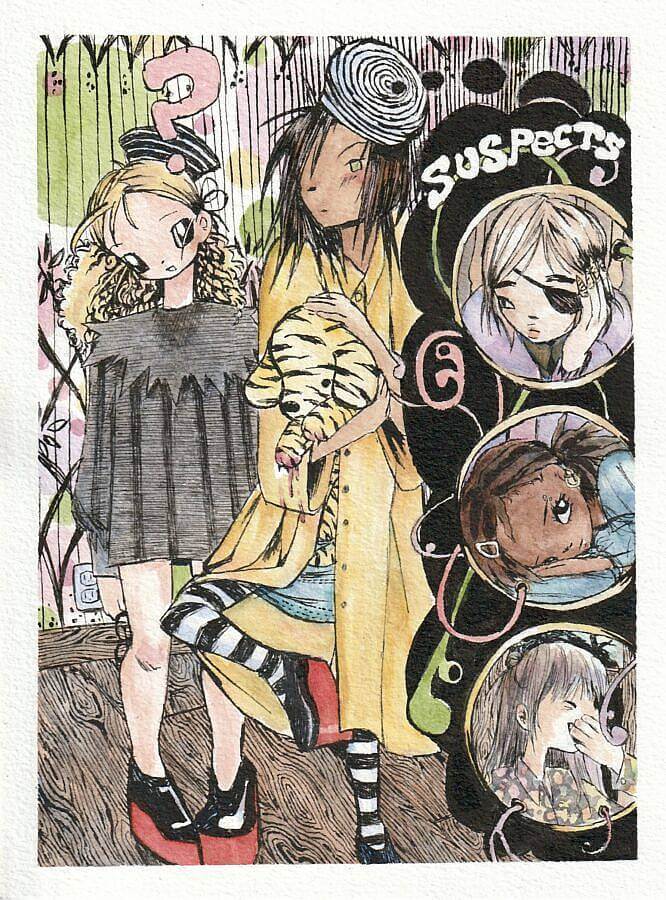
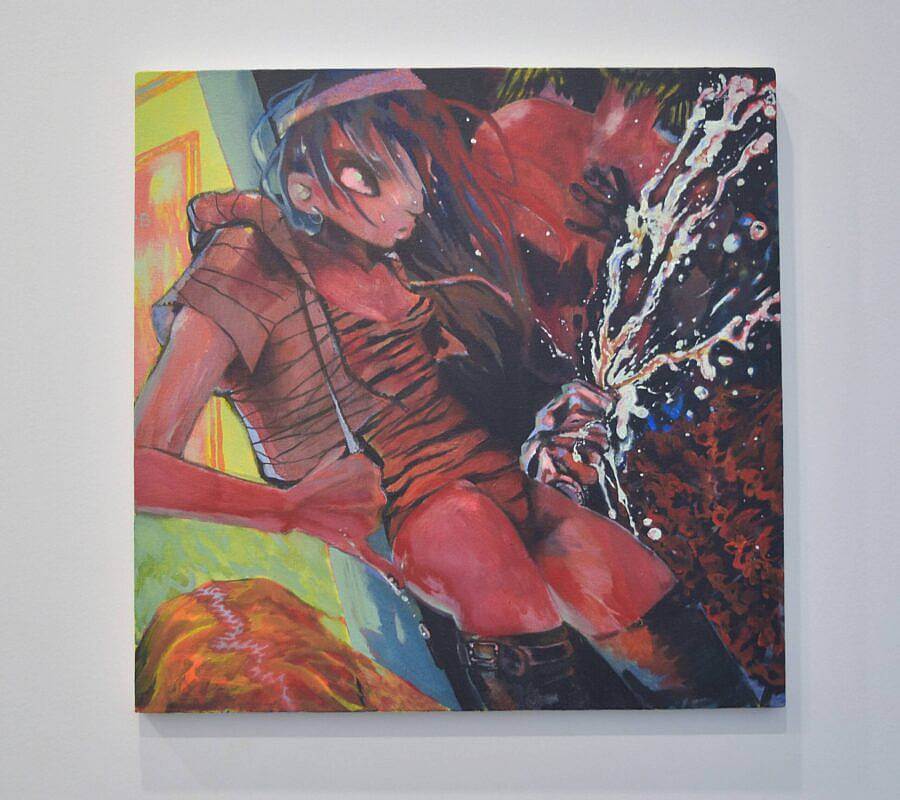
They come and go. I think of it less like symbols and more like little trends in their world. All the characters were into vintage gym socks from 2021-2024. In 2023 apples tasted especially delicious. This year they all got into poking things into their eyes, and subsequently, eyepatches. I think for me, creating symbols where there’s a 1:1 meaning between a motif and an idea strains the relationship between the painting and the viewer. With a symbol, I don’t want authority over its meaning (like I’m translating an idea into an image in a fixed, 1:1 way), I want people to follow their own feelings and associations. I put it in if it feels right. I feel like the people outside the paintings will see themselves and find each other while looking.
With the characters, I do feel like there’s specific archetypes and roles the characters fill; like the pigtailed blonde with the bondage hood who appears in at least a dozen paintings, to me she’s some sort of vigilante with delusions of grandeur; or there’s all these beastie/beastly boys who come in and out, and they have their own lives and can’t hang around too long; and a bunch of different articulations of butch/femme dynamics over the years. They’re not super stable characters, or rather they’re just as slippery as you and I. Change haircut, change gender, change mind.
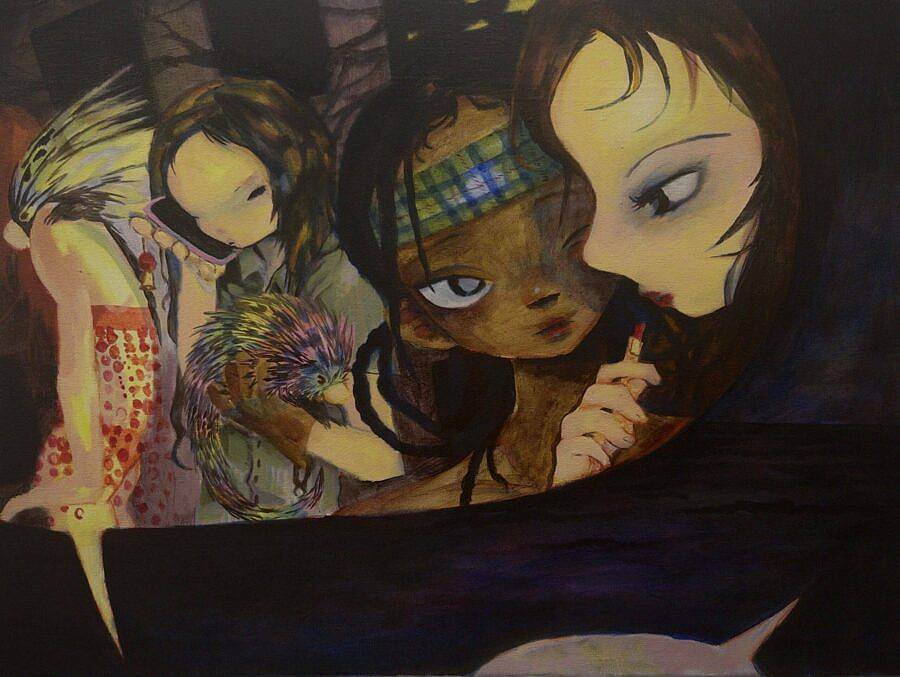
I just did a series of drawings for my show at Tusk that had eleven recurring characters, all different permutations of one character, a zoology student named Porcupette. Those girls are on my mind right now. I already want to do Porcupette Strikes Back. I think the people in those drawings are all totally different, with different attitudes and desires and actions towards one another. But they’re also all paradoxically the same protagonist of Porcupette, negotiating their respective protagonisms.
I think a character comes back if I feel like I have more to say about them, or like I didn’t do justice to what I wanted to show initially. A lot of the figures were painted in a very cliched, dull way in the past. I’m still pretty young and still learning how to express myself. So are they. I want them to grow up alongside me.
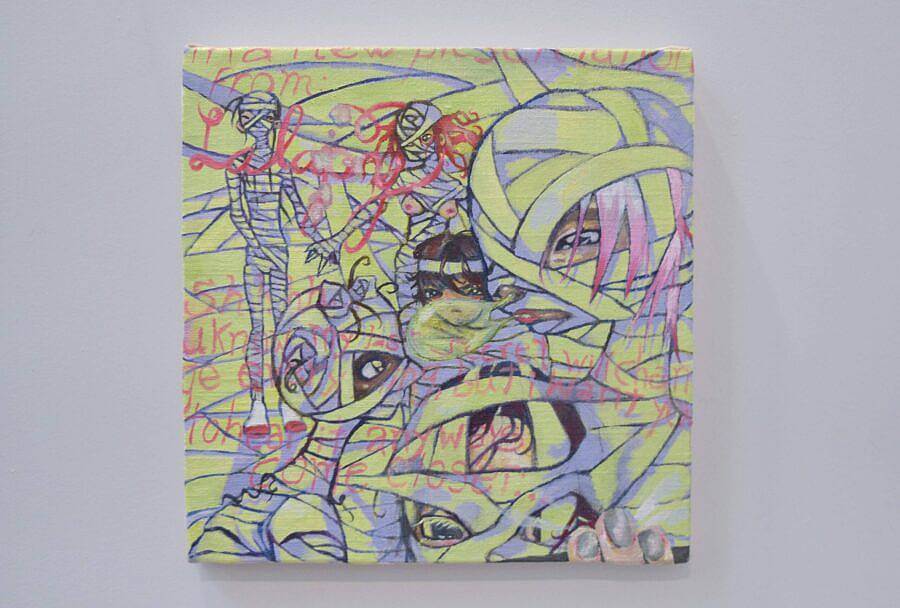
You have to close your eyes and imagine.. But also, I feel like we’re already there in some way! Or like, the figures are very much based on real people I know, or on myself, and even outside of just a visual basis, also on an emotional basis. Like I do feel like some of them worked in a drive thru with me in high school and others are worried they might have pinkeye and all these very real-world humiliations. No offense if you think you might have pinkeye. But in another way… they live in a 2-dimensional world without sound, which is fundamentally different from ours. It’s already difficult for real people to speak accurately and have someone else understand accurately. It’s on the edge of impossible. And for the most part, the world of painted figures lacks language. I think Rita Ackermann is the only painter who comes to mind whose figures seem to be able to hear (see?) the text that shares the painting with them. So how can they communicate? Through costume and gesture. And they have to be a little bolder to be seen or they just get lost in the negative space. I think that’s why they can get so violent. But it’s just oil on canvas, so there’s no need to worry.
I think the lack of language is also why in my work and in so many other figurative paintings, there is a strong kinship and equality between human and animal figures. They all share the same modes of communication, biting and scratching and climbing on one another. There’s no more division between the speakers and the speechless. Some animals are bigger than others, that’s all.
There’s a lot more to say, there’s a lot of stories I want to show you. I can’t spoil it.
Interviewed by Amira Diaw.