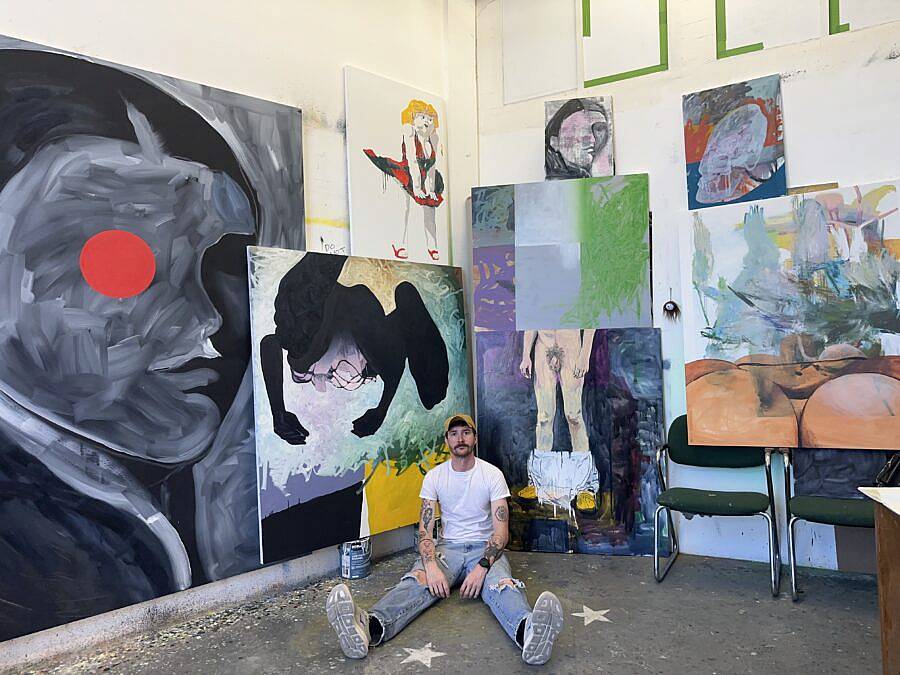
Tell us a little bit about yourself and what you do.
My name is Jake Fagundo, I’m 28, and I’m an artist living in Los Angeles, CA.
How did your interest in art begin?
My dad’s also a painter, so as a kid I remember him being in grad school making wild stuff around the house. I don’t think I made the decision to become an artist until about high school, when it became apparent I wasn’t able to focus on much else but painting, music, and skating.
What kind of imagery are you drawn to?
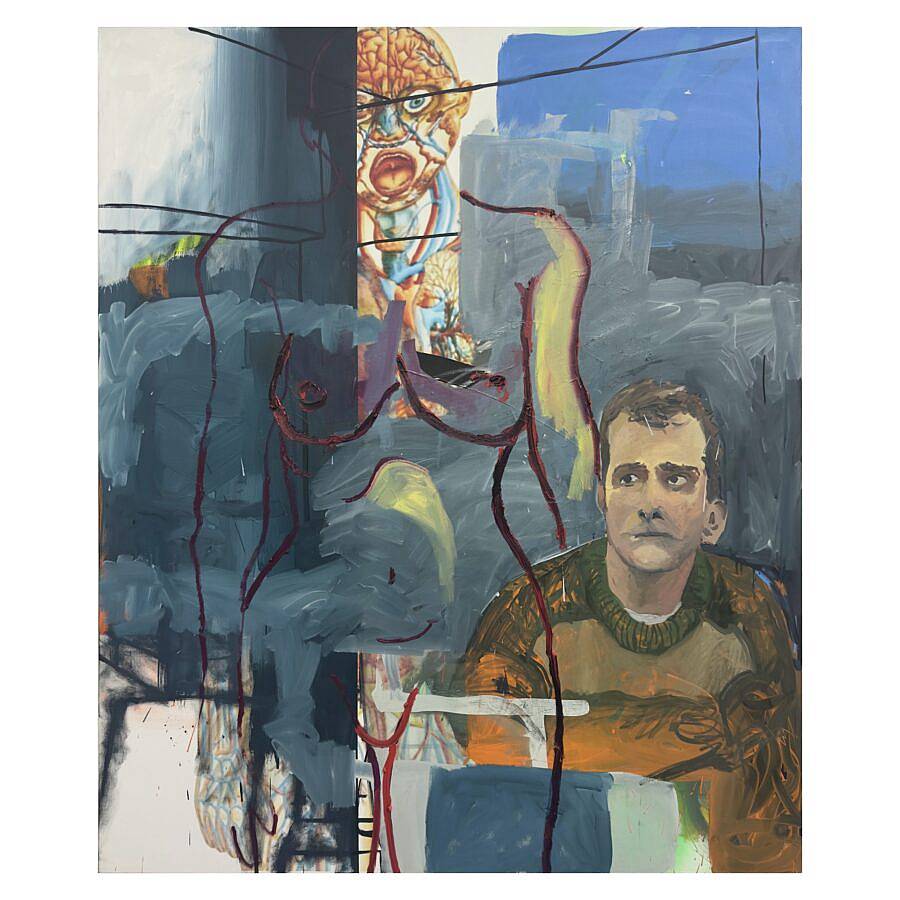
Honestly, I have to ask myself that question all the time, often coming to the conclusion I don’t want to fully understand it. A year or two ago, I focused on using images predominately sourced from conspiratorial media to intentionally complicate the attitude or morality or whatever of the painting via the image. Once I began to recognize a pattern in imagery, it felt like the surprise was ruined for me and the images suddenly lost what gave them their bite.
Now, I try to keep it really simple. If I feel compelled enough to save an image to possibly paint, I’ll sit with it and store it away. Many of them die in the “to be painted” folder. The ones that make it onto a painting are there because they met the criteria of images which I just couldn’t live without painting. Any through-line that’s drawn between images now feels truly organic. It teaches me more about myself and my practice retroactively rather than deciding to make paintings with a narrative between them.
Can you tell us about something that continues to influence your work?
I think there are two forces at play at all times in my studio.
One is the reminder that the studio is maybe the one place you’re really off the hook. Any embarrassment, failure, disappointment, covetousness, grandiosity, or general spazzing out goes. It all goes into the work and the work is better for it. Not only that, it’s where those things belong. Virtue is the last thing I care to see in mine or anyone else’s paintings.
The second force of inspiration is the necessity for greatness. Here, things get pretty superstitious. I’m convinced greatness comes from a place beyond our understanding. The words “genius” and “Djinn” originate from the same sentiment. It’s some external force that makes contact every so often, and everything from the prior paragraph works against this until surrender is reached. That’s the only way I’ve ever found it. It doesn’t work on our schedule, nor does it come when called. Those moments of communion are what keep me painting.
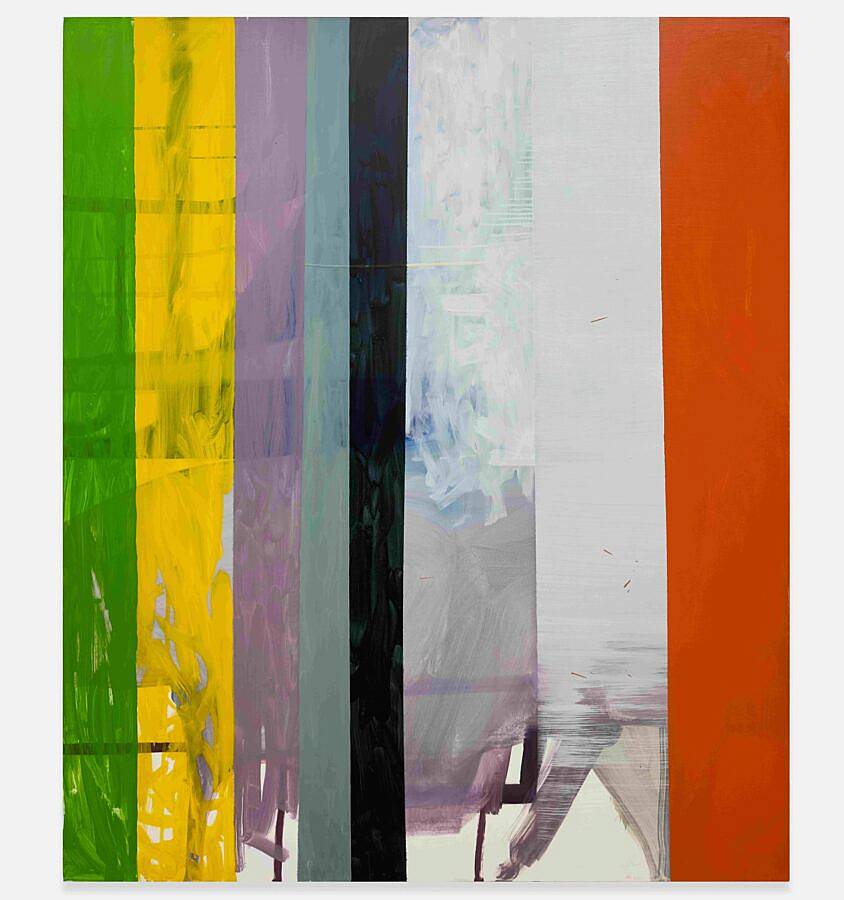
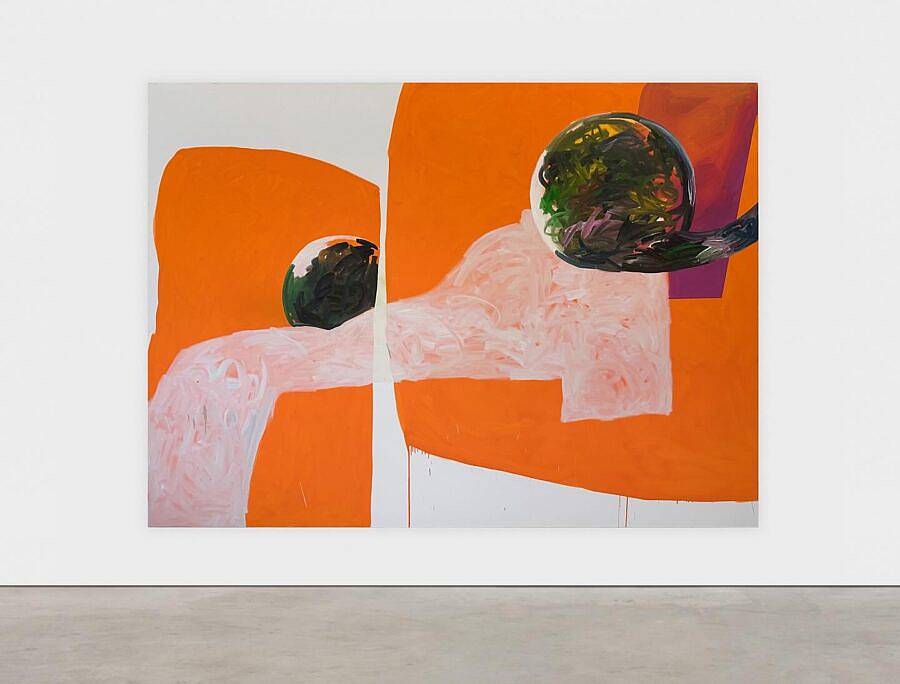
The figures in your compositions, which are usually naturalistically rendered, often sit against abstract, geometric backgrounds as if they’ve been cut out of an illusionistic world and landed in a flat one, creating a push and pull where we feel pulled into a spatial recession by the figures and drawn back to the surface by the swathes of color and gestural brushwork. Do you actively cultivate this kind of tension?
Yesterday, someone was in my studio and blurted out, “You’re an abstract painter.” I think he shot pretty close to the mark on that one.
As I said in a previous answer, the images are basically chosen based only upon their attitude and whether or not the painting and myself couldn’t live without that attitude being conveyed. I’ve come to think of them as another layer of the abstract painting beneath. Sure, there are the formal elements of each image and how they’re composed plays a role, but their attitude becomes another formal tool for the painting, the same as light, color, shape, etc. They add a cultural or social effect that purely abstract elements lack while remaining just as vague as the color yellow. To your point, I think they are necessary for the tension I need in the work. While the images don’t make the paintings narrative, my goal is to make the works complicated, whether that be emotionally, culturally, visually, or linguistically.
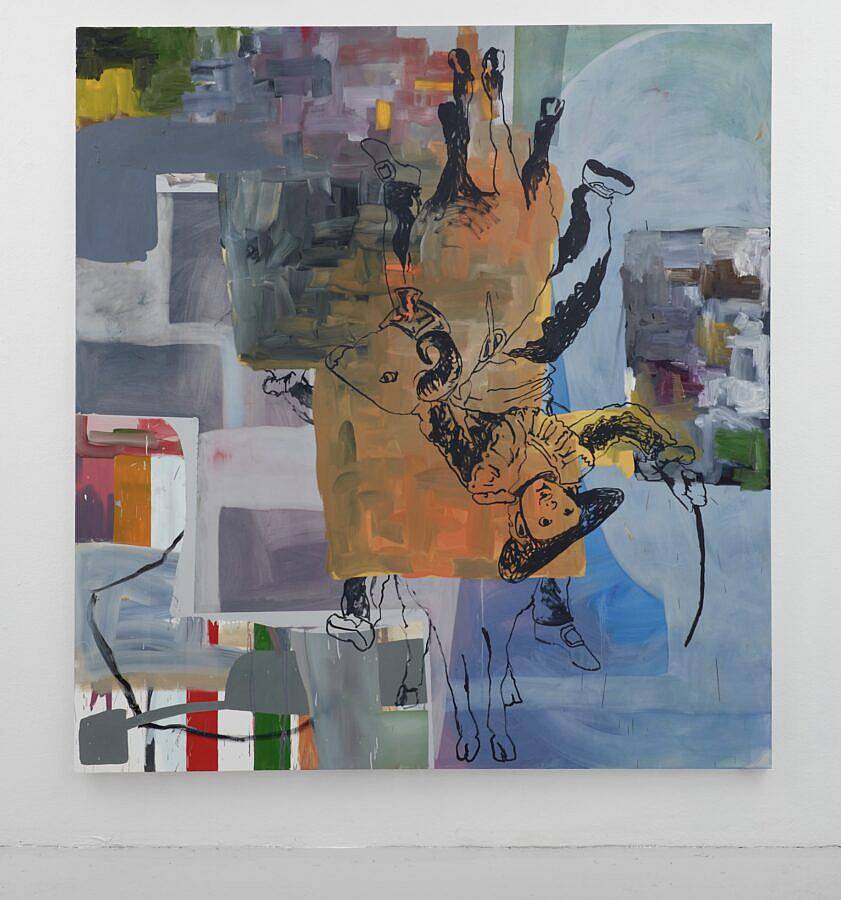
Your compositional style feels akin to collage, yet you generally work with just oil on linen. Did you ever experiment with collage or multimedia on the way to finding your current approach?
I’ve actually done very little collage—like nearly none since undergrad. Nor do I have an extensive drawing practice right now. I think maybe the visual effect you’re talking about is the result of the impulse to make the paintings feel like someone’s spent years building a gorgeous basketball court, only to play a game of ice hockey on it.
Do you begin a piece with a mental image, a composition plan, a mood, atmosphere, or a state of mind that you want to evoke?
It almost always just starts with an attitude, usually the kind that needs an adjustment.
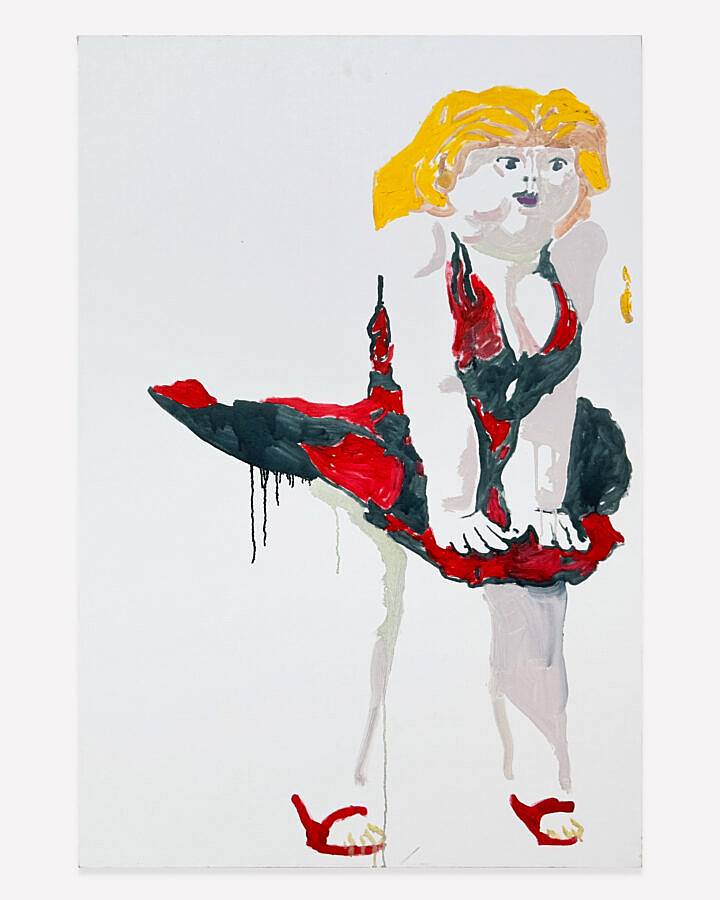
I’ve noticed you tend to paint on linen. When did you discover your preference for linen over canvas and how did that come about?
If you’re going to dedicate your life to something as ridiculous as painting, you might as well approach it from the highest standard. While endeavoring to make world-class paintings, I’m going to put everything I have into making sure they live up to that goal even on a material level. It also just feels really good to paint on.
How important is experimentation in your work? Do you ever test what you could “get away with” in terms of making a piece that still works or presses against the limits of what makes sense or feels complete or coherent?
I’d like to think most of my time spent painting is seeing what I can “get away with.” On one of my walls, I have a Yin-Yang painted with the words “Fidelity” and “Spontaneity” in their respective halves. Whenever there’s too much of one, that reminds me to push against what’s there.
In terms of coherence or completion, I think if a painting feels complete, great. If it’s pushed past that point, even better. But carefully calculating when a painting is “good and done” isn’t what I’m after, usually.
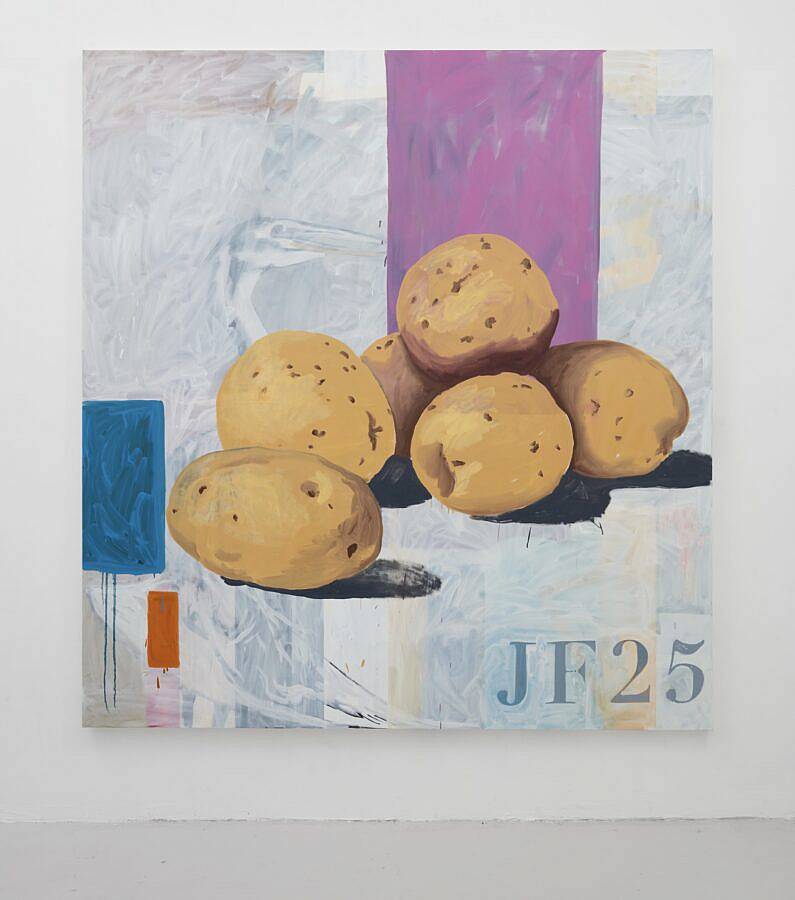
How do you think about closure in your work, and do you embrace or resist it?
I’ve found that it totally depends on scale and what the painting needs. There’s an intimidation factor when making really large paintings and an unseriousness towards smaller works. There’s something really special about pulling off treating a huge painting with the preciousness of a Post-it note, and a small painting with the anxiety and care of a mural.
What is your studio or workspace like? Do you have any rituals when you begin working?
It’s usually a total wreck. Again, anything goes in there, so it gets pretty messy. I do try to keep it a serene mess though—incense, guitars, tribal artifacts on the shelves.
Recently, to get started, I’ve been playing music really, really loud from my speakers while looking at the works in progress, and then I shut the music off when I get up to work on them.
Have you read or watched something recently that felt generative for your practice?
I’ve been listening to George Saunders books in the car. Each story has such a specific flavor of absurdity which I’m hoping finds its way into the studio.
What was the last art show you saw that stuck out to you?
The Paul McCarthy show at Journal.
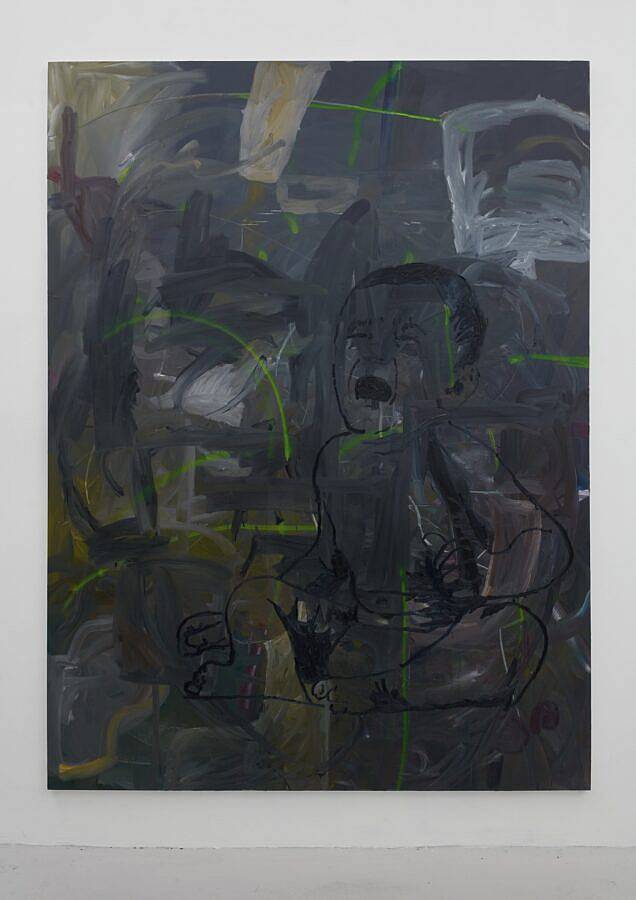
Could you share some recent, current, or upcoming projects you’re working on?
In January, Max Werner put me in a seriously humbling group show at Jarvis in New York and mirrored my painting with a Baselitz on the opposite side of the wall. That was surreal. Nothing planned for the future.
What do you collect?
Days having lived a perfect life.
Interview by Paul Fitzpatrick