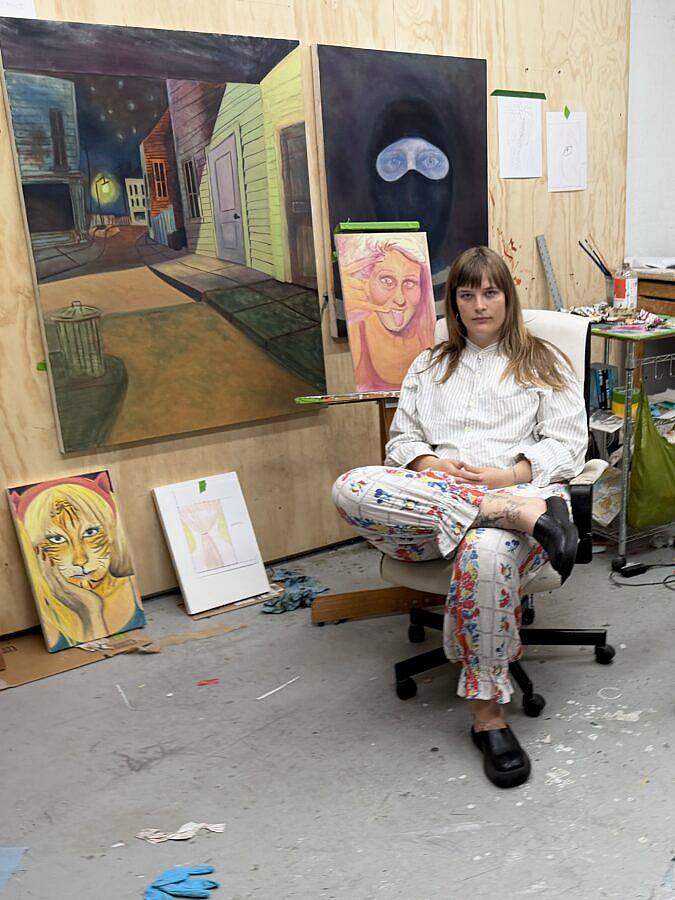
Tell us a little bit about yourself and what you do.
My name is Isabelle Adams and I’m a painter born and raised and currently in Los Angeles. I have a BFA from the School of The Art Institute of Chicago.
What’s been inspiring you lately?
Jason Fox’s paintings, Lee Lozano’s journals, George Saunders’ Tenth of December and Liberation Day, Marlene Dumas show/book Measuring Your Own Grave, Mike Leigh’s movies, James Ensor’s Christ’s Entry into Brussels in 1889, Hats by the Blue Nile, Don Delillo’s White Noise, Mircea Eliade’s The Sacred and the Profane, thinking about God. I’ve been rewatching the show The Leftovers in the studio which has been infusing the work sessions vibe with an interesting flavor.
What is your studio or workspace like?
Often tornado-like. It’s in a concrete basement with no natural lighting, which works better for me than not. I feel like when I enter the studio it’s useful to have less sense of time and more abstract space to focus on swimming through the soup of the mind.
I have an L shaped setup with different worktops for each medium. I always have a box of sparkling water and a corner store snack of some kind. There’s a station with a stack of paper, watercolors and pencils designed for me to go through fast when I need to think or write blindly. It’s a different state of mind than working in a sketchbook, more boundless. I have a weird fear of cleaning it up too much and then missing an idea because of it- I feel that if I have random drawings lying around, I’ll see one and a lightbulb will come. But there’s also heaps of useless mess- Right now I’m looking at a massive pile of used painter’s tape that I need to clean up. On the other side of me is a pile of used rags.
I have books to refer to when needed but I mostly listen to audiobooks or watch movies/tv while painting. There’s a piece of paper on the wall that says “don’t lose the substance for shadow” which I think is originally Aesop but I heard it in an Agatha Christie book.
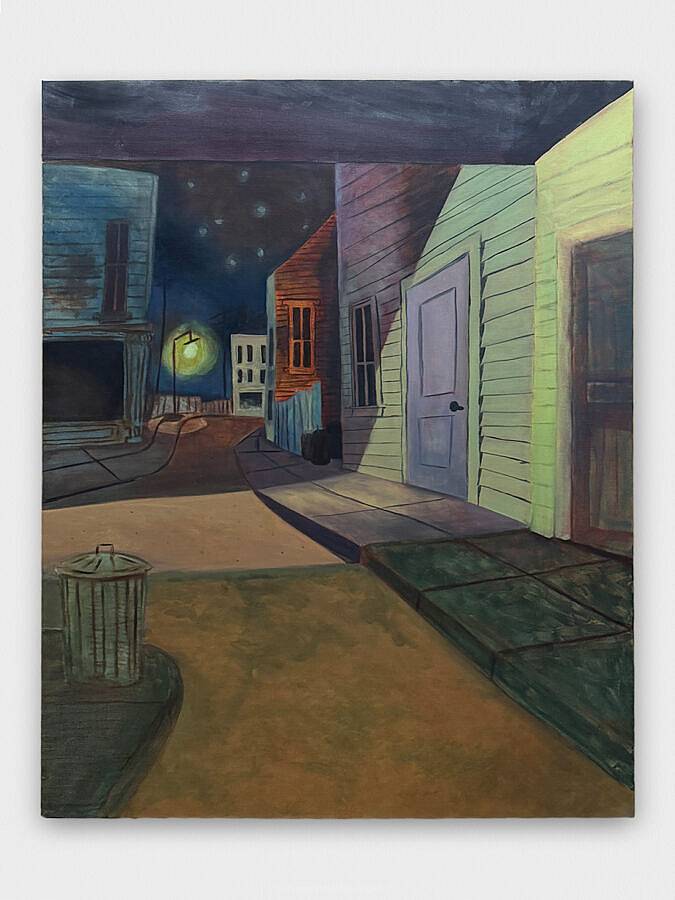
Do you begin a piece with a mental image, a composition plan, a mood, atmosphere, or a state of mind that you want to evoke?
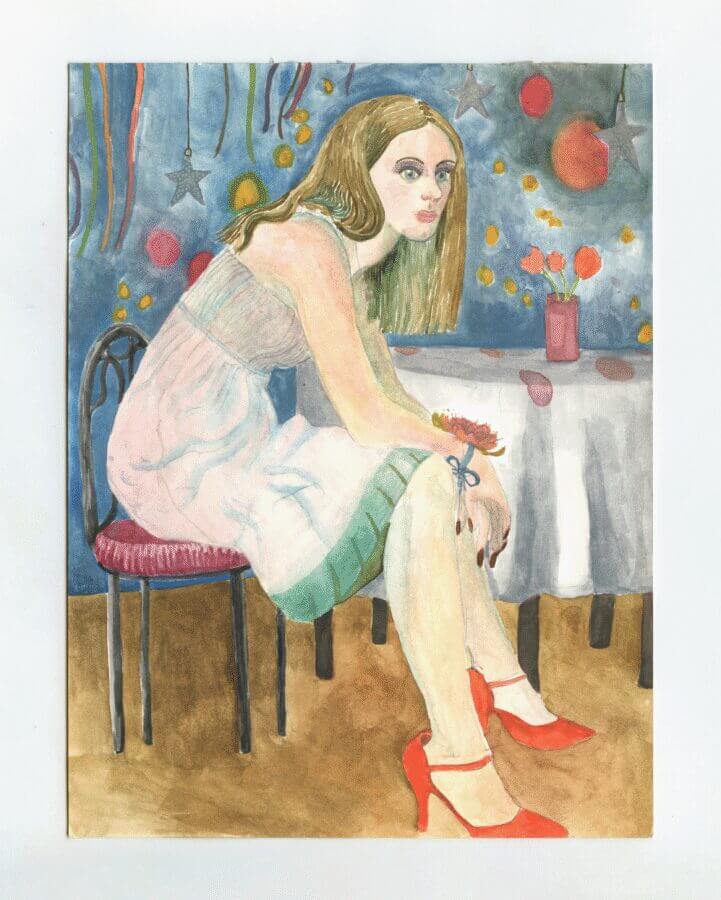
I’m aiming to create an unplaceable familiarity in my paintings, like recognizing someone in a yearbook but not remembering their name, or walking into a room and smelling something that smells like a significant time in your life but you can’t remember when. If the painting I’m working on was a person, who would they be?
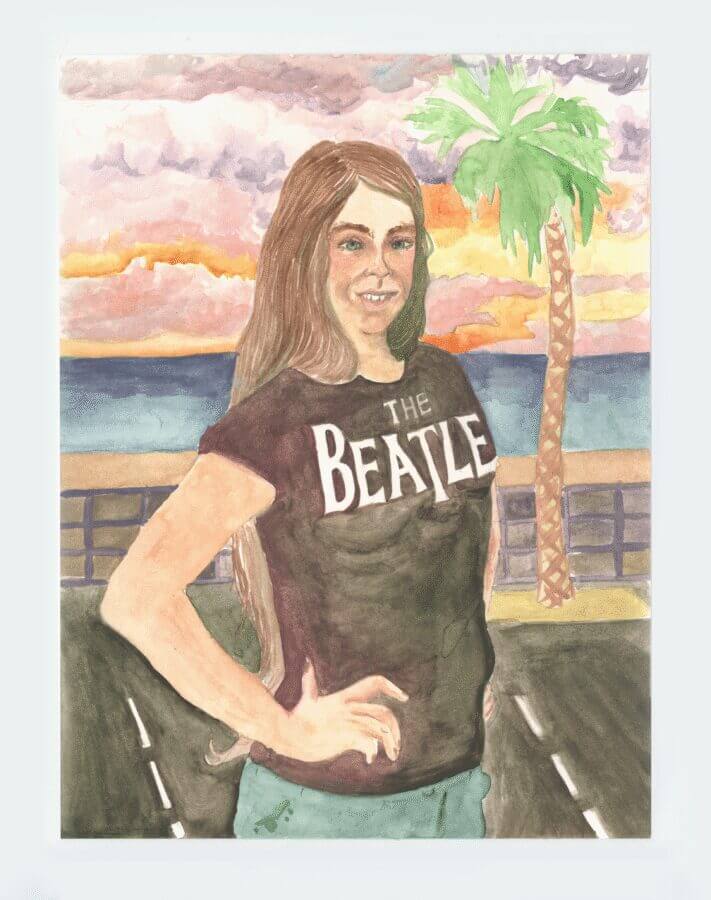
There’s a sense of something ominous that seems to lurk beneath your compositions, which at first present a kind of jovial innocuity but are then complicated by their uncanny rendering. Is this combination of the innocent and the sinister something you consciously cultivate?
I don’t think that the combination has to be sinister and innocent but tension between opposing forces is essential for a painting of mine to be successful. I don’t want to destroy the innocent by introducing it to darkness, I’m interested in the duality that exists in everything. The innocent must contain darkness to exist, everything in human life is experienced through contradictions. Life is unimaginable pain and unending joy. We have hearts both pure and empty.
I deeply love the writing of George Saunders, who is never above his subject. He never lets himself off the hook by taking an ironic distance from his characters. He is not a satirist, but he laughs at his characters, characters he refuses to condemn. I feel that I occupy a similar stance as an artist. My role as an artist is compassionate and reflective. I aim not to declare but to observe.
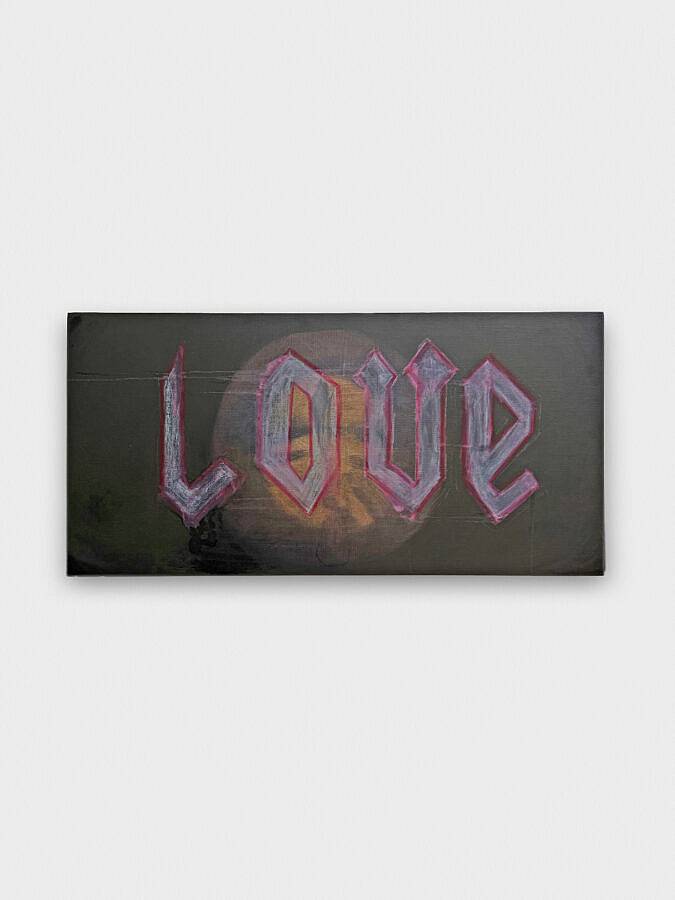
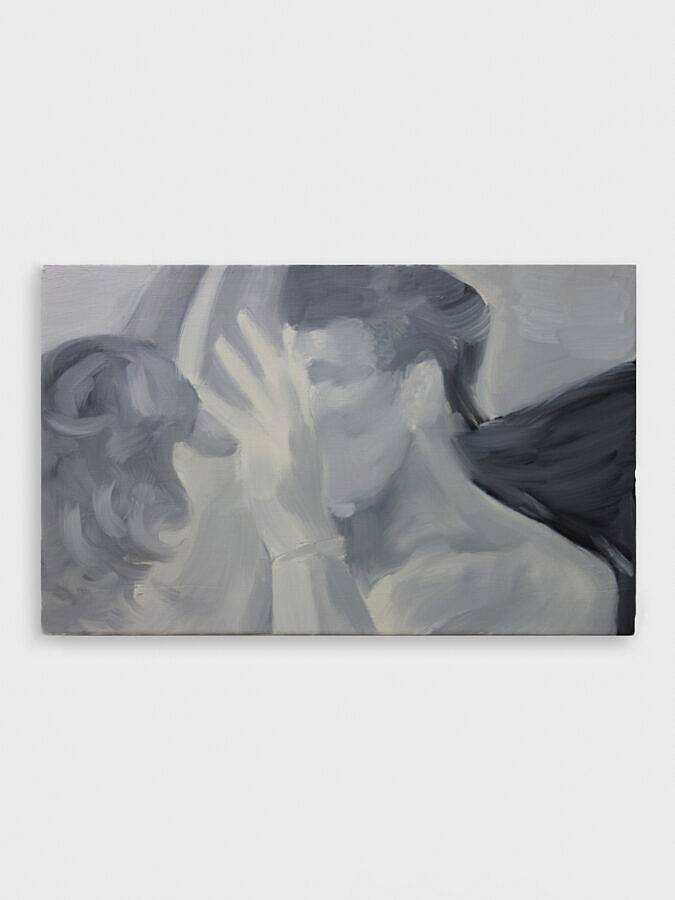
In your work, intimacy is often evoked, but in a way that feels abstracted or commodified. I’m thinking of Love (2024), which seems to borrow and complicate the visual language of advertising, where the word “love” sits atop a diffuse, imposing background—as if it is on offer, though we’re not sure in what capacity—creating a destabilizing effect by drawing on our associations with both the concept and this kind of imagery; or Dirty (2023), where the amorous subjects appear in an archetypal lover’s pose—recalling Hollywood romance posters or The Lovers—yet seem to coalesce in grisaille, becoming anonymous or fusing together. How would you describe the way intimacy and association operate in your work?
Lauren Berlant writes in Cruel Optimism that when we talk about an object of desire, we’re really talking about a cluster of promises we want someone or something to make to us and make possible for us. I think that’s exactly what I’m painting inside of, and what pop culture knows about people.
Much of modern life in America is composed of symbols that appeal to our collective yearning for something better or at least different than what we already have. Imagery floods us every day. Life is three-dimensional but our relationship to images renders our memories more and more like images of our life, which removes us from our own experiences. You become the observer of yourself from somewhere else. You return to your memories like a favorite song.
Darth Vader, E.T., an evil witch, Madonna, Shakespeare, etc.: all of these icons collapse into symbols of feeling. These images attach to something unconscious and persistent in people. I’m interested in how something ancient about the human being continues to exist inside the hyperreal, hyper-imagistic conditions we live in now. My paintings are made inside that material.
Painting is a useful tool for this because it operates in both registers at once. It’s imagistic the way a photograph or a movie poster is, but it’s also the direct product of a human mind, made slowly by hand, full of decisions that come from somewhere you can’t name. It can hold the unconscious and the cultural image in the same place without having to explain the relationship between them.
Twentieth century pop culture understood this with a confidence that feels almost lost now. Those images had a directness, a mythic quality. I’m interested in where that power went, how images fail and succeed. I was thinking about this watching Frederick Wiseman’s The Store, which immerses you in the day-to-day operations of a Neiman Marcus department store in 1983. It’s striking how complete that world is. The staff, the customer, the whole institution fluent in the same dream. Consumer desire seemed to be understood more clearly. Now it’s diffuse, something you move through alone rather than agree upon together.
At a certain point it becomes difficult to distinguish between yourself and the images that have accumulated around you. I work within a world where the two don’t have to separate.
What role does humor play in your work?
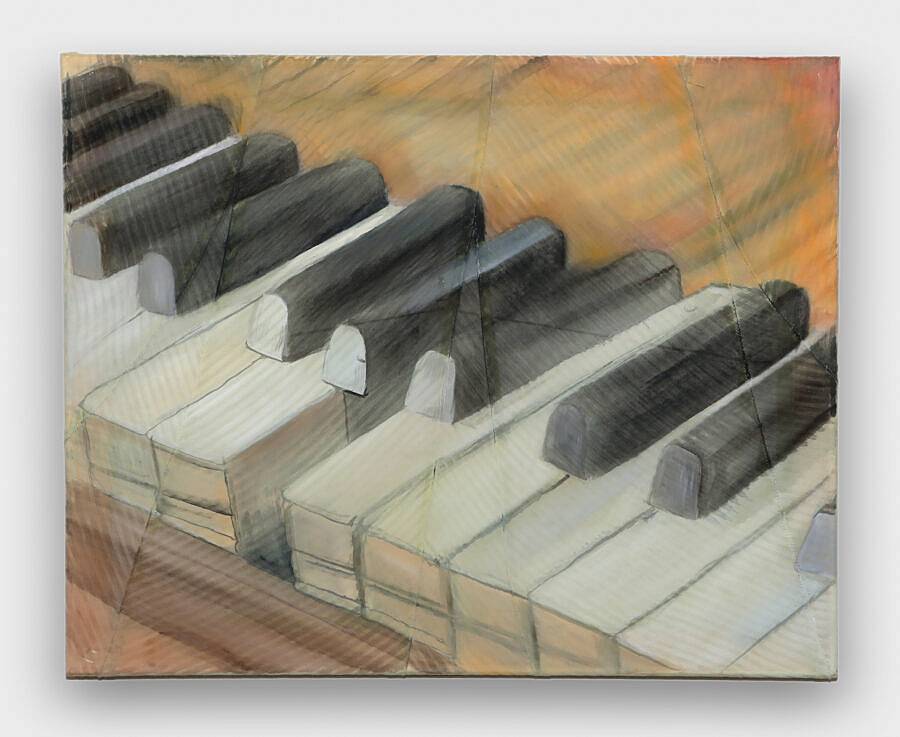
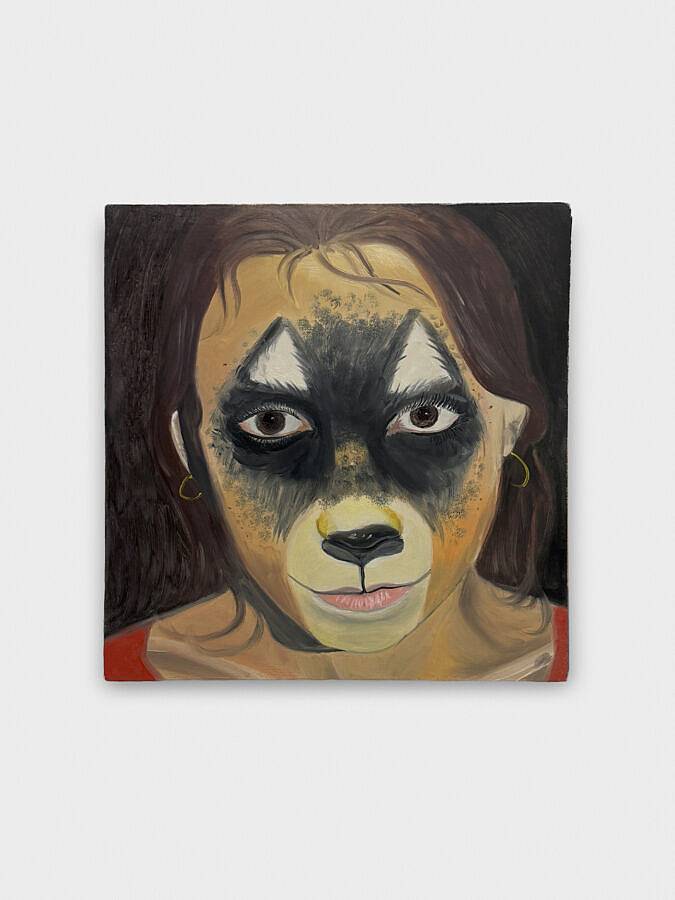
I often arrive at paintings through humor. It’s a good base for painting. The emotional weight and conceptual attitude get carved in later, through work and time. The greatest truths tend to hide inside what first hits as a chortle. When no idea arrives as a revelation, I spend a long time working five or so joke/meme-like setups/one-liners into as many sketches as I can, until something makes me laugh because of something ridiculous or surprising about it. Then I work the sketch until the laugh is balanced by something moving or gripping. Recently I spent time thinking about costumes and archetypes, so I drew many versions of a burglar character. I wanted to reduce an iconic, already semi-abstract figure into something personal and shorthand by understanding and rewriting its shapes. I imagined the burglar in incongruous places… how could its form be shaped into an interesting composition? The original kernel was “lonely burglar.” The combination of immediate sympathy and laughter made it seem like a viable path. There’s something about the underdog, the lonely and brokenhearted, that gets called in by a joke made at their expense. But it can’t be too funny. I’m not interested in too much satire or irony or being mean. I want the audience to have a sympathetic relationship with the subject.
What do you collect?
Memories……
Could you share some recent, current, or upcoming projects you’re working on?
I’m currently working on a solo show for a new Los Angeles gallery called The Beach. The show is in early June and I’ve been hard at work. Please come if you’re in LA.
Interview by Paul Fitzpatrick