Tell us a little bit about yourself and what you do.
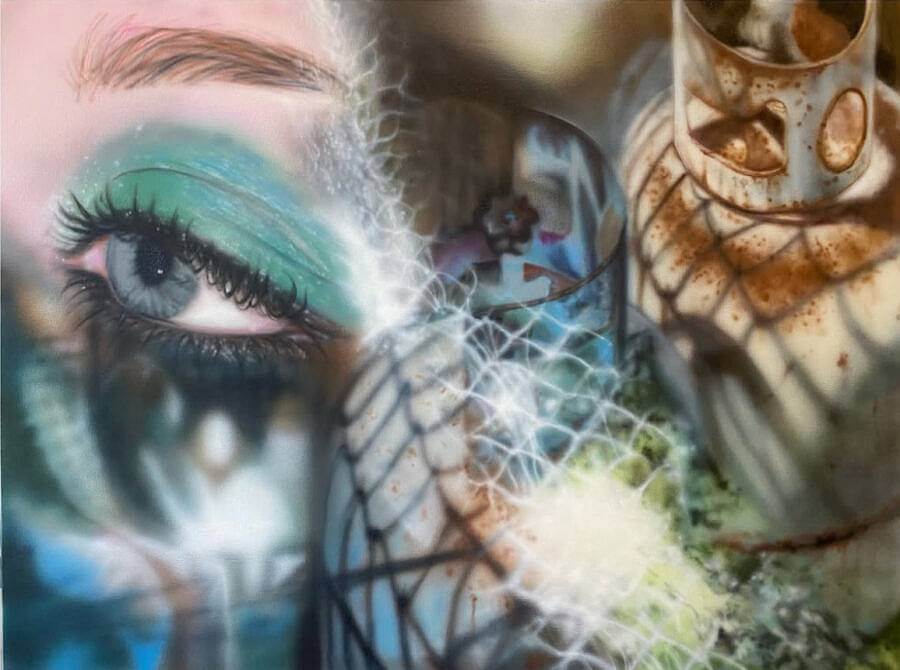
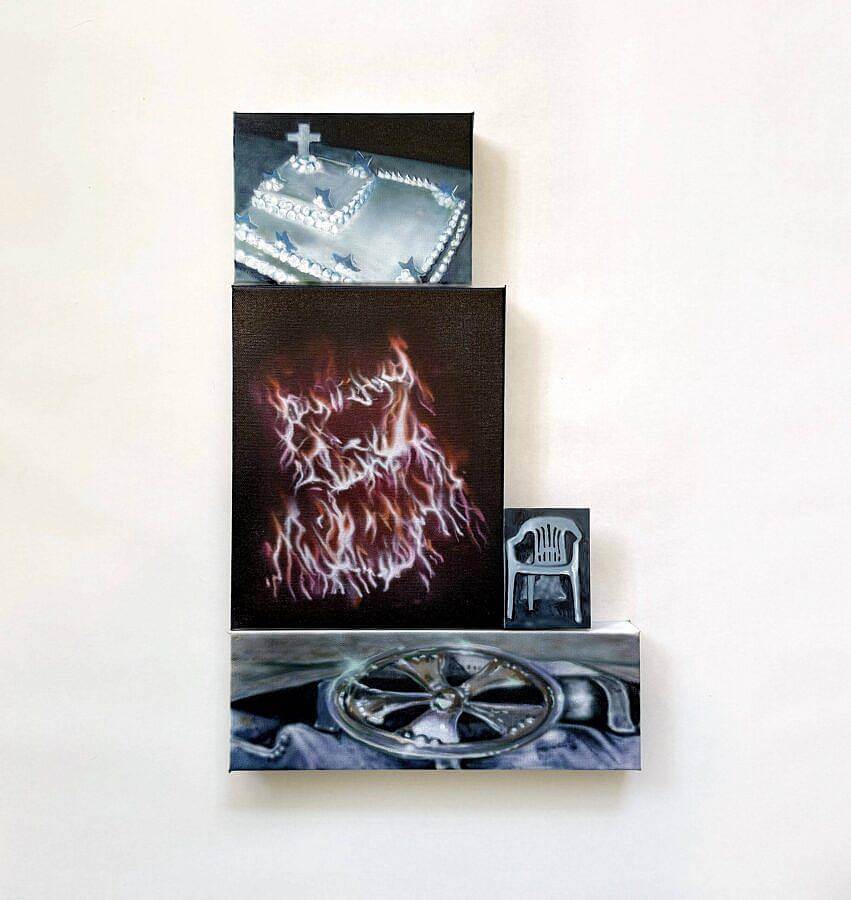
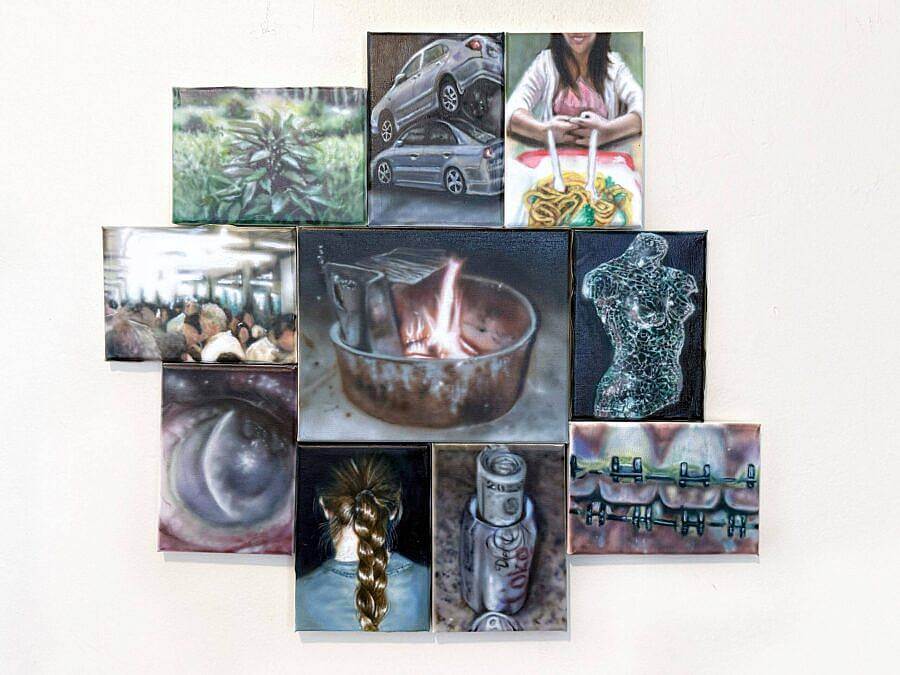
I’m a painter, working mostly with airbrushes using acrylic paint. I’m originally from Auburn, Washington, but I currently live in Los Angeles. I graduated from Western Washington University with my BFA in Studio Art in 2022. My work usually operates in a surrealist collage framework, or incorporates some element of combined images. Within my current work I’m interested in the ways that religion, dreams, and desires intersect with the modern digital zeitgeist. Using surrealism as a frame of reference helps me to contextualize the absurdity that exists in the interaction between these ideas. I work mostly with found images that I have digitally altered and collaged together to then paint onto canvas or panels.
What kind of imagery are you drawn to?
My work is reliant on photos that I have taken, or found online, usually from the recesses of a stranger’s defunct Flickr account. When I’m sourcing images, I like to source them from the early 2000s; the sweet spot typically lands somewhere between 2006–2013. Anything that teenagers were posting during that time feels especially earnest and genuine. Images that are obviously shot offhandedly are really interesting to me because there is an inherent authenticity present. I really love imagery that is on the outskirts of an idea; for example, anything that alludes to a person being present in an image is more interesting to me than the person themselves.
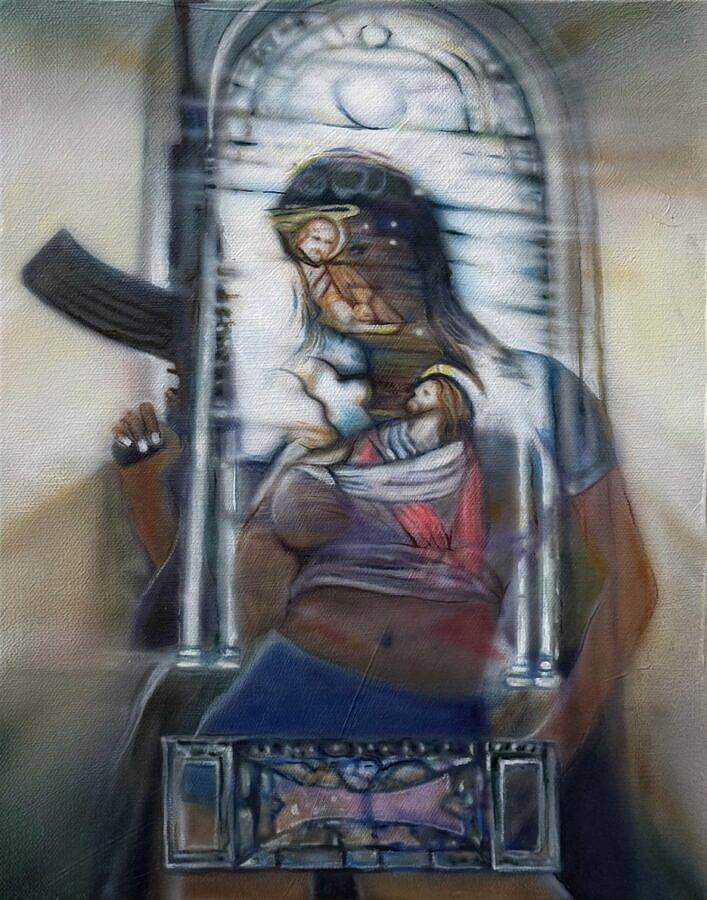
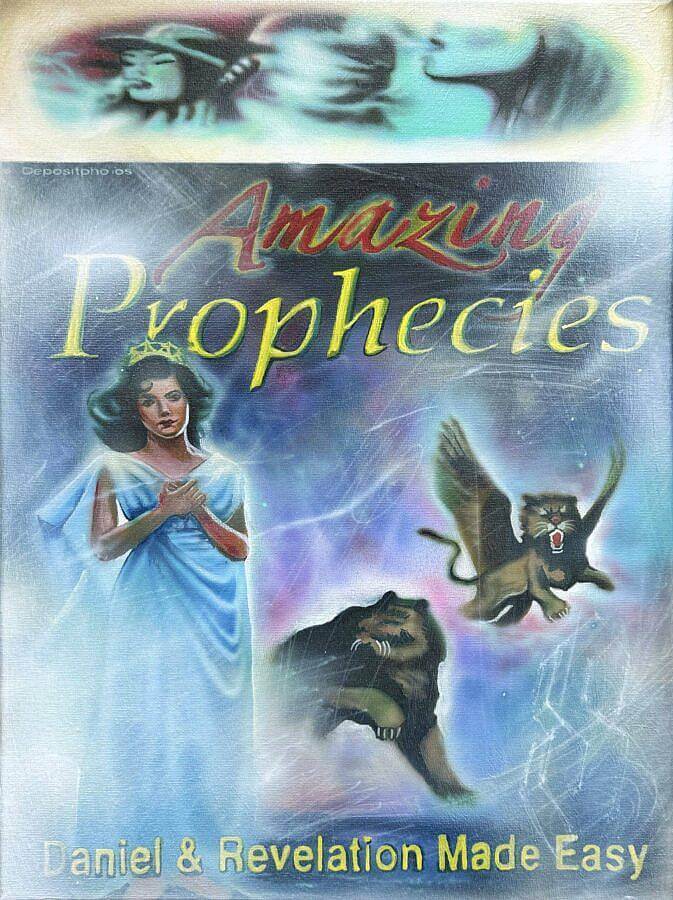
Personal experience is something that I enjoy seeing in an image. Lately this concept has been showing up in images of contemporary Christianity, for example photos of youth groups or baptisms. I grew up evangelical Christian and although I am not in that world anymore I still find myself drawn to imagery that deals with the church. There’s a visual cadence to intense religious imagery that I’m interested in subverting. Once you look at the “halo” of practice that surrounds a rigid idea or belief system, you begin to understand that it is fallible and as a bystander, I can oddly feel a little empathetic towards it. All this to say, I guess I’m most interested in visual nuance, or contradictions within an image that don’t offer a resolution but rather offer a moment of consideration.
What is something that continues to influence your work?
I’ve always been interested in how an image can degrade, originally in a quirky digitized internet nostalgia way but now it’s also informing the concepts within my work versus just the visual language of it. Being interested in the visual cues of digital degradation (i.e. pixelization, oversaturation, deep-fried photos) gave way to me being curious about how belief systems degrade in a digital context. The internet has become a major catalyst for seeing how things like religious ideology (specifically in terms of Western Christianity) can devolve into abrasive views of the world. Now I am interested in the visual evidence of degradation because it reveals how something is constructed.
Is there a phrase or idea you can think of that feels especially relevant to your practice or that resonates?
Consideration. I don’t want to come up with an answer for everything. I think it can be more valuable to just think about something and leave things open-ended. In that same vein of thought, I don’t want to jump to conclusions about what a piece means because I don’t want to shut any doors for myself or anyone that spends time with my work.
What is your studio or workspace like?
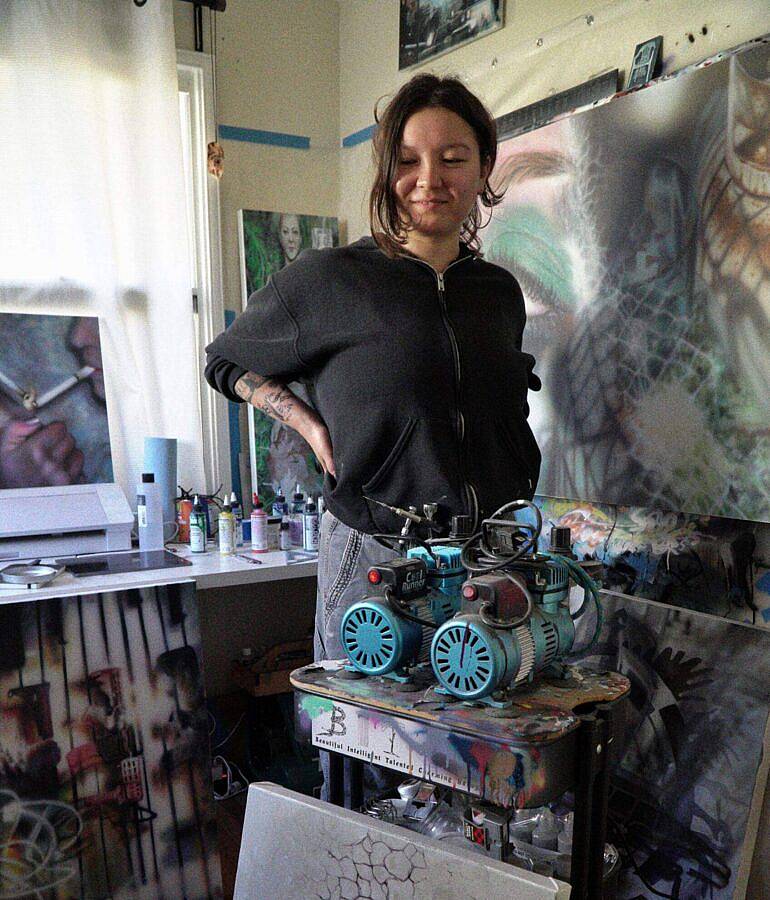
My boyfriend and I live in a small house in Highland Park, and one of the rooms is my studio. It’s a small space so all the walls are covered floor to ceiling with work, but I have a few pieces hanging up in the rest of the house as well. That’s the nice part of having a home studio: I live side by side with my work and it makes it so that it’s very integrated into my daily life. I have a couple of letters from my mom and dad that I keep taped on the wall above my desk, alongside a variety of stencils that I probably will never use again but am attached to for some reason. The space does lean towards being messy, but everything is exactly where it needs to be so it’s easy for me to jump back in. One of the books that I keep on hand and regularly reference is Surrealist Subversions, a compilation of essays about the Surrealist movement in the US. Otherwise all of my other reference material lives on my iPad and laptop.
What is it like living and working in Los Angeles?
I moved here in 2022 after living in Washington state my whole life and it’s provided a huge shift that’s changed how I approach my creative work. I’ve become much more critical about art and it’s helped me dial in my interests and goals as to the kind of artist I want to be. There is so much visual stimulation here, so many things ask for your attention. I realized I could kind of give myself over to that and become overwhelmed with ideas of where I should be, and compare myself to people around me, but that obviously can be so catastrophic to your self-worth as an artist. Lately I’ve realized that I can just do whatever feels right for me and I’ll be fine, and this feels like a good place to be to do that. There is so much chaos here that begs you to be curious about the world in a very engaged and reactive way.
What’s your relationship to sentimentality?
It’s definitely a compass for me in terms of what I try to bring out in my work. I’m also very attracted to it within other modes of art, because it’s something that is felt rather than explained, and it’s something that anyone can tune into. It’s a language that is very dream-like, but the moment you over-analyze it the magic is lost. Sentiment can easily eclipse emotion and logic, but I like trying to make the three things interact and obfuscate each other in my work. There’s a fine line that being oversentimental can cross where it becomes overly dramatic or kitschy. But honestly the work that feels the most true to me has always been made in a state where sentimentality has taken the wheel, mentally. Sentimentality offers an easy entry point for people to relate to art, and if it’s done right it can be a very instantaneous moment of recognition for someone to see themselves in art.
What role does humor play in your work?
It’s very subtle but I’m always thinking about it, mostly in an ironic way. I love finding images that are so obviously postured a certain way, and then collaging them with images that are doing the exact opposite. For example, a crown of thorns superimposed on top of an image of a neon-colored girl in a bikini holding a bong is just so ridiculous to me and points to the absurdity of this current moment in time. But Christians could look at that painting and be like, “yes Jesus saves,” but that’s not what it’s about at all. So it’s also funny how things can get lost in translation if you’re not blatantly underlining the meaning of whatever it is you’re making. Within my work humor has the function of unifying a composition, or leveling the playing field to where you’re forced to find similarities between two disparate images and ideas. That’s why I keep going back to collage, because it’s a traditionally Surrealist method of art-making and is a reflection of how you can function in the world, by constructing your own perspective on life that comprises everything you are surrounded by.
What is something you’ve always wanted to do and are working towards achieving?
I’ve always thought that I will end up making abstract and minimalist work. It’s one of those things that I’ve tried to do but every time it just feels so forced and calculated, and something is off about it for me right now. There’s some missing piece to it that I’m looking for, and it’s the kind of work that feels the most difficult but that just makes me want to figure it out even more.
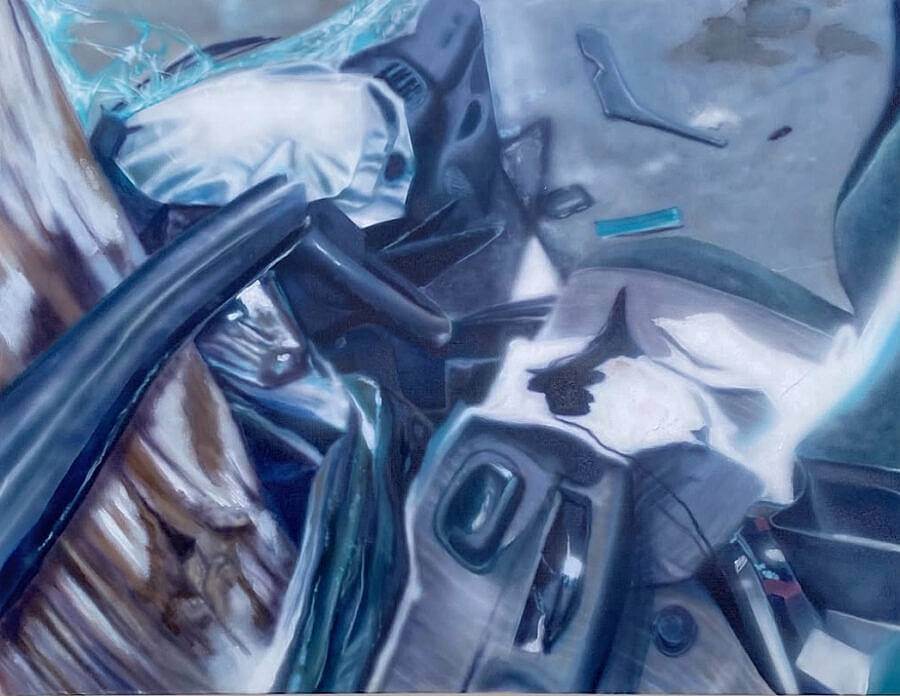
A form of abstraction that I feel has helped me understand it well as a concept is doing studies of car crashes. There’s enough structure present to where you can really get lost in the details that are visually very abstract, but it also carries a lot of emotional weight because of the implication of tragedy and loss. In the process of painting a car crash there are a lot of opportunities to mold it into a really beautiful composition. Abstraction is such a pure form of creative expression, being able to elicit responses that are personal and hard to articulate. When I am seventy or eighty I hope that I will be making abstract work; this is the lifelong trajectory that I envision for myself.
What was the last thing you changed your mind about?
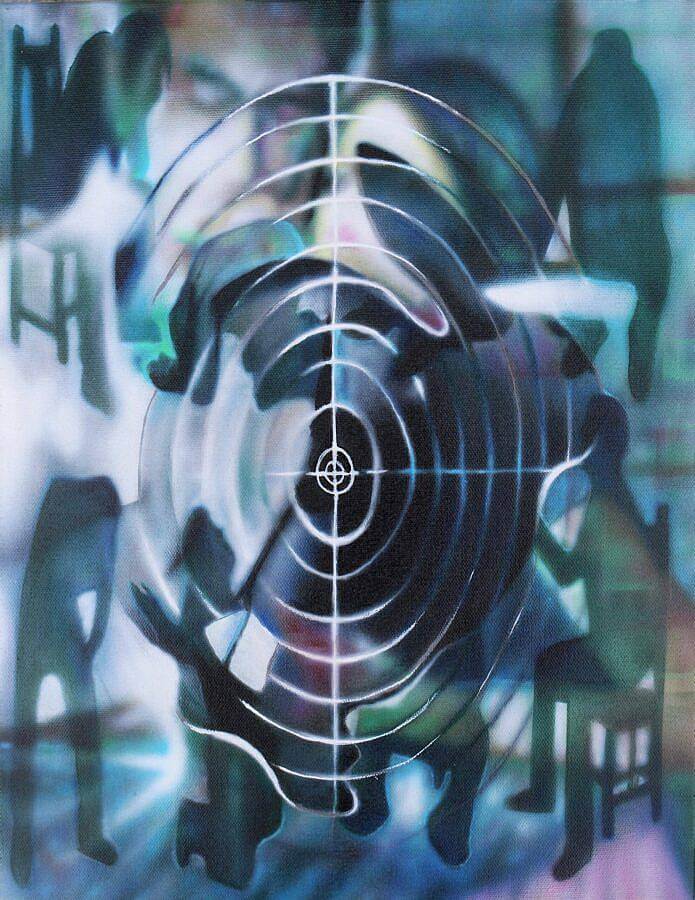
Work ethic. I used to hold myself to a super rigid schedule of like, “I have to finish a painting every week!” because I felt like my work wouldn’t stay relevant otherwise. All I would do outside of my day job was paint, but then I just reached a point of burnout and every time I would “finish” a piece it felt dead. Most of last year felt like it was really pulling teeth to make work that I had a relationship with and there were a few months where I thought I was going to step away from my practice indefinitely. And that was so awful, to kind of be set adrift without the part of me that is important in how I relate to the world.
My work ethic in regards to the studio downshifted because I realized that I needed to view my practice holistically rather than just doggedly producing work. Painting is starting to feel like the fruit of everything else in my life. Now studio time feels as if I’m pulling at a loose thread and I can allow myself to just be curious about it, rather than trying to pull something apart just because I can. There’s also something about the studio, that no matter how much time I spend outside of it, I can always drop back in and pick up where I left off. It’s like having a relationship with a friend that’s known you forever, and your relationship is always going to be evolving but it will always be there.
Interview by Paul Fitzpatrick