Tell us a little bit about yourself and what you do.
I’m Tasneem Sarkez, an artist based in Brooklyn, New York. My work is invested in ideas of nostalgia, post-modernism, decoloniality, and kitsch aesthetics as it’s contextualized to Arab modernity. Often visualizing moments of tension and power dynamics between different sectors like globalization and technology, speed and mechanics, gender and authority, simulacrum and hyperreality. My process is based in the dissemination and recontextualisation of images and objects that weave autobiographical elements, digital networks, and art-historical references all together.
Is there a moment you look back on as being formative to the work you do?
I have a list in my notes app called “landmarks” that basically chronicles every moment in my life so far that has been a formative time of the work I make. I started it because I noticed that the art would change as a response to the experience, but it would build off of the last. It reads:
Civil War 2012
Morocco 2018
Cross Country Roadtrip 2020
Gold Bullet on Broadway 2021
Istanbul 2022
Libya 2025
When needed, where do you look for inspiration? Have/how have these sources changed over time?
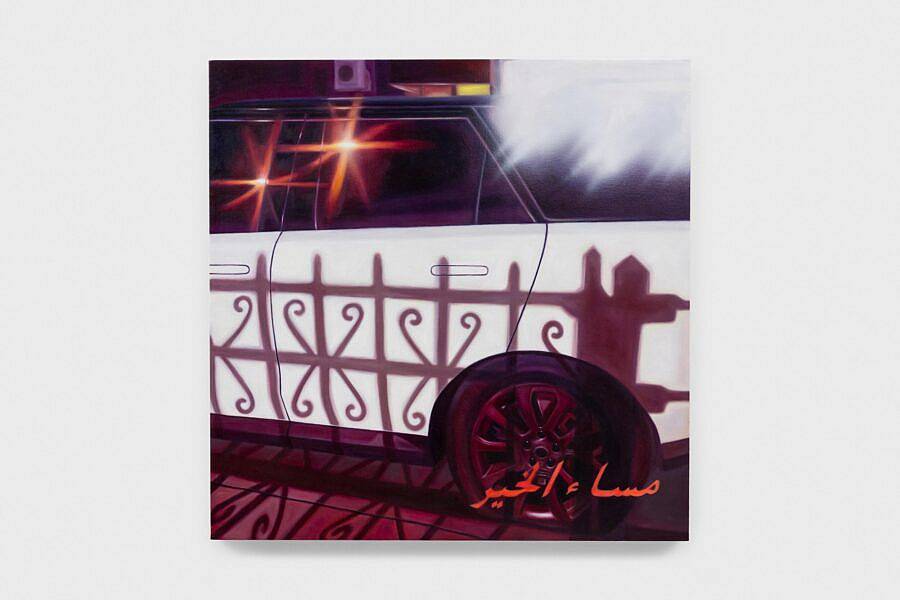
I just walk around a new neighborhood I haven’t been to, or go to an Arab American one. I find inspiration in a lot of things, and it can be as simple as a font or a random poetic line of text found on a car. The sources haven’t really changed over time, but I think my attention to where I get inspiration has continuously gotten more distinct to the ideas I’m interested in, where I am able to find inspiration wherever I go. It feels intuitive for me. But I don’t try to put an expectation of finding inspiration in a particular activity or thing, because you never know what you’ll find, it’s just a matter of how you see it.
What kind of imagery are you drawn to?
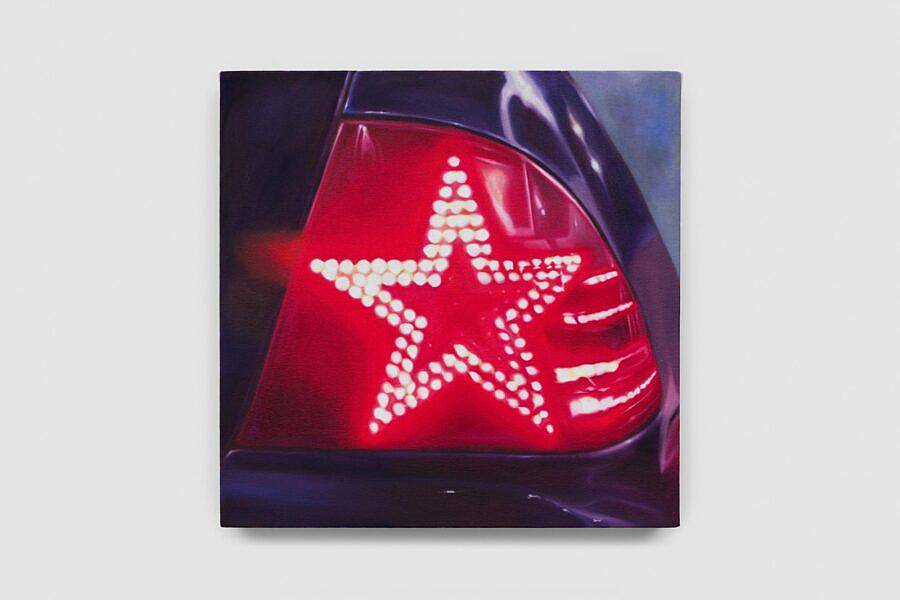
Anything with text. Bold fonts. “Bad” Graphic design. Car decals. Roses. Bootleg Perfumes. Patterns. 99 cent stores. Halal Carts. A ZaZa world blasting Nancy Ajram. Faded street signs and posters. White girls that pose behind the deli counter to post a photo online saying “my ock loves me.” M.I.A Bad girls music video. Fake designer items. Butterflies. Prayer Beads. Trophies. Eagles.
How do you use social media? Is there a certain lens you view content through?
I’d say finding a lot of my memetic and cultural inspirations comes from social media. I’ve seen a man dressed in traditional Saudi Arabian clothing lipsync a lana del rey song in the mirror while holding a rose. There’s these pockets of the internet that exist in part because of social media and people’s ability to express themselves, where a pattern has definitely developed culturally and algorithmically that is specific to Arab culture in a post-modernism & post-internet way that I love. They blend a sense of historic culture, while being ironic or poetic. And I like how various images, memes, videos, I find on social media accurately speak to the aesthetics of Arab culture as it’s being actively documented and manufactured online. That’s where the language of algorithmic still lifes came from in the context of my work, when considering the sort of patterns that generate a larger representation and commentary on identity, art, and politics.
What is a challenge you and/or other artists face and how do you see it developing?
I think a challenge I face as an artist is how to translate different aspects of the work to different audiences. I’ve always liked how my work can be experienced in different ways, and there is a sort of privacy to understanding the work that is often felt by people of the Arab community that can pick up on symbols or patterns more easily, or even more emotionally. And I’m not saying I want the work to be palpable to a western audience in order for it to feel validated, but rather the opposite, in that I want my work to be understood as time, politics, and history evolves.
So I think for me, a challenge I have sometimes is finding a balance between being translatable, but not giving away too much at the same time, because I like when people bring their own experiences to inform how they interpret the work. So it’s a matter of creating work that gives everyone some sort of entry point of understanding, but that entry point looks different for everyone and thinking through those compositional elements, language, removing text or creating my own, the emphasis of a particular color on a symbol, etc – can be hard to decide because I often think of the painting or the sculpture as the sum of its parts, and each part needs to be considered. I’d say that part is hard in deciding what is “worth” painting.
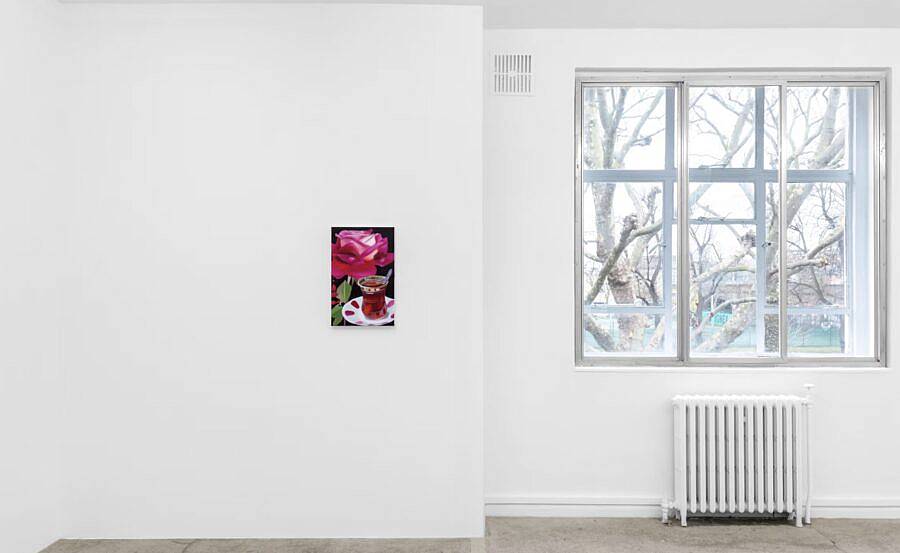
What’s your studio or workspace like? Do you have any rituals when you settle there?
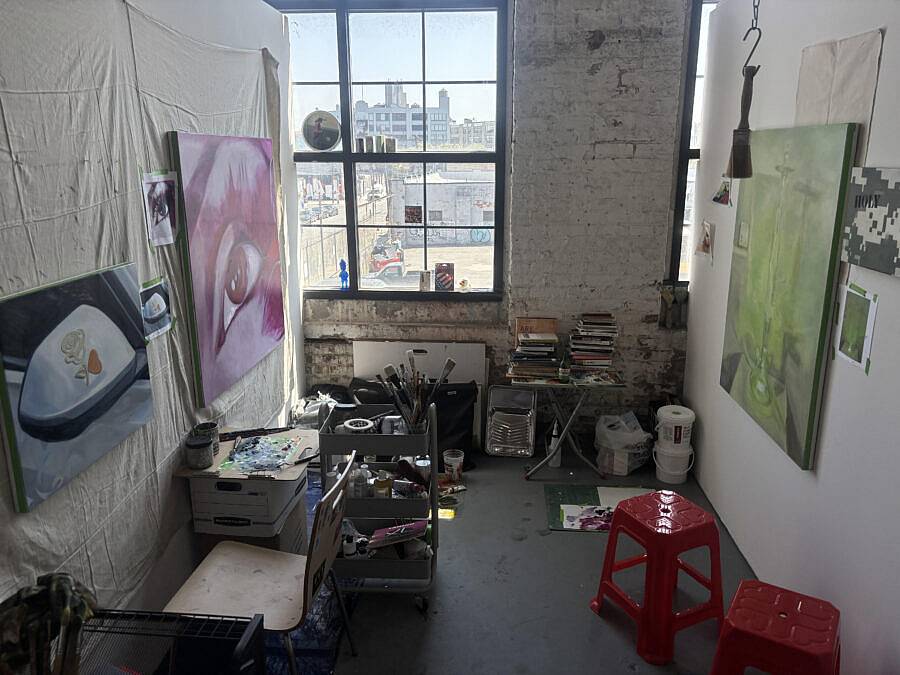
I share my studio with my friend Amber Wynne-Jones who is a great oil painter. We just moved in earlier this summer. It’s great because we’re both oil painters, but have very different styles and it’s fun to learn and feel inspired from each other. Rather than offering fixed representations, her paintings operate as records of psychic tension, revealing how meaning is continually formed, concealed, and undone in the very act of painting. Her work works resist hierarchy and resolution in the way figures and landscapes collapse into each other, and it’s a nice perspective to have alongside in the studio.
I have a couple different rituals. I always have to start with a coffee/snack run. I also can’t paint unless the studio is organized, so that’ll be the first thing I do after I get my coffee. I have a harder time painting if the area around me feels messy, so I reset my brain and space to feel “blank,” to put all my attention to the painting. I always give myself an hour of “free time” after I set up. Looking at different books, magazines, archive folders on my laptop, youtube videos, etc. And I have to do all of that before I paint, in that order, or else I feel off.
How does your creative community now compare to your creative community when you were younger?
If anything it is bigger and better. Growing up in Portland the art scene there is very small but also stays in that kind of hipster/graffiti/illustrator aesthetic which I don’t mind, but I don’t necessarily relate to within my work as much as I did when I was younger. I found that after moving to New York, and also traveling to London a lot, that I have more friends working in a variety of disciplines that feel more in conversation with each other, and I’ve identified with that more.
Are there any travel experiences that are formative to the work you do?
Definitely. I’d say my Morocco trip in 2018 is probably the most formative because that trip gave me a lot of answers to questions I had at the time about myself, but also a newfound curiosity in figuring out what my relationship to art and identity could be. I was very excited by that feeling of curiosity that it’s what made me decide to take art seriously, and I haven’t changed my mind since. And then Istanbul in 2022 is the second most important because it was the first time I saw my extended family from Libya in 10 years. It was a continuation of the same feeling I had in Morocco. It was almost like a gap of time was closed between the two trips and opened another, as far as mapping out the conceptual framework I was operating in. And I’d say my art after the Istanbul trip became more invested in symbolism and language as it pertains to my work now. I figured out what I wanted my thesis to be soon after and it was titled “Reciprocities of Diaspora: Arab Modernity and its Historicity.”
Are there any ideas or areas of research you’re excited to explore further in your practice?
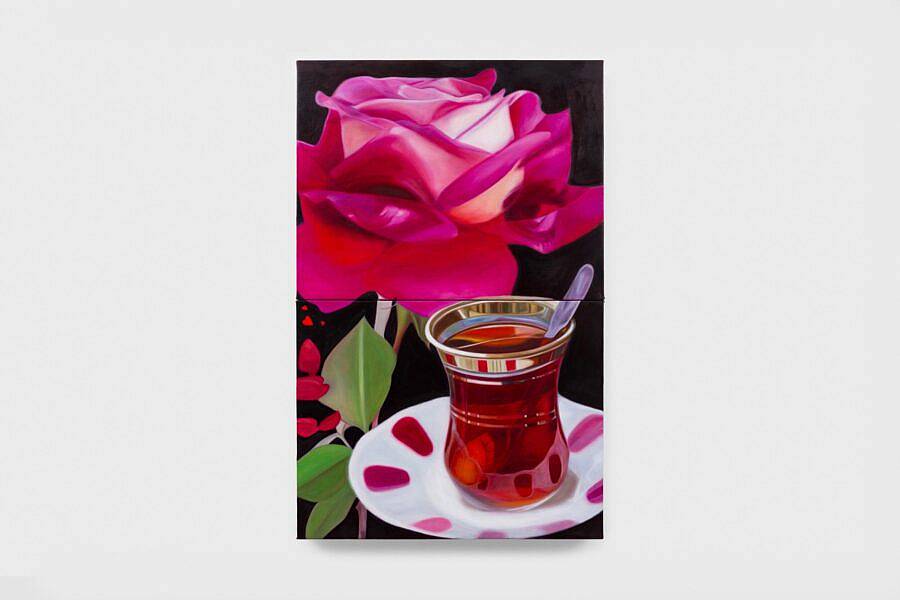
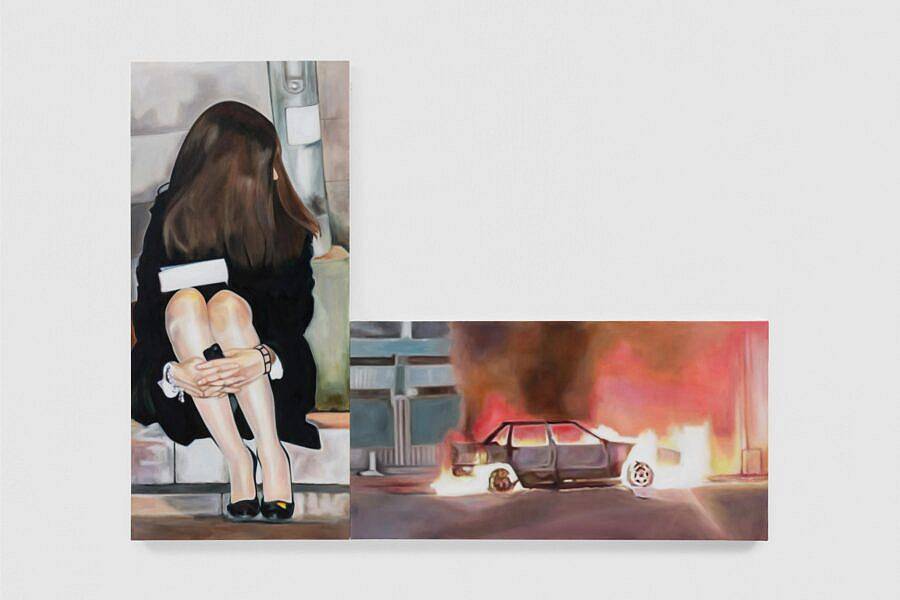
I’m excited to explore more playful compositions of canvases. I’ve made a few paintings that are paneled like Day of Revenge or High Tea and that composition is something I want to continue in my work. Because I’m interested in creating these algorithmic still lives, it makes sense to me to have parts of the painting that break up and assemble together in ways that are complimentary to the overall image, and that visual break between the two canvases speaks more to the simulacrum of imagery, representation, imported v. exported ideas and products of culture, where it can feel more narrative than a singular painting. Like putting the pieces of a story together. Or how a meme online can be broken down into its text and image, or built upon by adding a filter, etc. It speaks to a similar additive and reductive process with image making in the era of the internet, that I find very interesting.
How do you manage tending to the variety of responsibilities in the work you do? How do you mitigate burnout or exhaustion?
If I feel burnt out I normally give myself some sort of field day. I’ll go to random discount stores take photos of different products, people, cars, posters, things I see on the street. I like to go to Bay Ridge the most. Or even spend a day looking at the NYPL archives. I try to find some sort of activity I can dedicate a day to, to just find inspiration to sort of cancel out any feeling of exhaustion, and every time I’ve found something new to take inspiration from.
What do you collect?
Recently I’ve been collecting copies of this Egyptian crossword magazine from the early 2000s called “Salwa”. I found them in London at first, and then some in Libya. It’s an outdated pop culture magazine that combines western and Arab celebrities in a way that perfectly captures many elements I’m inspired by visually and conceptually.

Is there something you want your work to communicate to the viewer?
Painting is a space of memory. And for Arab artists who are working within the framework of their identities, the commitment to their trust of process and research, will always be a resistance to logics of hegemony that are universalized about us, in remembering, rewriting, and creating our cultural memory. I think my work is filling the gap as to how our history as Arab people is being represented to the public.
All photos courtesy the artist and Rose Easton, London.
Photography by Jack Elliot Edwards.
Interviewed by Luca Lotruglio.