Tell us a bit about yourself and what you do.
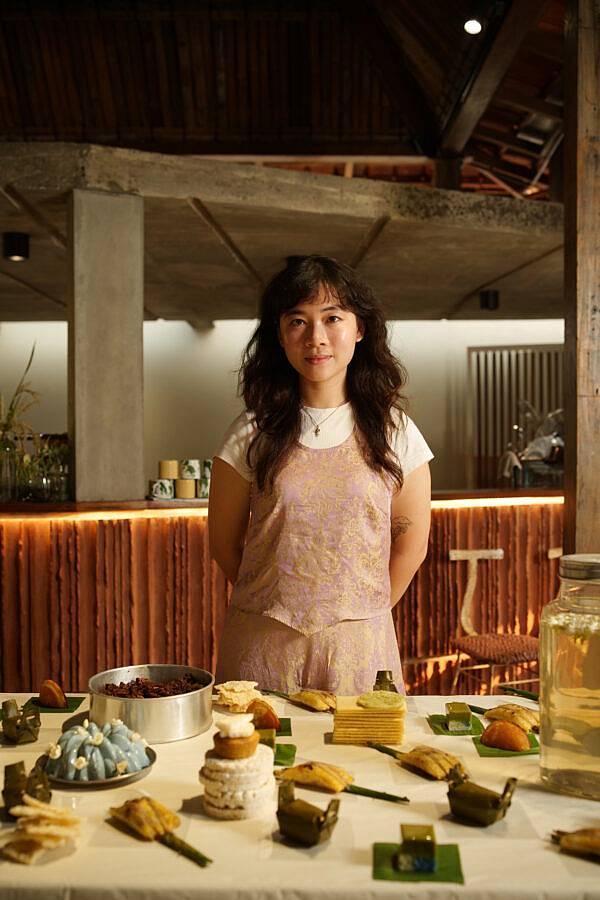
Heyu my name is Kiều-Anh Nguyễn and I am an interdisciplinary artist based in Hà Nội, Việt Nam. I play with ephemerality of archiving while drawing, writing, making non-perfume scents and eccentric ice cream.
How did you become interested in fragrance?
Someone bought a lot of niche perfume samples from LuckyScents for me in 2016. At the time, I was mindblown by the capability of (persuading people that they can be) smelling more than you could as you breathe. Imagine explaining popcorn, carrot and gunpowder scent in a bottle to a medieval child (me)!
What led to the birth of ba-bau collective, and can you tell us about your involvement and programming there?
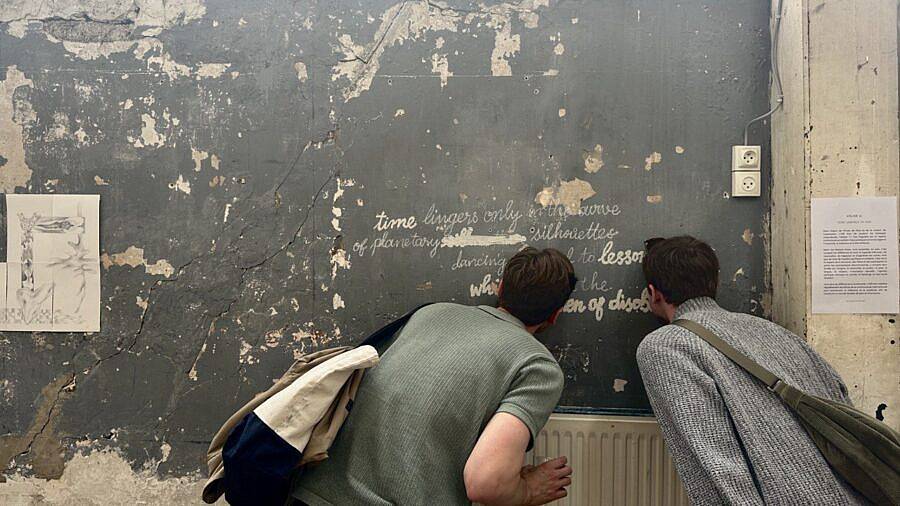
We had the space (ba-bau AIR) first before we had the collective. Then one day we had to form a collective to join a program together, and everyone nodded. The current members are not the same as the founding ones. The space is our common resource and we take turns hosting and programming to our personal and group interests – mostly hosting our friends’ work and collaborations, even outside of the physical space. Right now, ba-bau AIR is a joint studio for collective members.
Are there any commonalities that unite the members of ba-bau?
Does being queer count? Not just about sexuality / preferences but queerness as a way of living, then I guess that strikes for us. A lot of trust, empathy and forgiveness towards each other too, both in working and in daily life.
How has living and working in Hà Nội affected your practice as an artist and a programmer/curator?
Hà Nội raised us all into flexible divas with taste! Jk but I think flexibility is an insane skill that I have to continue (un)learning while being in this city. Sometimes you just have to do it without waiting for permission, because getting it done is better than getting it properly done, and the lack of resources trained us to carry out things within the skinniest budget. At some point we need to think of a sustainable model for the community to circulate itself without being too dependent on one or two familiar faces. This is not just for me or ba-bau, but for all independent initiatives in town – culture, art, solidarity, etc.
Who are the artists/creatives/musicians that you have been inspired by lately?
Personally I love listening to musicians who helped me understand the temptation and flowstate of voluntarily being mesmerized by sirens: Oklou, Caroline Polachek, Magdalena Bay. Not a person, but the smell of phở bò on the streets of Hà Nội and fresh za’atar have done wonders for my brain chemistry too.
Can you share a reaction to your work that has lingered with you?
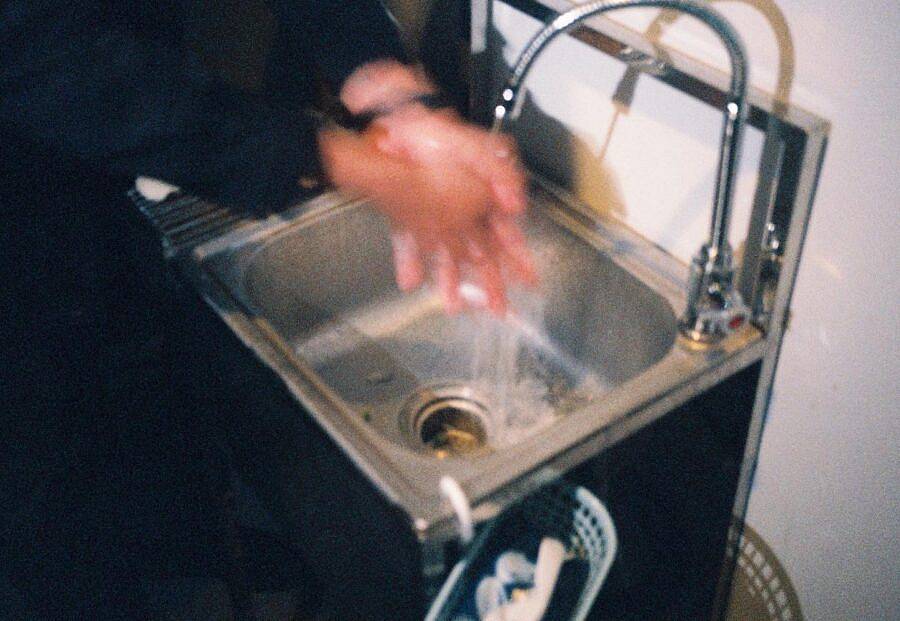
Two reactions come to mind. Once upon a time, I made a work called something between dry and drained, which were hand-casted soaps, and participants were encouraged to interact with them by directly taking the soaps and washing their hands at the stainless steel kitchen sink installed in the exhibition space. After that, either they smelled like ginger, fresh and clean, or canh bí gừng (wintermelon ginger soup) as if you just came back from the kitchen. The idea was to challenge people to look beyond the line of comfort and cleanliness through the versatile scent of ginger in Vietnamese medicinal rituals and cuisine. From the exhibition notes by the visitors, someone wrote: “Bây giờ mới biết làm con gái khổ thế nào” (“Only now do I know being a woman is this hard.”) All it took for him was the inability to clean off the soup smell on his palm for a short period of time.
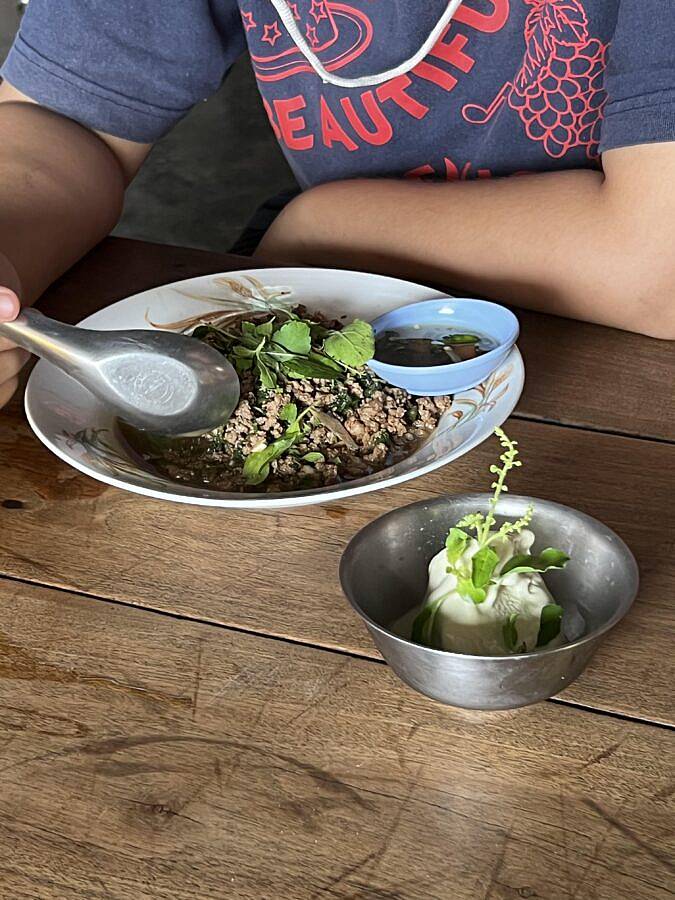
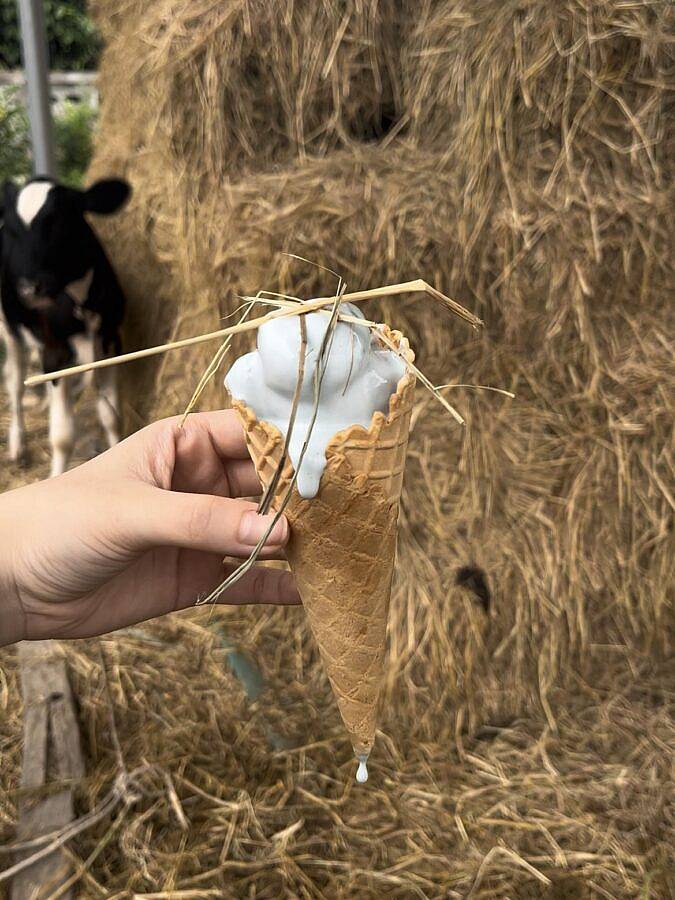
Another time, my open studio in Baan Noorg [Collaborative Arts and Culture] (Thailand) with ba-bau AIR was called “A Daily Dairy Diary.” Everyday for one month I tasted fresh milk from 4 different farms in Nong Pho, Ratchaburi – a town famous for their raw milk product. In collaboration with the oldest ice cream shop in town, Sai Fon, I created 2 ice cream flavors: one for the farmers and one for the cows. For the farmers was an ice cream based on their daily meal (rice with holy basil pork), and for the cows were what they eat and the botanical of the surrounding area (the scent of hay and breadflower or chommanad). Way later after I left, I discovered through a friend visiting that Sai Fon kept the flavor “one for the farmers” on their menu, and “one for the cows” made an appearance on Thai TV, as Baan Noorg members had to recreate the process of making that ice cream for the interview. I made my main quest look like a side quest and I side quested too hard. I think it is really cute that at least my side quest made a positive impact, and those whom I sought help from can benefit from my fruits (which are now also theirs).
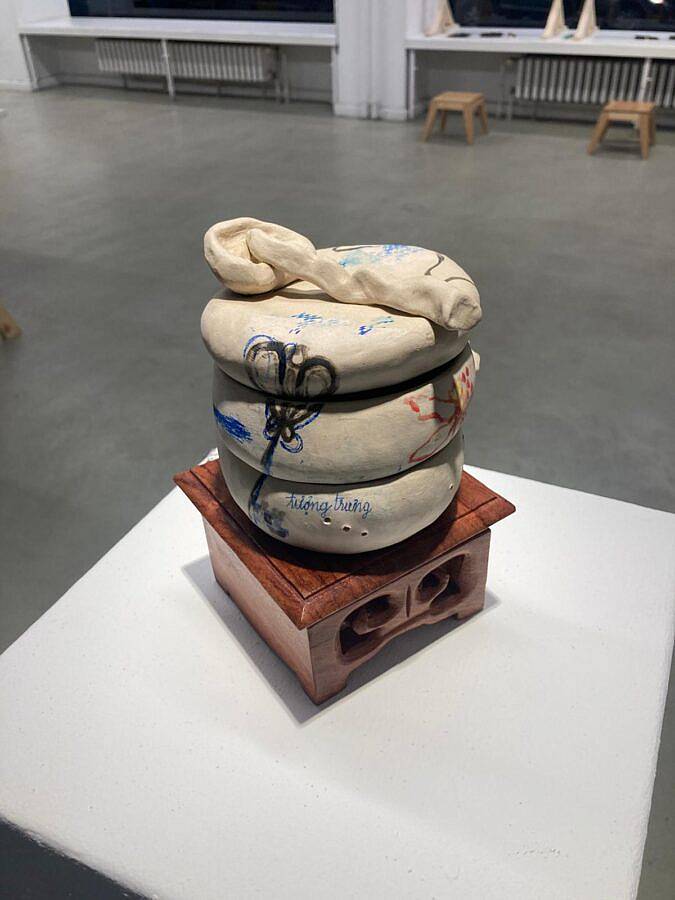
Your work Cổn cổn lãng hoa phù cổ kim (The imaginary thirst is unquenchable, 2025) is deeply concerned with indigeneity and temporality, all while embodying a post-anthropocene sensibility. Tell us more about the work; I’m particularly curious about the two titles you have chosen for it, as well as your decision to incorporate Muong people botanical embroidery patterns into the piece.
A bit of context about the work: from 2023, part of ba-bau decided to expand our research to one of the collective member’s hometown – Hoà Bình, land of the Mường ethnic natives of which our member is one. Together, we spent time there, eating a lot of cỗ lá Mường (leaf-wrapped feast) and thinking about the grand displacement for the construction of the Hoà Bình Hydroelectric Dam.
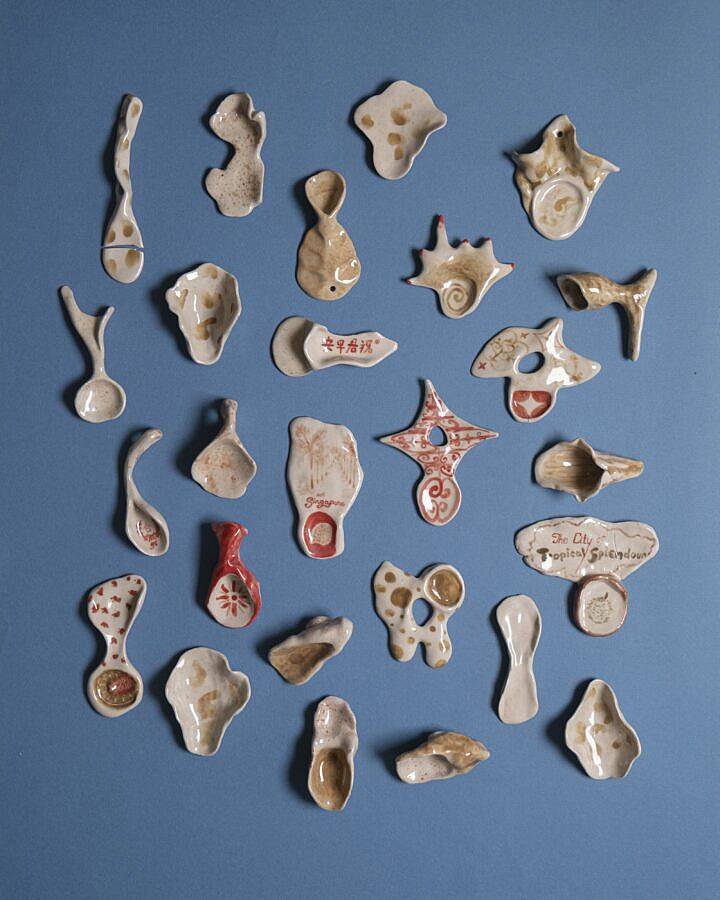
The work is a birthchild of the ending of “The Little Match Girl” by Andersen and Vietnamese folk tale Thánh Gióng (Saint Gióng) where there is an object that can suffice your deepest desire for comfort and give you endless food in times of despair (hence the English title). I infused the scent of lá dổi & hạt dổi (native wild plant and seed that is very common to Mường cuisine) from when I first knew of the plant in the ceramic tiffin-cum-incense bowl, which function both as a time capsule of the definition of home to the Mường and as a fossilized memory of identities, with scattered body parts of imaginal mythical creatures lived in the bed of Đà River and botanical embroidery patterns (hoa quýt, hoa sim). The scentscape is not only lá dổi sterilized, but an atmosphere of domestic rituals and the intimacy of shared meals, like memories of gathering by a fire place on a damp spring night, while knowing the scent also changes and fades by time.
The title Cổn cổn lãng hoa phù cổ kim is a sentence from a poem called La Phù giang thuỷ các độc toạ (“Alone in a tower by La Phù river”) by Nguyễn Du. The Vietnamese translation from the original Hán-Nôm title means “the surging waves carried away the past and present.” I too have the same feeling of observing the ephemeral changes of life as it goes by, especially distantly learning this displacement is already set and done years later.
Are there any areas, techniques, or materials that you’re interested in exploring further in your work?
Traditional Vietnamese culinary & olfactory knowledge via botanical and medicinal aspects is my next swimming pool for this summer. Other than that, I hope to get back on track with drawing and archiving scents of Vietnamese native landscape greenery in context of urban Hà Nội.
What do you want a viewer to walk away with after seeing your work?
Not limited to seeing but also reading, smelling and eating too maybe? A lot of the time when making works, I love to recall the innocent feeling and the first-times realization of life in me after reading a really good piece of literature when I was a child (and to be fair, those were such good works that the feeling still lingers and grows with me until now). If you feel like something has cracked in you, and there is no point of returning, either you forget about it or it allows you to hold so much more as a person. But that is for my side; I believe that each work has its own life in as many visitors’ lives. After all, there is this beautiful silver lining of being playful and hopeful about it, if not both then either of them.
What are some recent, current, or upcoming projects that you are excited about?
Six years ago, I started my olfactory self-study firstly with transitioning sensory through ice cream making, and now I am slowly returning back to creating more whimsical flavors that are 1. interestingly edible, 2. put a question mark first and then an exclamation after, and 3. within my attempt in decolonizing “taste” and “desire” for flavors. Essentially, these are the same criteria that I would execute for my olfactory work.
This year, I just released my first zine “TMI: Perfume Foundation 101” where I talked about the relationship with smelling practice versus the sense of home/land in context of gentrification between Hà Nội and Yogjakarta with my collaborator Khairunnisa. While planning to distribute it globally (!!) we both are already penning for the next issues (??). In 2027, I will collaborate with Rotterdam-based Canadian artist Gabi Dao to create scents related to our Vietnamese spiritual world and our dialogue will explore queer kinship and community, not only between the living and the dead, but also with non-humans, unnamed deities, and homeland.
What do you collect?
I am a hoarder of all things that smell nice – Malaysian vetiver, incense and resins of all re(li)gions, perfume samples, Southeast Asian versions of dầu gió and snuff bottles, you name it. Other than that – flavored salt, sea glass, semi-precious stones, and lastly, tarot decks.
Interview by Seth Nguyen. Artist portrait by Muhammad Fariz.