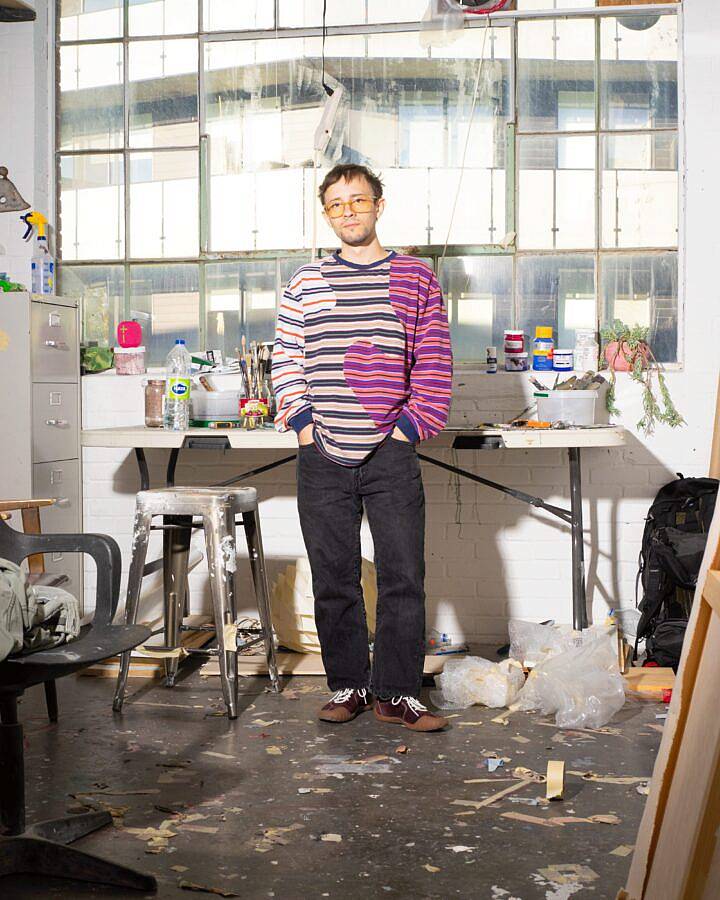
Tell us a little bit about yourself and what you do.
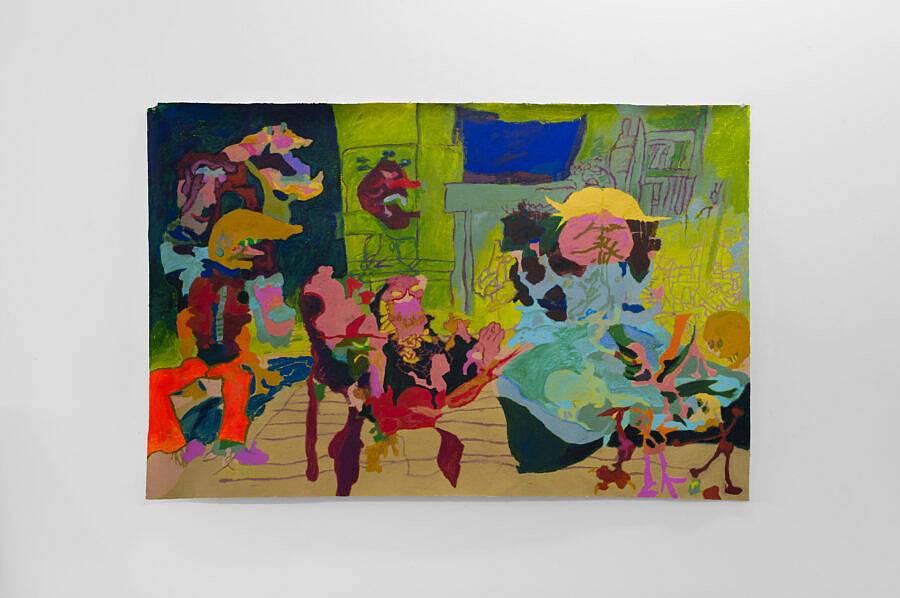
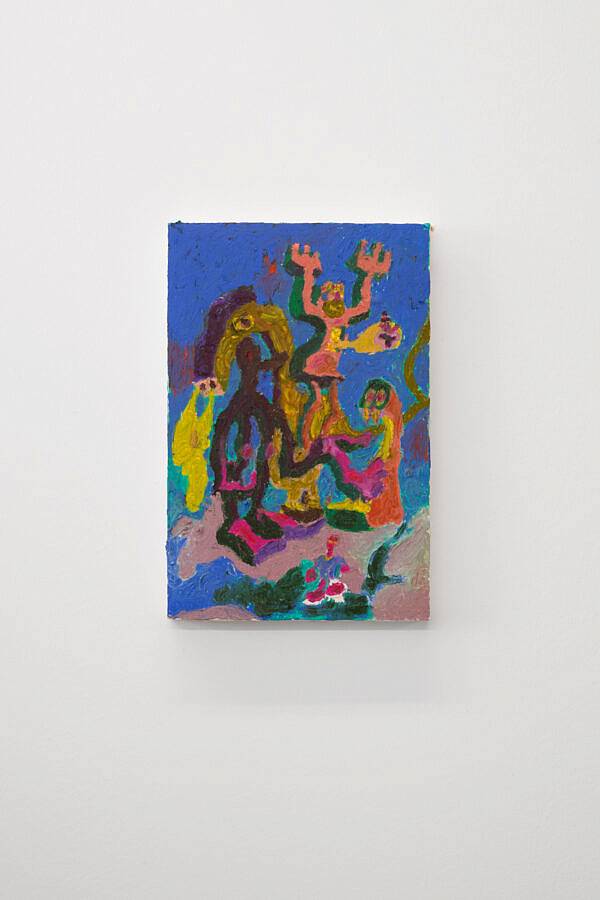
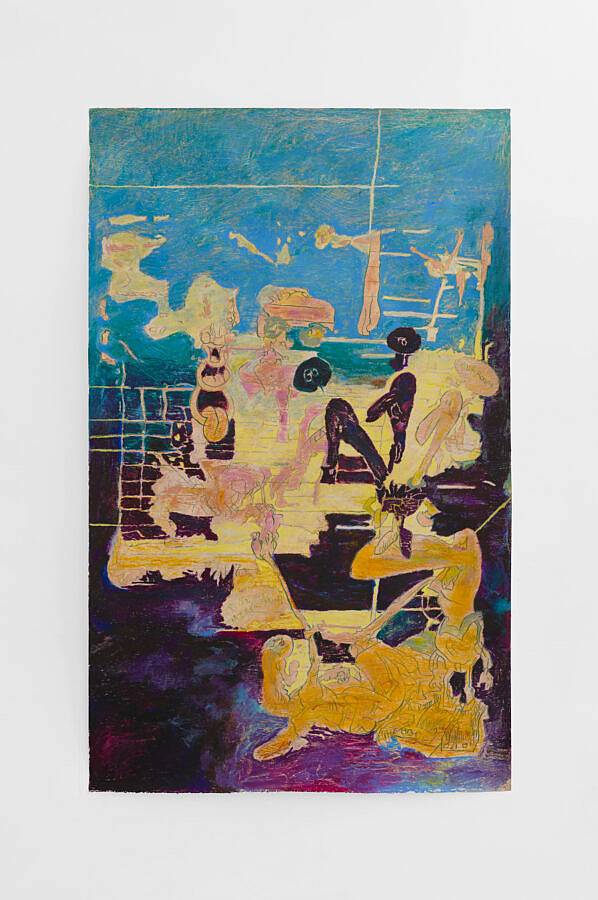
I’m an artist based in Montreal. I completed my Masters in Painting & Drawing here at Concordia University a couple years ago, but I still haven’t figured out if I’m a painter or a drawer. I like to create images of ghouls who look like they could use a little therapy.
Can you tell us about how you began working with oil pastels?
I actually first got a small set of Sennelier oil pastels at a garage sale in 2019. They were sitting in the sun all day, so when I opened the box at home, the pastels were pretty melty. I started putting some marks down on paper, and it was love at first sight. The way they glided on paper was so satisfying, like butter. No other brand really has that same malleable quality, and now it’s the only one I use. By the way, I think now’s a good moment to bring up that every time I talk about Sennelier in an interview, I get a cheque in the mail.
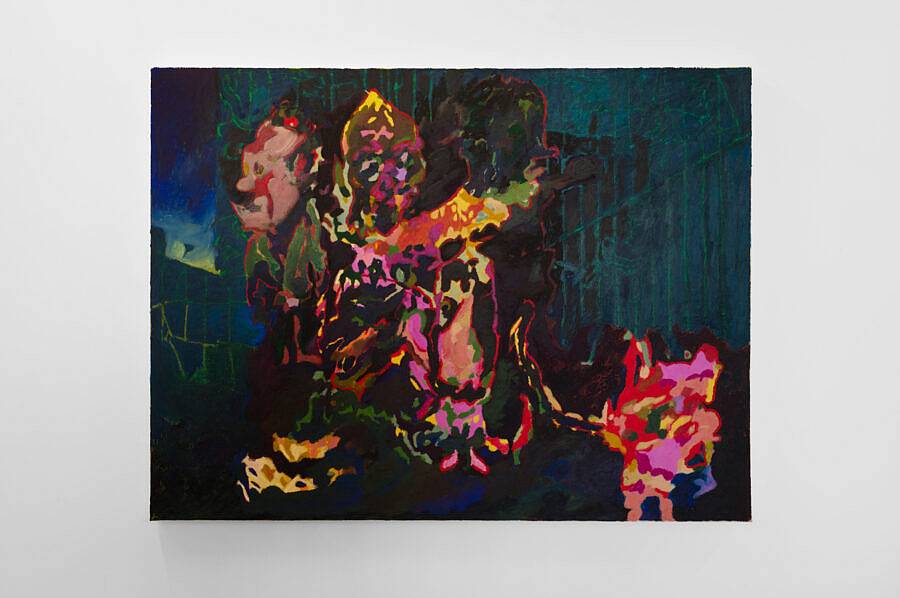
What is something that continues to influence your work?
1- Movies are a big one. I sometimes think of my drawings as scenes in a movie. It’s hard to pick favourites, but Crumb, Paris, Texas, and The Celebration are all up there. I’m always gonna have a soft-spot for Godzilla. David Lynch is probably the biggest inspiration, though. The garbage troll behind the diner in Mulholland Drive is part of my DNA at this point. And while not a movie, there’s not a day that goes by I don’t think about the last five minutes of Twin Peaks season 3. Baffling and devastating.
2- Comics is what I was making before I started pursuing galleries. I just love the medium and the form. I’ll always be a cartoonist at heart. Plus, a geometric line or a grid meeting an organic shape just hits really hard for me.
3- Textures. My Top 3 Textures are goo, melting plastic, and layers of wheat-pasted posters torn off a wall.
4- Cartoon mascots. I’ve been documenting mascots I find on signage for this zine I’m making called Perfect Little Gentlemen Quarterly Review. I keep an eye out for are the weird ones that look like the business owner begrudgingly let his recently-graduated illustrator nephew do the design.
5- Covid. How could it not?
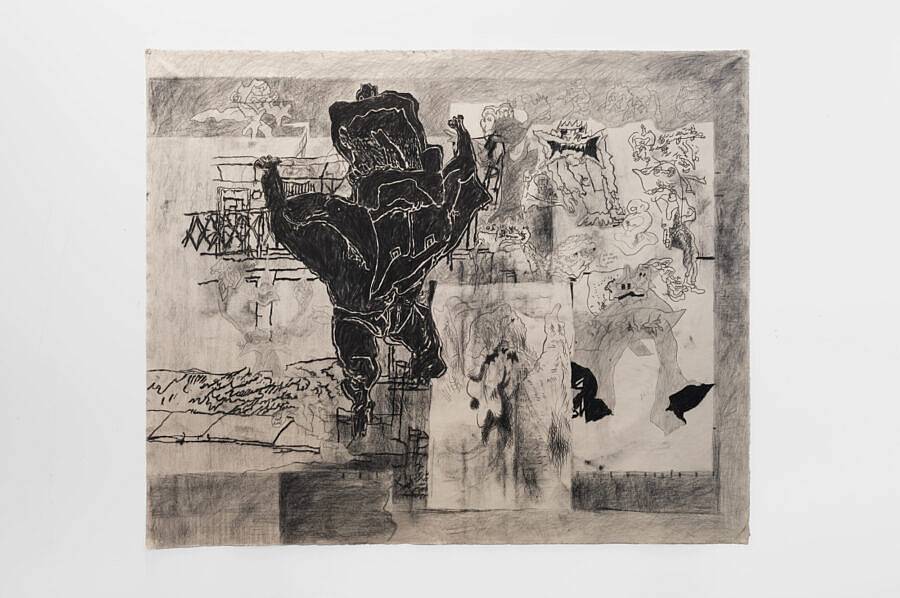
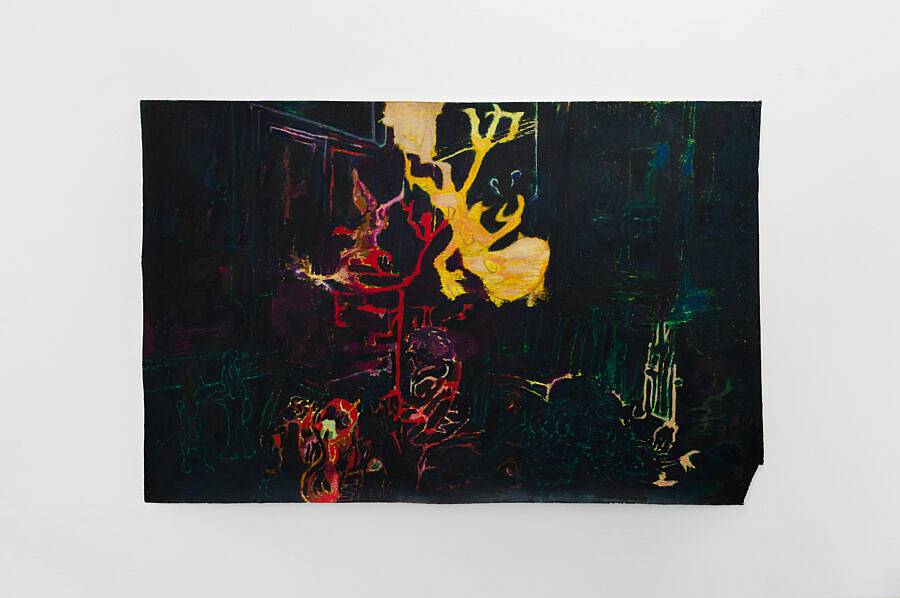
Most of your compositions don’t feature illusionistic spatial recession, but depth is often evoked through scale; at other points the figures seem to uneasily occupy the spaces they inhabit, creating a productive tension for the viewer to sit with in decoding the image. How do you imagine the visual plane your figures appear on?
You hit the nail on the head with your wording there: “tension.” Intimacy is something I explore a lot in my work, thematically and compositionally. There’s, of course, the way I stack all my characters together so tightly, but that extends to the suffocating nature of the environments they’re in as well. It’s like the limbo world they live in is the space between a camera and a stage backdrop, and that space is closing in on them.
Do you ever test what you could “get away with” in terms of making a piece that still works or presses against the limits of what makes sense or feels complete or coherent?
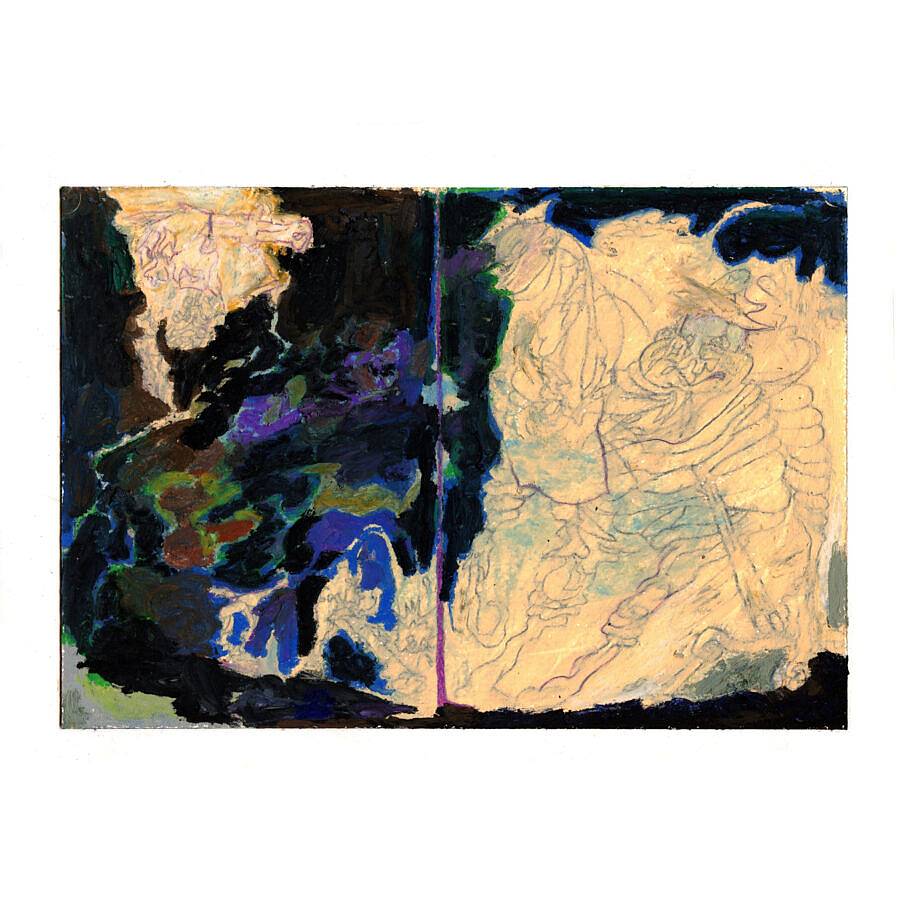
Maximalism is my natural inclination, so it’s very difficult for me to let a drawing or painting just be, you know? I’m usually doing a lot of fidgeting around in every nook and cranny. However, I’m cooking up a new series of works where I make a base drawing that I end up burying in a larger composition of black, like a relic jutting from the ground. I wouldn’t really call it “minimalism,” but since most of the picture is just darkness, it’s as stripped back as I think I’ve ever let my work be. The challenge, then, is seeing how much of the original image can have black pastel caked onto it, and to see how I can give this empty space a body? How do I trick my brain into thinking this piece is complete when there’s technically “nothing happening?” My solution has been to layer up the black with dark blues and greens and purples. There is noise now, but it feels part of a larger mass rather than me throwing a bunch of confetti at you.
How has your work evolved over time?
When I first started art school, I was making way more rigid work that emphasized detail more than anything else. I was wearing influences like R. Crumb or Charles Burns very plainly on my sleeve, with clean ink drawings and etchings. I think I was more concerned with proving I could draw than experimenting or challenging myself. It was only when I got further along that I started to be more curious about breaking down my images. I learned to let a little play and discovery into my process instead of suffocating the picture with my need for control. I was finding out about great artists like Seripop, Betty Goodwin, Leon Golub, and RB Kitaj — artists with obvious skill who were able and willing to turn those skills on their head and to toy with the form. Cecil Court by Kitaj, for example, is such an unsettling image. It has confounded me for years, and yet I am so enraptured by it. The skeleton of the painting is sturdy, but it also has this unknowable quality…the dense combination of the colour, the composition, the perspective, that texture: it shouldn’t work, but somehow it does. It’s really a masterpiece.
So, basically, my priorities changed. If I know exactly what my drawing’s going to be from the start, why bother finishing it? So when I’m making a drawing, I ask myself: how can I fudge with this a bit? How can I intuit this and surprise myself?
What is something you’ve always wanted to do and are working towards achieving?
Embracing slowing down.
What was the last thing you changed your mind about?
For a number of years, I’d felt guilty about the fact that I’d be using materials that leave such a mess, like the oil pastels or charcoal. The pastel in particular doesn’t dry, so it’s bound to get everywhere. It’s very inconvenient. I’ve had studio visits with gallerists who’ve come in and asked “oh, are you sure you don’t want to use oil paint?” Or, “you’re doing it on paper? It’ll be\ easier to hang if it’s on canvas.” Those were valid questions to ask: why not streamline the process and make everyone’s lives a little easier? It would certainly save the gallerists a bundle on framing and archiving costs. And the truth was, I didn’t really have an answer for them. I had tried oil paint a number of times, but for whatever reason, it just didn’t come to me in the way this other stuff did. Regardless, the impression I’d gotten was that my process, and by proxy, I, was getting in my own way.
A few things I’ve come to learn recently, however: Firstly, when a gallerist or a collector comes along who really believes in what you do, none of the hassle matters anymore. It’s a longer, potentially more expensive process, but as long as the thing’s got four sides, is primed and can fit on a wall, they’ll figure it out with you as your collaborators. I thank my lucky stars every day for having gained people like this in my life, and for the trust they have placed in me.
Secondly, I have learned to embrace the mess as part of my process. I like the mess! I like that it’s reactive and radioactive, and that it can smudge and stain and wrinkle. This is part of the “play” I talked about before: the work taking on a life of its own and my having to respond to that. It unlocks opportunities you can never completely plan for. And if you do something for long enough with enough intention, people will come to believe in it with you.
And lastly, art restorers gotta eat like the rest of us. If my art is still around in 100 years, I’m sure it’ll be as gunky and dusty as ever. My work is gonna get some conservator’s kid through college!
What was the last art show you saw that stuck out to you?
I was doing a residency in New York last May, and the trip was filled with great exhibitions! I got to meet a lot of really cool artists and even went to NADA for the first time. It was just two weeks of art, art, art. The one show that’s continued to stay with me the most since, however, is probably the Lotus L. Kang exhibition at 52 Walker. It’s far and away from the kind of work that I make, but it was so inspiring and insightful in terms of installation, making two-dimensional work sculptural. And gah! The light and the colours, the way the images morphed and interacted with each other and their environment as you walked around them. It was constantly playful, with so much room for discovery. I could’ve been in there for an hour.
What have you been listening to lately?
Cameron Winter is a consistent go-to. Vegyn, Headache. Been also going back to Young Fathers a lot since their soundtrack for 28 Years Later.
One song I’ve been listening to on repeat is Jim O’Rourke’s Halfway to a Threeway. It’s funny, gross, sinister and a bit sad, but, somehow, still very beautiful and very easy to listen to. I used to really like listening to sad music, but as I’ve gotten older, that’s felt maybe a bit too indulgent. An even greater incentive for moving away from the stuff is the fact that a lot of my sad music heroes like Nick Cave and Radiohead have, politically, turned out to be fucking cornballs. But in Montreal’s weird, non-committal transition from winter to spring, it’s been a lot easier to indulge in the sadder, slower stuff.
Interview by Paul Fitzpatrick