Tell us a little bit about yourself and what you do.
I primarily work with ceramics. At the moment, I don’t have a permanent home or studio. I move around, borrowing other people’s houses and kilns, firing my work wherever I can. I’ll go almost anywhere, but my family registry is in Japan, and I spend most of my time there.
Is there anything you’re working on right now that you’re really excited about?
Since coming to Mexico, I’ve been collecting materials for dyeing. In Oaxaca, I met an elderly man who weaves incredibly beautiful Tapete, and I bought cochineal dye from him. I haven’t been able to experiment yet, but I’d like to dye fabric, paint on it, and maybe even make stuffed objects.
I’ve also been enjoying taking photographs recently. It feels like I’m stealing something, or receiving something. Almost the opposite sensation of making ceramics.
Both film photography and dyeing take time before you see results, and you never really know how things will turn out. That uncertainty connects to the pleasure I feel in ceramics as well. At first glance, everything feels scattered, but I have a sense that these things will eventually come together into a single body of work. I’ve also started keeping a dream sketch diary.
photo by Taisuke Nakano
How were you introduced to ceramics?
I studied oil painting at university, and ceramics was something I encountered through classes. Clay can transform into so many forms, and you can pour energy into it. It felt like making a golem. Almost immediately after I started, I realized this was something I would be touching for the rest of my life, all the way until the grave.
Who do you think is making important work right now?
Lieko Shiga. She is a photographer based in Miyagi Prefecture, where I was born.
I think everyone has realities they want to look away from. For me, one of those is the Great East Japan Earthquake on March 11, 2011. At that time, my house was filled with the smell of dead fish, and death felt extremely close.
Because of that, there were moments when the act of living itself felt all the more radiant — nuclear energy, reconstruction, the environment, and humanity, whenever I think about these things that feel impossible for an individual to fully grasp or change, I think of her and her work.
What I find truly remarkable about her is her determination as a single individual to think through what is happening now, however difficult it may be, without allowing herself to merely trace or repeat someone else’s words unthinkingly, but instead insisting on thinking from what she herself has felt.
What is it that you think might initially draw you towards a work of art?
Visual pleasure, good lines and color is super important. But what matters most is that the work is extremely personal and even self centered. I believe that, first and foremost, the artist must be saved by their own act of making.
How has your work evolved over time?
In the past, I was more drawn to fragile, narrative driven work, and that influence was strong. I wanted to value my own vulnerability and woundedness, and I was interested in where connections formed through that fragility might lead.
Now, in one way or another, I find myself making work with the importance of positive energy in mind. This has nothing to do with embedding moral correctness or righteous messages in the work.
In terms of form, I feel that my work has become more drawing, like more focused on line and color. At first, the surfaces were excessively decorative, almost as if they were meant to be completely covered. At some point, we played a game of drawing universally recognized characters using nothing but memory. The lines of the characters he drew were remarkably fluid and expansive, and it was clear that they were drawn while preserving the habits of early childhood.
I do not perceive children’s drawings as free; rather, I think of them as constrained. When I look back on my own childhood, I remember hurling everything I had outward with a body that was still unfamiliar to me.
A body that has not received formal training* in drawing responds in a very direct and honest way, picking up on its own physical habits and the stimuli of the five senses—much like a plant stretching toward the sun.
I decided to try making those lines in ceramics. This became the National Characters from Memory series. From there, my awareness of line began, leading me back to my own drawing practice and ultimately to the work I am making now.
Residency programs also played a big role. I gained technical knowledge, learned how to fire kilns on my own, and began making works larger than my own body.
(*By “training,” I mean formal art education.)
What is something that you’ve always wanted to do and are working towards achieving?
Making video works. For me, sometimes artworks reflect their surroundings, and I feel video resonates well with that idea.
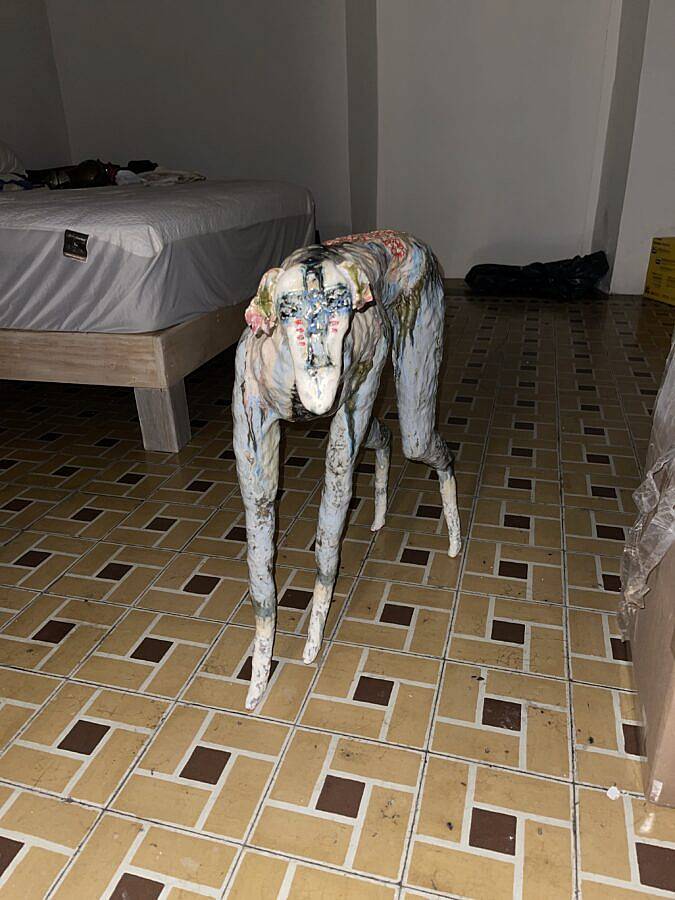
During my stay in Mexico, I’m collecting images and plan to make a short film about dogs and death. I bought a wooden box at a flea market and would like to use it as a stage for animation, mixing it into the film.
Do you ever find your work to be historically referential?
I think there’s influence from painters like Henri Matisse. At my local museum in Miyagi, there were many works by Kandinsky, Paul Klee, and Chagall, which I saw often. But more than that, I’m influenced by anonymous ancient tools I’ve seen in museums. My father owns many books about ancient civilizations—often bordering on the occult or conspiracy theories—and I’ve long been fascinated by Maya, Aztec, and ancient Mediterranean cultures.
Although I was born in Tohoku, my mother is from China, and my father moved there from Saitama, so I wasn’t very familiar with regional rituals or customs. Studying local culture and climate at an art university in Tohoku was therefore very meaningful for me. We learned about Matagi hunters, Ainu bear-sending rituals, and the coastal ecosystems of Miyagi.
I usually realize these influences only afterward, rather than consciously incorporating them.
Since seeing the cave paintings in Indonesia in 2019, I have also become interested in mural painting.
Is there anything you’re reading or watching right now that feels important to what you’re doing?
I’ve recently started reading Latin American literature. There is a genre called magical realism, which doesn’t distinguish between reality and magic, and I find that approach resonates with my work.
I’ve also learned that there was a similar movement in China starting in the 1990s, which interests me.
photo by Masami Sano
Your work encompasses a lot of figures and animals. Can you speak on this? Who are they?
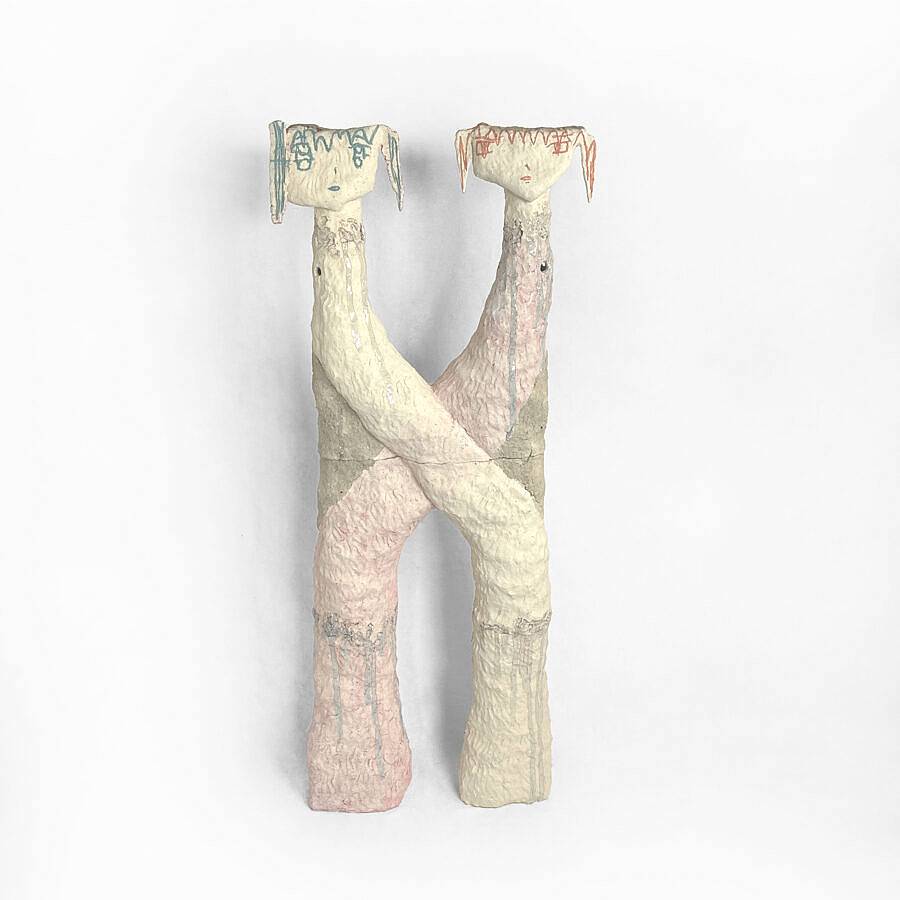
People often ask whether the girls or characters in my work are self-portraits. They’re half me, and half not. It’s similar to how, in dreams, you might naturally live as someone, or something entirely different.
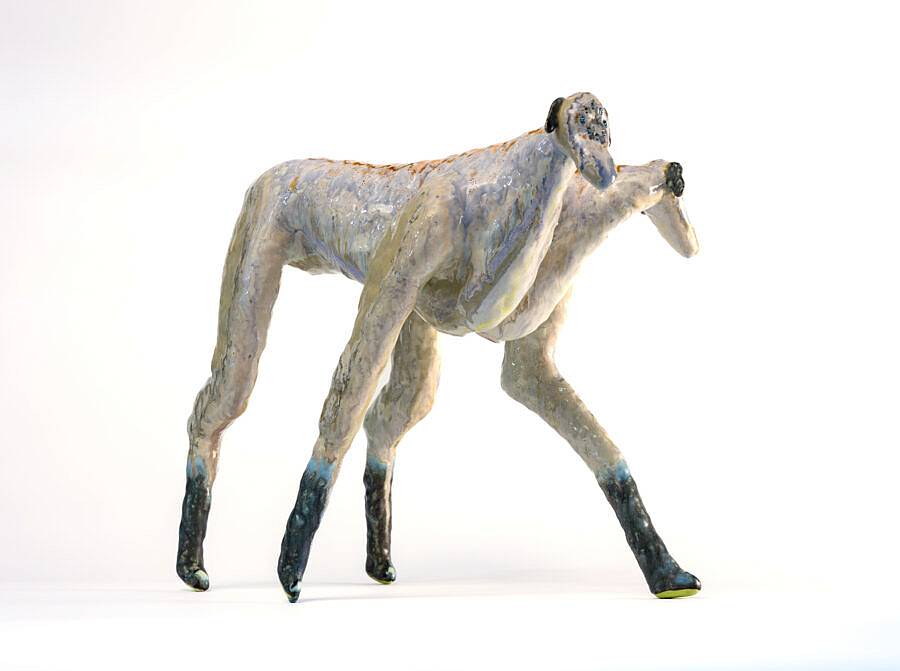
My chimera-like forms are sometimes inspired by the imagination of ancient people. I combine plants and inorganic materials and give them faces. Faces are crucial. No matter how inhuman the form, once there’s a face, it suddenly feels human. I don’t follow any religion, but I do believe, or rather, I sense that invisible energetic beings exist around us and influence us.
My mother is very spiritually sensitive and actually sees these beings. Recently, when she described them to me, I realized they were very close to what I’ve been making. I’ve never seen them myself, only felt them.
My mother also has an unusually low body temperature, around 35°C, sometimes even 34°C. In a strange way, I think that places her closer to death or shadow, making her more susceptible to these presences. (She’s healthy and energetic, though.)
I once heard the voice of a bodiless boy when I was extremely weakened. Perhaps we and these beings are both blinking in and out, and when our timing aligns, something happens. My work can be seen as my own interpretation and visualization of these energies, transformed into living beings with a sense of personhood.
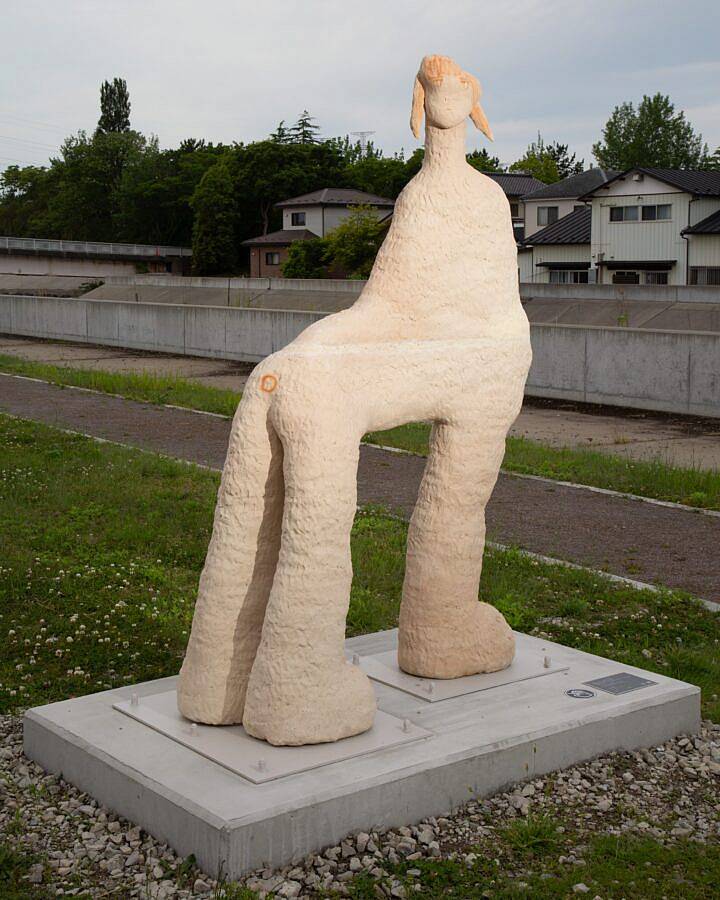
photo by Taisuke Nakano
Does your environment influence your work?
For me, seeing is the very first process of making. When the environment changes, what I see changes, and new stimulation arises. That’s why I move regularly and sometimes travel impulsively, to increase input.
Sometimes I think of myself as a bee.
Do you think your work takes on different contexts when shown in different areas of the world?
I make my work from a universal place, but I am an Asian woman, so when my work is shown outside Asia, it may be viewed through that label. Those labels aren’t important to the work itself, though my roots are important to me. Still, yes, I’m curious about how my work is perceived in different places.
What influences do you think play an essential role in your work?
Playing alone as a child. Moving from place to place. Walking. A vision I saw when my dog died.
And also simply I love eating.
photo by Taisuke Nakano
What was the last show you saw that stuck out to you?
The Hilma af Klint exhibition. It made me think, God has good taste. And if that’s true, then I feel hopeful about continuing to make work.
I was also excited by the prophecy that a temple would one day be built and filled with paintings.
Do you have any rituals when entering the studio?
Not really. I check whether the Wi-Fi works, make sure I have food and drinks, and try to make the space comfortable. When making becomes intense, life and work tend to blend into a mess.
Can you tell us a memory of someone interacting with your work that frequently crosses your mind?
In 2022, I co-created a work with my mother for an exhibition at the Sugimura Jun Museum of Art in Shiogama, my hometown. After my mother began living alone, I started visiting home more often. At some point, I realized I didn’t really know much about her. I wanted to think about my roots through her.
The process didn’t always go smoothly. During the COVID-19 pandemic, my mother returned to Shanghai, and a lockdown created a physical distance between Japan and China, making some ideas impossible to realize. But that separation led to new video works filmed in both countries.
Just before the exhibition, the lockdown was lifted, and my mother was able to return to Japan, allowing us to somehow bring the exhibition to completion. More than anything, I felt that I was able to speak with my mother along a different axis than before. I also heard, for the first time, about the invisible beings she sees in her daily life.
Interview composed by Liam Owings & edited by Seth Nguyen. Artist portrait by Taisuke Nakano.