Tell us a little bit about yourself and what you do.
I am an artist living in Toronto and I work in a studio not far from where I live. I use a variety of media and I often feel that I kind of reinvent the wheel each time I make something new. Because I work with so many materials, I have started to refer to my practice as “expanded collage”. I sometimes think that my works each look like they were made by a different person and that’s not necessarily intentional.
Are there any influences that are core to your work?
My work is influenced by my surroundings, by music, literature, film, anything that finds its way into my life at the time. Three years ago I read an essay comparing the work of British artists Lucy Skaer and Becky Beasley. In the essay, the author referred to the writer and thinker, Maurice Blanchot, and since then his theories of the image and “fascination” have been very influential to me and I always kind of use him as a guide for when I make work.
When needed, where do you look for inspiration? How have these sources changed over time?
I feel that nothing is really off-limits in terms of inspiration. I watch movies, read books, look to art history and search for discarded stuff in the streets as sources. I find that a lot of my ideas come to me while I’m in the process of making something. Sometimes my ideas are well-considered and others are a bit more immediate. I feel that, currently, I perhaps refer to literature more than I did in the past. There’s something really interesting to me about carving something out of written text and transplanting into the world as something visual. I still struggle, however, to do it in a way so as not to simply translate the written into the visual at a 1:1 ratio.
How does reading influence what you explore in your art practice? What are you currently reading?
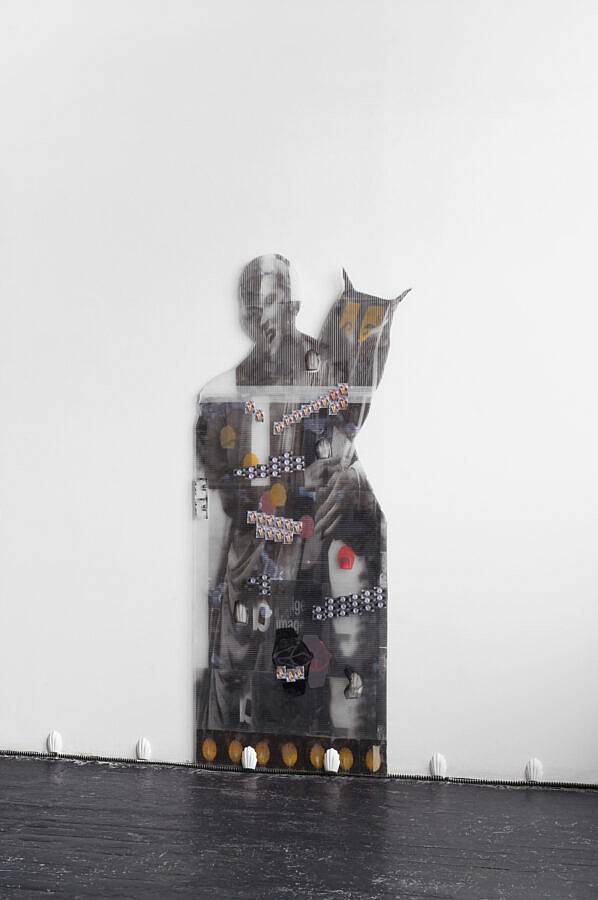
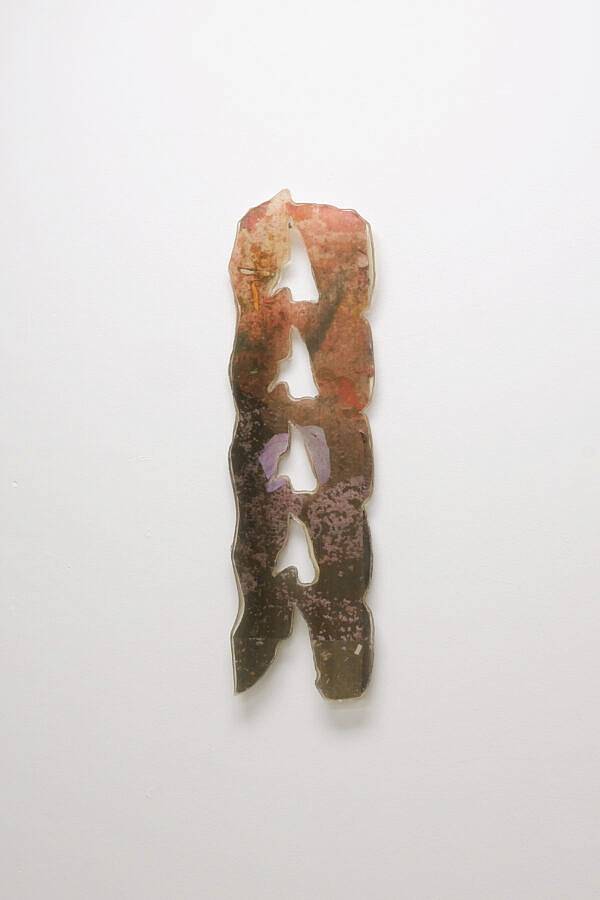
What I read greatly influences my work. I was introduced to the book Formless: A User’s Guide by Rosalind Krauss and Yves-Alain Bois in grad school and it’s a text that I refer to time and time again. The book is kind of like a glossary of words associated with Bataille’s theory of the “formless” with essays relating to each of the words, ordered alphabetically. It has been really helpful for me to go back and read certain essays if they apply to what I have been making or thinking about and I often find myself going down rabbit holes looking at the footnotes and then looking up what is cited there and so on. It’s a fun spiral. Sometimes fiction informs my work as well. The piece behind me on the wall in my studio portrait was loosely inspired by the short story “Music” by Vladimir Nabokov and another short story of his, “Signs and Symbols”, formed the basis of one of my paintings. Right now, I have resumed reading The Voyeur by Alain Robbe-Grillet.
How were you introduced to the mediums that you work with?
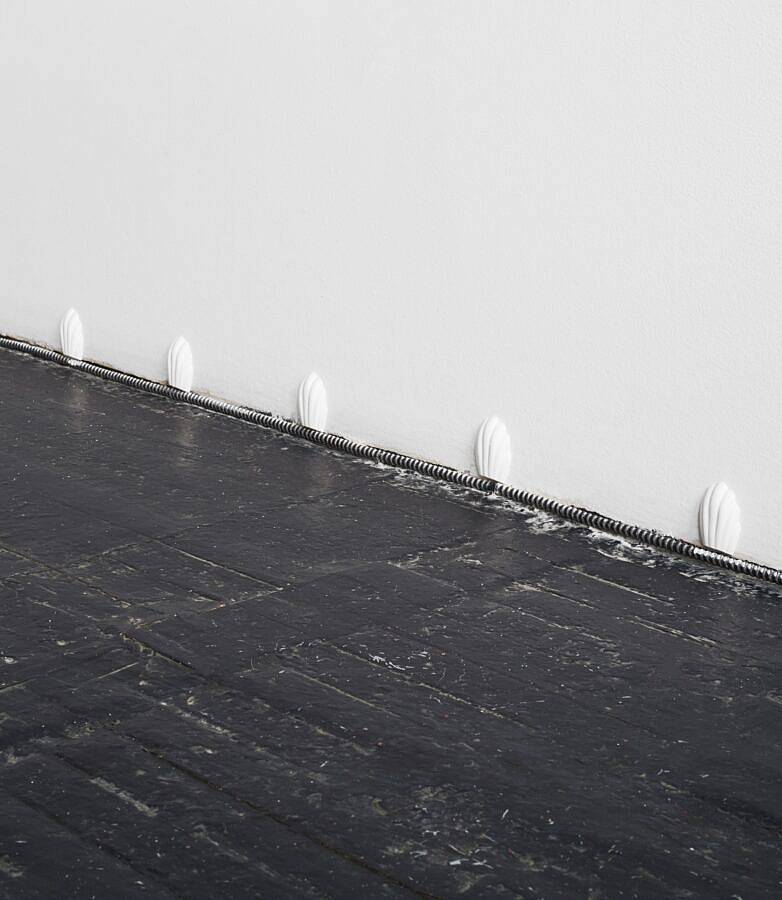
During my BFA, I was primarily just painting and drawing while taking a photography course or a sculpture course here and there. I found sculpture and photography to be stressful and more of an “unknown”, so I stuck with painting for the most part. It wasn’t until my MFA that I really allowed myself to explore new things. During this time, I remember being shown images of Aganetha Dyck’s beehive scans, where the distorted movement of the bees was captured and time was compressed. Around the same time, I also discovered Trisha Donnelly’s practice, of which a big component are her striking flatbed scans. Being introduced to these two artists prompted me to purchase a handheld scanner and it became a prominent tool for me in my work for several years. As someone who never really had much of a technical photography background, the handheld scanner ended up being precisely what I needed to be able to explore other mediums. It allowed me to think of photography and images in a more sculptural way, just through the very act of recording all of the minute details and information along architectural surfaces like floors or walls or tombstones. I think the handheld scanner set me up for a personal methodology/mindset of openness and curiosity when making and I have since expanded my work to include a variety of media like resin, plaster, found objects, latex etc. With this openness to new media, however, there is also always the necessary embrace of failure and mistakes.
What kind of imagery are you drawn to?
I’m drawn to obscured, obstructed and mute images, but I think I generally try to make them that way. I suppose the images that attract me always have a “doubleness” about them, they are doing two (or more) things at once. For example, I recently came across a photo of a miniature theatrical maquette, viewed from the back, and it featured multiple proscenium arches and framing structures. On one level it is simply a maquette of a theatre but, to me, it also looks like a large format camera, an 8 x 10 camera, so it was kind of operating on two levels (the two levels being two distinct but overlapping systems and structures for framing the act of looking and vision). I’m really interested in metaphor and I’ve been thinking a lot about how to reveal its mechanism, or to illustrate it in some way, but I think the more you try to examine how it is structured and how it works, the more it recedes, hides and disguises itself. It’s an inherently theatrical device, which is why I’m perhaps drawn to the architecture of the theatre so much. This all probably seems like a very obvious statement, but I think a lot of the time to make art or to think about art is to be able to look at something from a distance, from a bird’s eye view. I’m also very interested in “shifters”, whether they be linguistic or visual. The film theorist, Mary Ann Doan, writes a great essay about the index and shifter words like, “this”, “here”, “that”, words whose meaning changes depending on “mutating” contexts and circumstances. The visual equivalents of shifters for me are something like the “fermata” in musical notation, a symbol that signifies that a note should be held for slightly longer than its value. Therefore, the entire piece of music can differ slightly each time it is played, depending on who is playing it and how it is played.
Are there any principles that guide your work with found imagery?
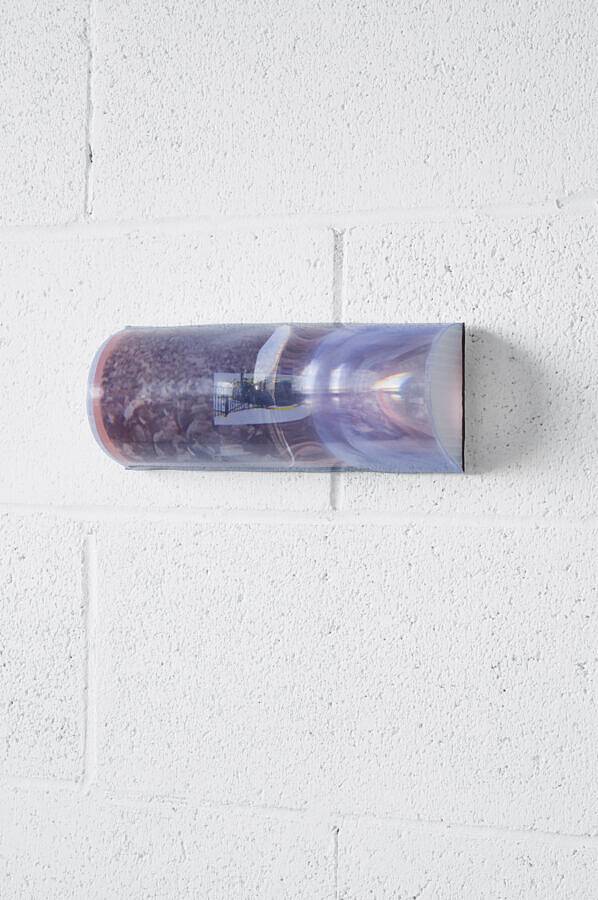
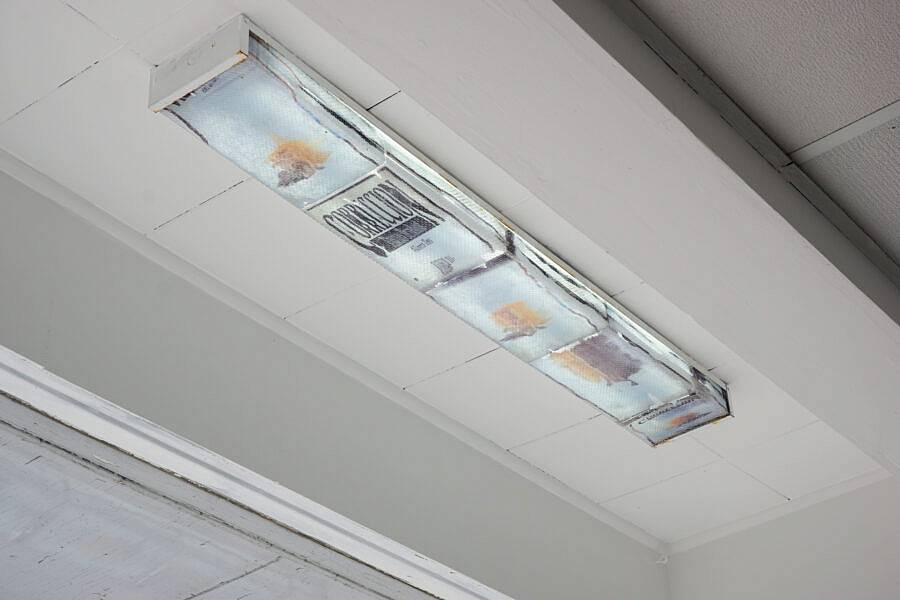
I think a lot of the time my work is interested in examining the relationship between form and content. I will either start with an object/material and think about an image that could relate to it and vice versa. For a while, I would browse Craigslist for photos of vintage objects for sale and the manner in which the objects were photographed by the sellers played a big role in my selection process. I was really drawn to the accidental, almost haphazard nature of these photos’ compositions. These would then serve as reference images to paintings for a while, although I did manipulate them further using a flatbed scanner. Currently, when I use found images in my sculptural work, they serve as a tool to communicate specific experiences I have had or, moreso, they often function as a “bridge” linking two or more separate ideas. The space or gallery in which I will be showing work plays a big part in what I end up making, so the images I select will often loosely refer to the space itself, or there will be a chain of associations linking the image to the space. For example, I recently used an image of the cover of the Spanish edition of the novel Correction by Thomas Bernhard for an image transfer on a fluorescent light cover. The space it was being shown in had evolved several times, having been different businesses throughout the years until finally becoming a gallery for a brief period of time. Correction centers a lot on architecture but also the constant internal “revision” and self-correction of the protagonist to the point of being driven mad. The choice to include the cover of the Spanish edition was meant to extend these ideas of revision, alteration, adaptation and reappropriation in both physical space and literary/linguistic space. Lately, though, I have been building and composing my own images, specifically by photographing small, theatre-like dioramas using drywall, carpet, inkjet prints and LED lights that I have composed and assembled. I really like the idea of labouring over something and inserting so much detail into the object just for one photograph.
Is there a moment you look back on as being formative to your identity as an artist?
I grew up in a very artistic household; my dad is a painter and my mom is very musically-inclined, so art was just a natural part of daily life. I’m not sure there was a specific moment that made me want to be an artist. I think having been surrounded by art from a very early age made being an artist inevitable, although for a while I thought I wanted to be an architect.
How does your creative community now compare to your creative community when you were younger?
I would say that my creative community has become richer now as opposed to when I was younger. In undergrad, I barely went to openings at all, but now I go to one almost every week (or try to). Repeatedly going to events and being in these spaces breeds a certain level of familiarity and that then can turn into a genuine sense of belonging and community, as cliche as that may sound.
What is your experience as an artist living and working in Toronto?
I like Toronto a lot, but I feel like I am always in the minority when I express that haha. It’s a smaller city compared to certain U.S. cities, so there is definitely a closer-knit sense of community and the people here are generally very supportive. There is a lot of really incredible work being made here all of the time as well as a lot of very exciting DIY spaces around the city (shout-out to my pals at Hearth!).
What’s your current studio or workspace like? Do you have any rituals when you settle in there?
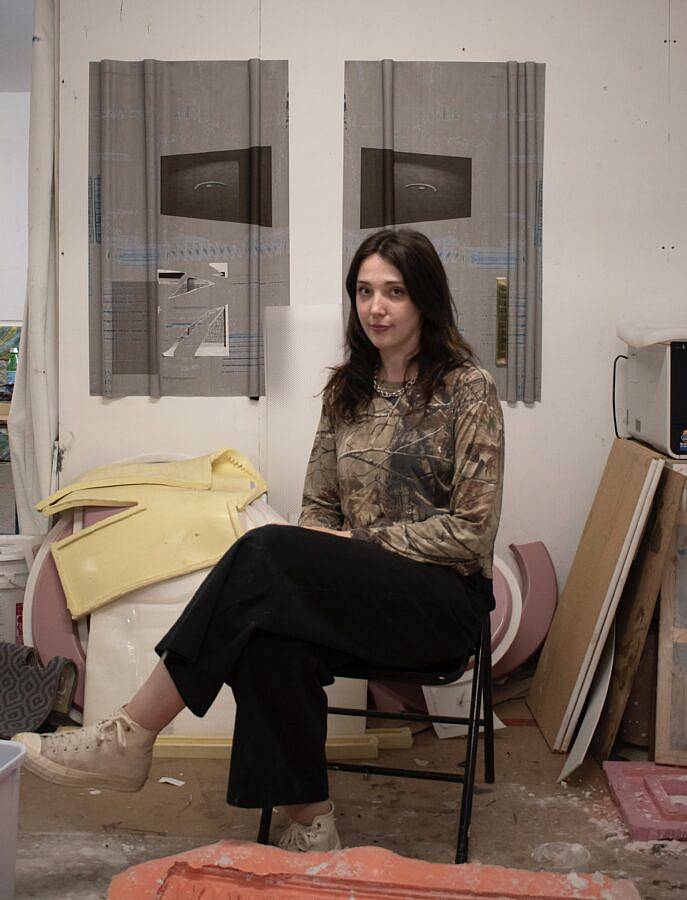
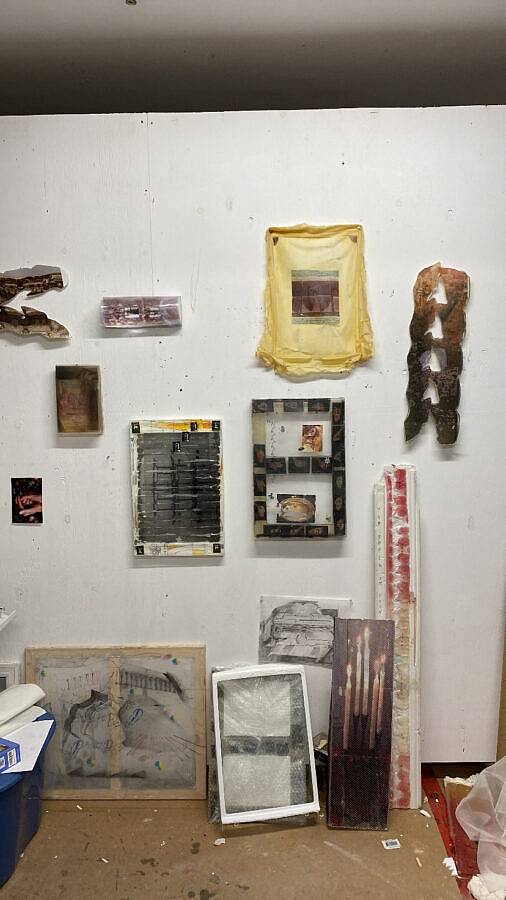
My studio right now is extremely chaotic and disorganized (but I’ll still share a photo haha). I have accumulated a lot of stuff over time, so I am slowly running out of space and things are precariously stacked on top of each other. Before I even leave my apartment I usually come up with a game plan first so that I know exactly what I need to be doing when I arrive. My work, a lot of the time, involves gathering small components like photos and scans or making molds in order to finish a certain step in the process so I really have to think about the order that things need to be completed in. When I get to the studio, I usually like to get to work right away and I’ll often listen to music the entire time I’m making something, unless I am reading.
What do you collect?
I mostly collect rejected objects that people leave behind our studio building. I’ve picked up ornate wooden gates, cement garden dividers, carpets, chair seats etc. (I almost grabbed a vintage Parisian birdcage from the 1960s). My friends will also give me stuff that they’ve found, like large plastic letters from a sign that I still need to do something with.
Portrait photographed by Philip Leonard Ocampo.
Interviewed by Luca Lotruglio.