Tell us a little bit about yourself and what you do.
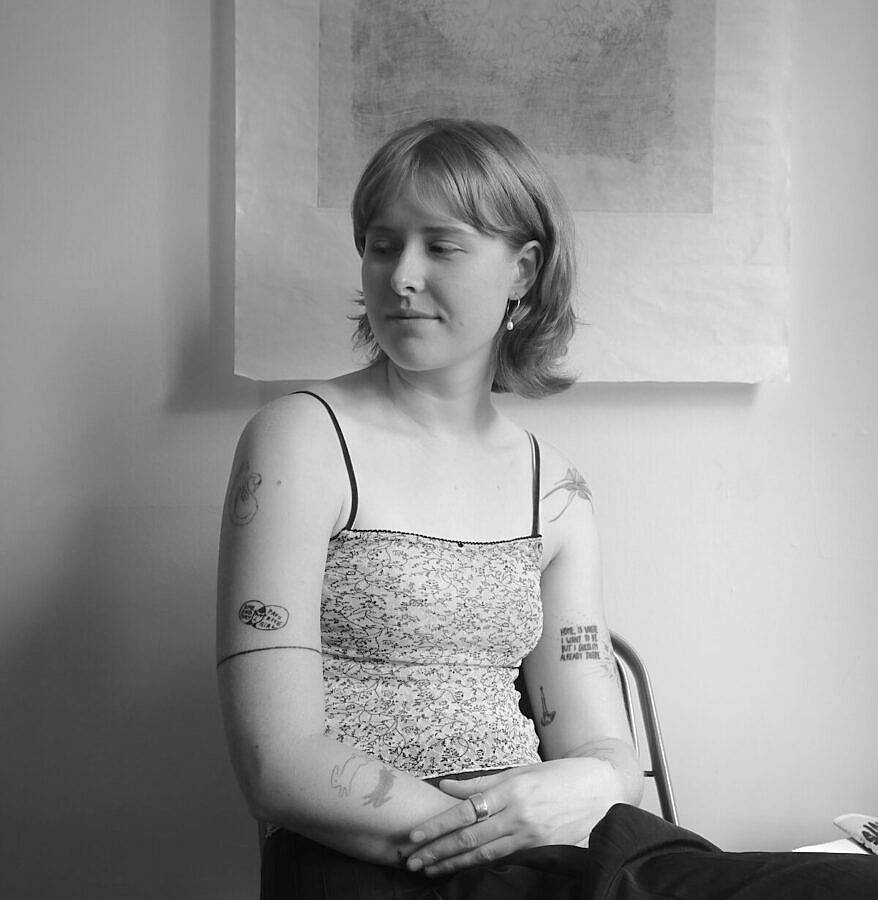
Most days, I wake up and take a walk in Chicago. I think about how I used to take walks in Colorado where I grew up, and consider the differences and similarities of these places. Sitting on a bench, I think about my day and vaguely meditate on how to stay in touch with myself and the world. I get groceries, usually the wrong amount. I answer emails and listen to the radio. I tattoo or paint most days. Every now and then, I show work amongst artists and curators I find to be good company. This makes me feel serendipitous in a very large way. Unexpected and fortunate discoveries continue. I see friends at a show, we bob our heads to the music, maybe shake our hips if it’s that sorta thing. In summer I bike home, probably in the rain. In winter I take the bus and consider whether or not I should talk with the person I’ve met once (or maybe twice?) sitting a few seats behind. I saunter with a friend and chat while in jovial motion. I look out the window of an airplane and I’m really happy to be seeing what I am seeing, but I’m also uncomfortable from situating my body to see the light flooding the plains and the moon rising over Lake Michigan. Most evenings I sit on my porch and wonder if I need to change what I’m painting and how I’m painting it. I think, Kate, get a grip. They are what they are. It must be time to go to bed.
Is there any source material you find extremely relevant to your practice right now?
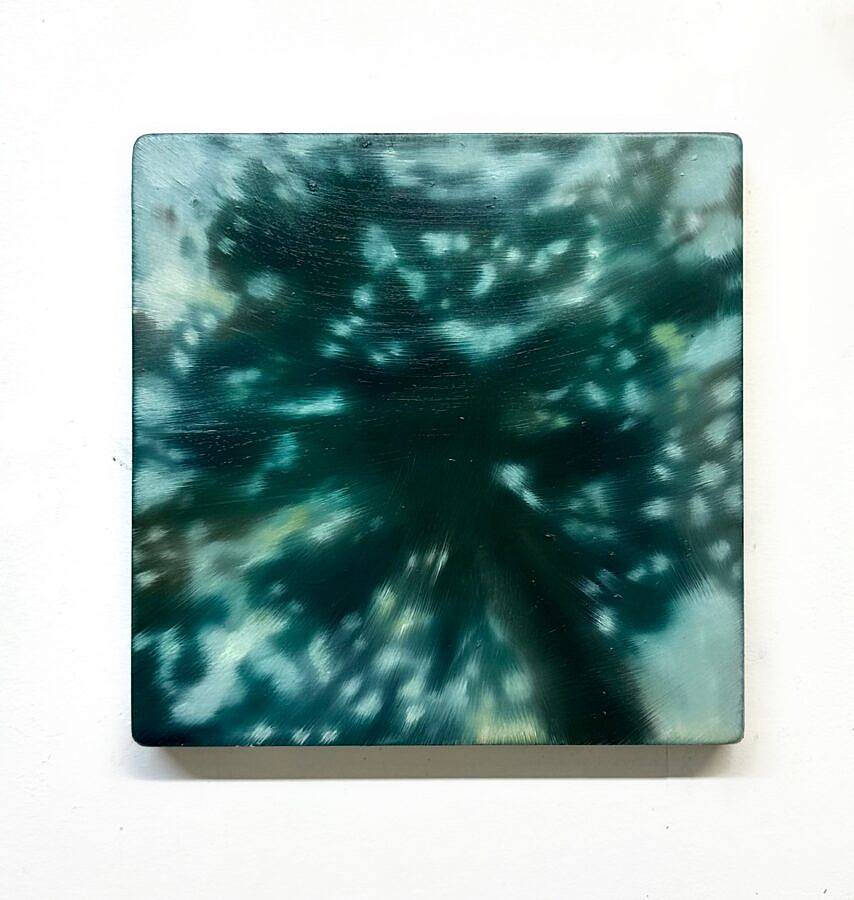
Right now, I’m working on paintings from the perspective of looking up while laying on the ground. The research for this has been splendid, mostly achieved by laying underneath a tree or two, studying the dappled patterns and movement of the leaves. When it’s night, this research pivots to laying in an open space, likely a park, searching for the edges of my vision where the trees and street lights form a ring around the night sky.
I often am painting from memory, so I try to be an active observer and collect glimpses to work with. Sometimes, though, reality will just flood in and force awareness upon me. Those are probably the paintings really worth making.
A lot of your work seems to take on a soft nature. Do you think this is true? Why or why not?
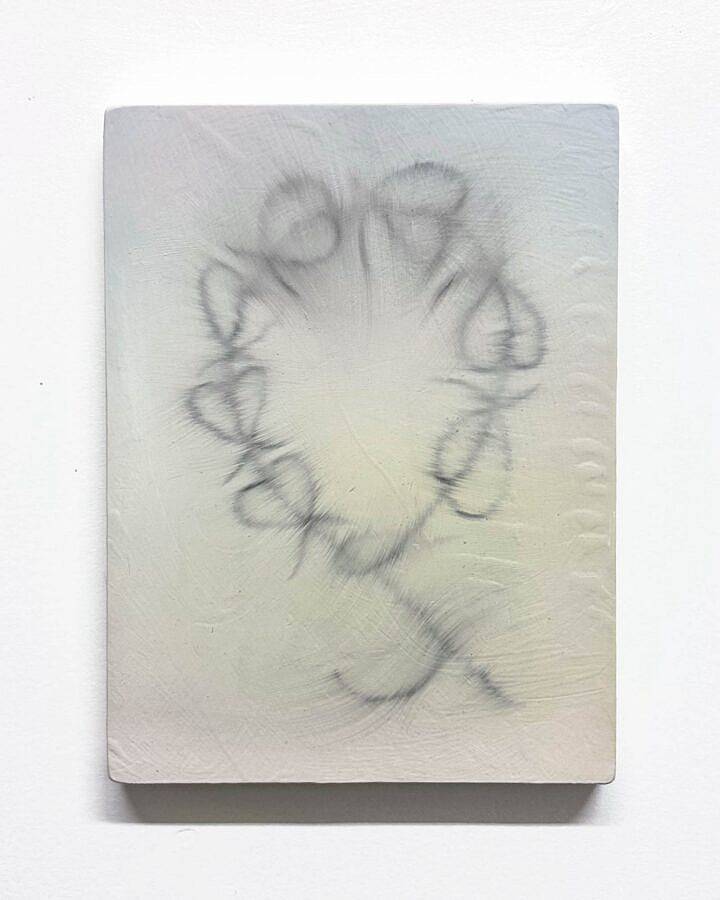
I love the contradiction of trying to capture something fluid and fuzzy while paint ultimately becomes lignified and static. I’m interested in softness as a malleability and an openness, or a lack of definition. I find myself most interested in paintings that allow me to meet them halfway; something that asserts mood and atmosphere before subject or form. A softness or blur in an image prompts uncertainty and allows me to skirt full abstraction, letting the ambiguities point towards a few potential subjects. Is it a tree or is it a dandelion? Am I looking up or down? Softness on the eyes births questions.
Do you find a lot of your work to be historically referential and/or personal?
I’m always thinking about writers and painters of other times. Part of what drew me to art is the way it acts as a relic: something to stand in the painter’s or writer’s place once they have passed on. I cherish the works that I have come across where I feel I’m really meeting the artist, where their history is made personal… Virginia Woolf’s ideas on what reality is made of in A Room of One’s Own. Emily Bronte’s devastation in Wuthering Heights. Emily Dickinson’s lucid awareness of God/Nature in each of her poems. Joseph Yoakum’s reconstructed memories in his landscape drawings. Agnes Martin’s hand in her lines of graphite and washes of paint, as well as her notes on beauty, innocence, and happiness. I find these artists offer me a whole web of emotions and ideas to question in my own work.
Tell us about your relationship with tattooing.
I began tattooing 5 years ago, August 2020. It was something my dear friend invited me to do with her. Without her encouragement I don’t think I would have tried it, though I have always been curious about it. I would draw tattoo designs for my friends in high school to get done at shops, but saw the loss of my touch when another artist executed my designs. After that first attempt at tattooing, I wondered how I could use it as an extension of my drawing practice. I love the idea of carrying visual affirmations on our bodies, or marking a time and place. It also came into my life when I was seeking autonomy over my body and my circumstances. Tattoo can be really powerful in that regard.
How do your drawings intersect with tattooing? How are they translated onto the body?
When drawing flash, I am often thinking about shape and flow in regards to the body. I incorporate a lot of air or negative space in my drawings to let the skin show through the designs. A body has so much information on its surface: moles, freckles, hairs, wrinkles and folds. This, in addition to the architecture of muscles and bones, gives a drawing a lot of life even if it’s only a few lines.
I’ve been opening my process up to more spontaneous compositions and free hand work in the last couple years. My clients and I can “frankenstein” a design, combining parts from my flash and freehand elements that lock into place on the body, always keeping movement in mind. I love this collaborative aspect to tattooing, working with each other to find the right place for the design to live.
I spent a lot of time etching in school and it developed alongside my tattoo practice. The needles, gloves, transfer process, and slow meditative quality to the work marry the mediums for me. With etching I was similarly interested in getting the most out of each line, and letting the atmosphere from the plate tone carry the image. I’m interested in handpoke as a way to replicate the line quality of etching, on the body. Often it settles as a soft and organic line, which feels connected to the way I drew before I began tattooing.
How do you distinguish yourself between two solid artistic practices?

Your recent paintings have begun to grow large in scale. Do you think this makes them work differently? Is it exciting?
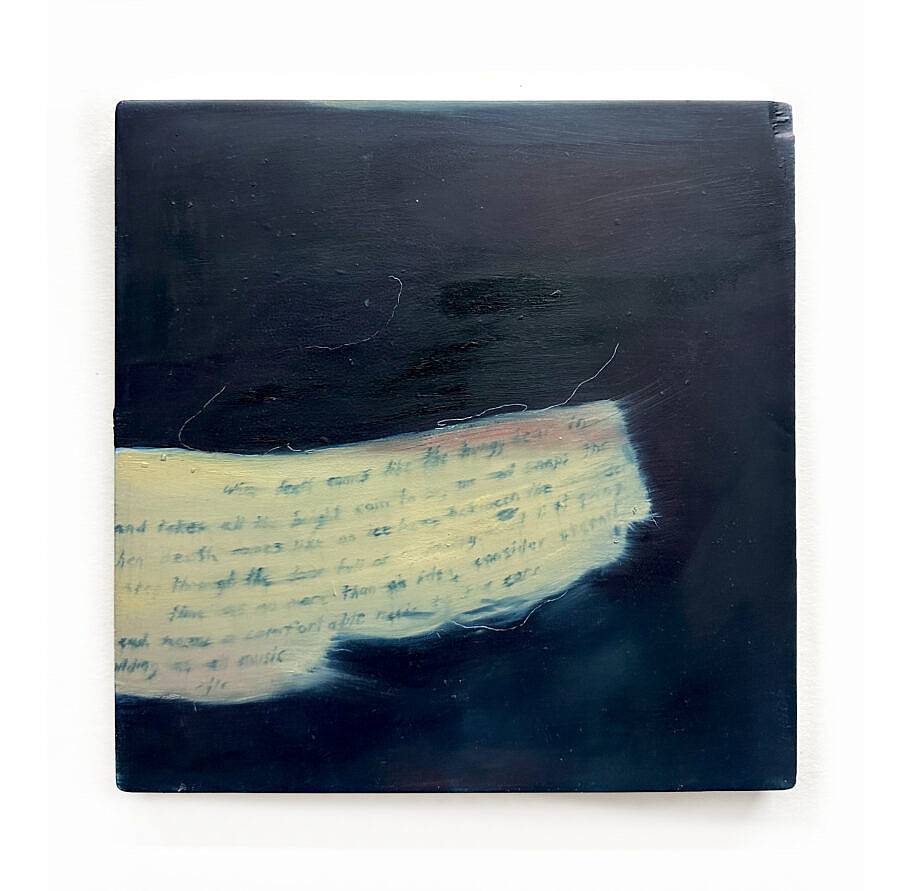
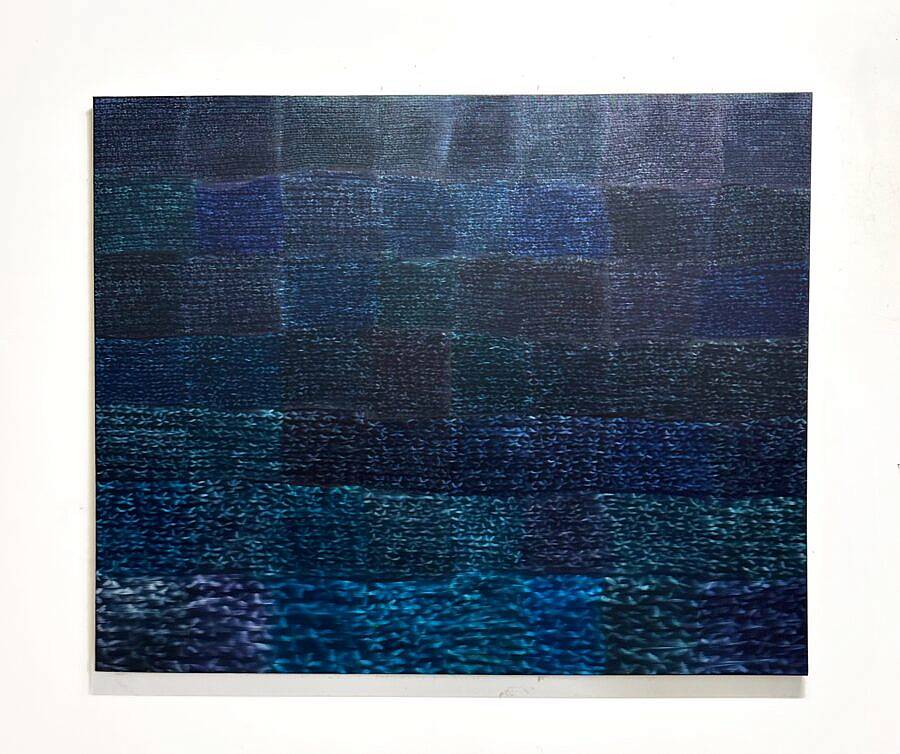
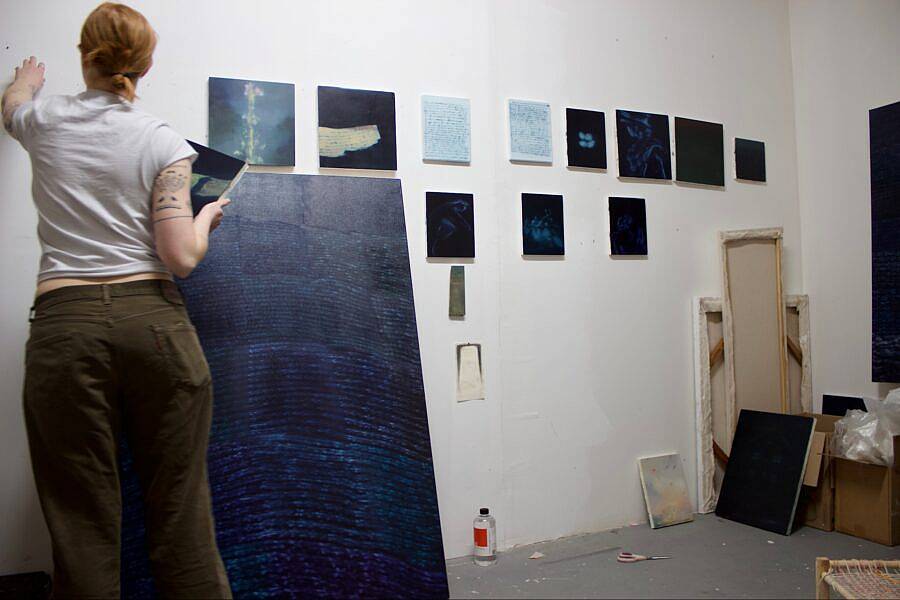
The big paintings are really just an accumulation of many small paintings, at least for now. Most of the small paintings I finish in a day, and the surface dries as a unified, slick glimpse of something. I care a lot about the surface quality of each painting, and was thinking of how to achieve this same feeling on a larger scale. The solution ended up being this patchwork of small painting sessions getting layered and brushed into each other. The small paintings capture one moment, and the large ones become an accumulation of these moments. Maybe a map of them over a larger span of time and space. I feel like I’m still figuring out my language at this scale, and that is what’s exciting to me. I find it best when I don’t know what a painting is gonna look like at the onset, ‘cause it keeps me engaged in the unfolding of the image.
What was the last show you saw that stuck out to you?
The First Homosexuals at Wrightwood 659 made me teary eyed. So many subtle and tender and fierce relics of queer life. Plus, there was a stunning photograph of Virginia Woolf. It prompted me to look up “Virginia Woolf lesbian?” and recall that often overlooked part of her identity. I coulda kissed her cheek on that beautiful silvery surface if they wouldn’t have kicked me out!
Do you have any opinions on the amount of work being produced by artists in this current climate?
Maybe a lot of work is being made now in comparison to other times in history. I wonder. Perhaps we are in a big ocean of work with its own Great Pacific Garbage Patch. It’s not for me to decide what’s in the patch, or what is a whale, or what is a bubble rising to the surface. All I know is, I’m happy the ocean is big and that there’s a lot of unknown for me to explore.
What is one of the bigger challenges you and/or other artists are struggling with these days and how do you see it developing?
Paying rent and feeling original. This has been the case for a while, I think. The rent part isn’t developing in our favor and originality’s trajectory is hard to gauge. My own struggle with originality has landed on an acceptance that, as Audrey Lorde says in Poetry Is Not A Luxury “…there are no new ideas. Only new ways of making them felt.”
Do you think collaboration is important and/or inherent to being an artist?
Yes. That being said, please do not talk to me when I’m trying to paint.
Can you tell us a memory of someone interacting with your work that frequently crosses your mind?
I recently was in a group show at Bodock, where the work was viewed in the dark with flashlights. People were really active in their viewing, using the spotlights to trace the whole surface of each piece. It seemed to be an engaging way to view my darker paintings, and it was very gratifying seeing people treat the painting like an artifact to be inspected. Everyone was looking at different angles and distances to discover the nuances of the surface, which is a response I’m often hopeful for!

Interview conducted and edited by Liam Owings