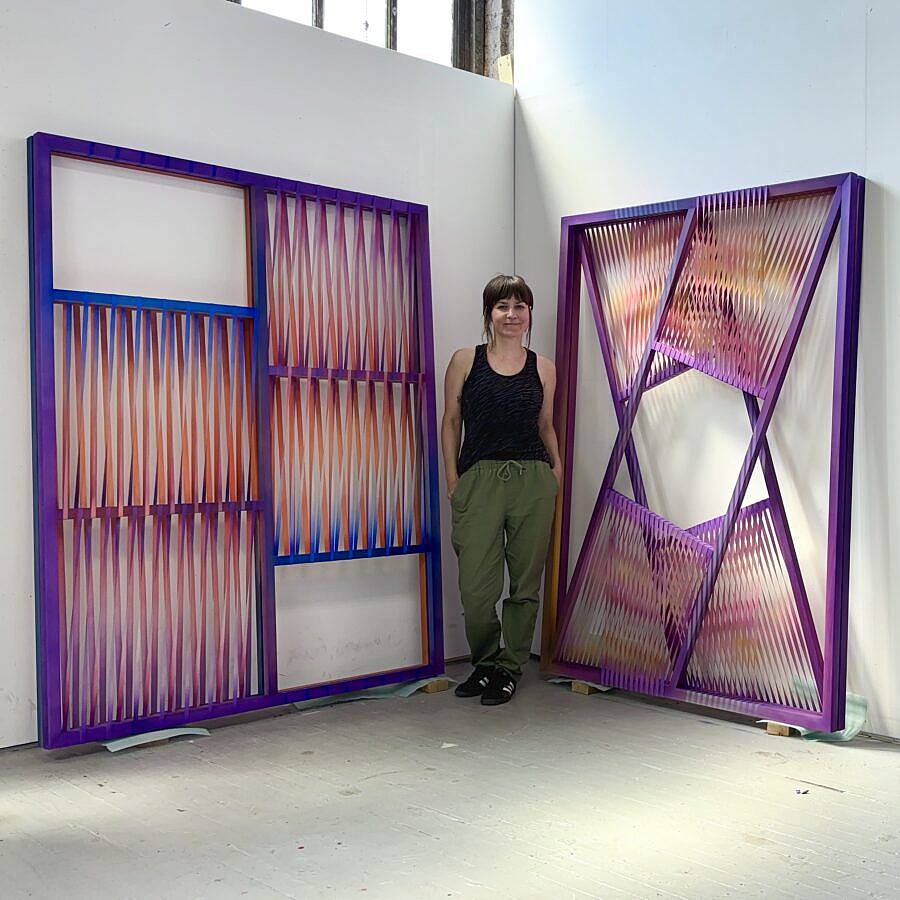
Tell us a little bit about yourself and what you do.
I grew up in the Upper Great Plains region of the US, a part of the country I’ve always had a complex relationship with. More recently, I have been able to credit the landscape and atmosphere of my early years spent on the plains with my fascination with observing shifts of light and color. I would watch the open sky and it was a way for me to document and actually ‘see’ time pass. The sky was like watching a clock tick or a sundial slowly bend a cast shadow around. These experiences were early markers of my relationship with color, and seeing that color didn’t have bounds. In the sky, color didn’t end or begin, it just kept shifting. The sky, refraction of light, and atmosphere are important avenues of curiosity for me and inform the artwork that I make. I regularly use textiles, wood, paint, dye, and photographic processes. The process of creating my work hold just as much meaning to me as the resulting object/experience. The process is how I learn about the questions that provoke the work.
I have a specific, yet broad, line of questioning that anchors most of the questions I ask of the world when I am developing my work. An influential question involves how we as humans have developed tools, mechanisms, and processes to visualize or ‘see’ something we can understand as a theory or hard fact, yet it escapes our vision. How do we then devise a way to ‘see’ this thing? This fascination of mine started a very long time ago, but some early examples I can share involve the history of photography and imaging processes, including the use of x-rays and magnetic fields to ‘see’ inside the body (X-Ray, MRI imaging, etc.). Recently, I was at the eye doctor and allowed extra time to spend viewing the images of each of my optic nerves, documented through an image to assess the health of my retinas. To see an image of each optic nerve, this incredibly tiny structure that is in a sense my biological camera, was a truly existential experience. These are the things that really shake me and inform the paintings, sculptures, and installations I make. I am endlessly curious about color, perception, abstraction, and materials.
Who do you think is making important work right now?
I very recently visited “Dyani White Hawk: Love Language” at Walker Art Center in Minneapolis. I’ve been following Dyani’s work for many years for many reasons. I first saw Dyani’s work in person in Pine Ridge Reservation in South Dakota when I was an Artist in Residence at Badlands National Park. I was raised in South Dakota and spent most of my 20s in Minnesota, so I have a very intimate connection to her work.
Dyani’s work is invested in many shared aspects of my own and I value how she presents her work. Her firm engagement with abstraction is pulled from lived experience, cultural history, and vernacular and domestic forms of making. An important, clear assertion is that abstraction has existed for so long and certainly pre-dates any modernist European ‘invention’ of abstraction, especially within painting.
She brings a strong challenge to this idea that abstraction was a European, modern invention/innovation, which is something that has always really aggravated me. I studied art history as a young art student, and even the discipline of art history, as a pretty young field, at times felt problematic in ways that were really productive challenges to me as a young artist and thinker and I continue to question structures and institutions within artistic production and how its stories are told in the present, and from a historical angle.
I also value the visibility of Dyani’s collaborators and her recognition of the labor of others for the work to be realized. This aspect of art production is embedded in the content and meaning of the work. It also is an aspect of artistic production that has been opaque in various ways throughout history and yet still in contemporary art. As a maker/builder-type of artist who has also worked within fabrication as a laborer, I really respect this visibility from other artists.
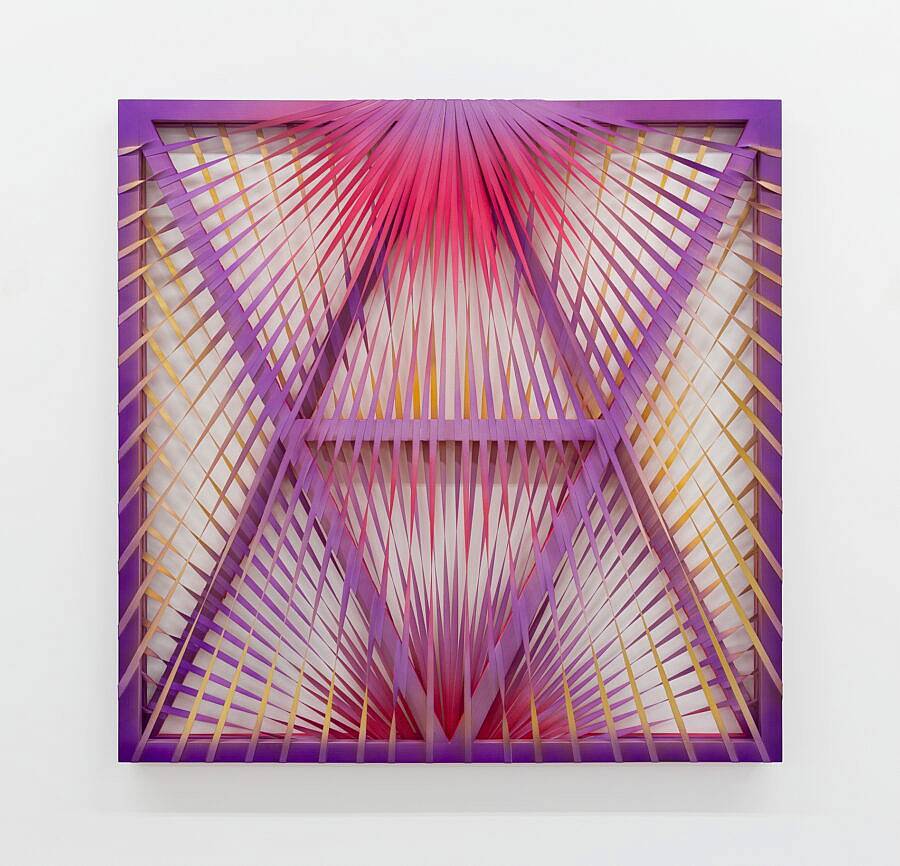
How were you introduced to the mediums that you work with?
I have been using paint and fabric in various ways since I was a child and have always had a close relationship with materials and tools. I am from a family of makers and began learning different processes, skills, handiwork, and craft-associated techniques at a young age.
These acts of making, as a young child and person, continued developing into artistic methods as I became older. I love to work with my hands and this is very important to me.
Paintings are made of textiles, the canvas, so I always consider how can I think about and use canvas in ways to acknowledge what it is as a material (and a very strong one; it was historically used to make ship sails) compared to only considering it as a surface of which to apply paint onto. This acknowledgement allowed me to manipulate canvas as a very physical material, and then things got really exciting and perceptually/conceptually shifty.
I began using textiles increasingly more when I lived in Doha, Qatar over a year-long fellowship. I began using translucent textiles as a method to mix color via layering translucent physical materials. I was seeing translucent fabrics everywhere and it was a logical move to make. The city was in transition, covered in architectural scrim, and I was seeing the sunsets through a filter of the finest sand suspended in the air. Translucent layers were everywhere, and I began experimenting with them in the studio to make paintings and site-responsive installations both indoors and outdoors.
The wooden stretcher/strainer that creates tension across a stretched canvas is the basis of most paintings, and years ago also became full of potential for me. As a student, I started getting really interested in building the stretcher and found the process to be enjoyable, like a nice challenge, and a bit more linear of a process for me than ‘how do I make a painting’ which is a real can of productive worms! Later, this led me to learning more about woodworking techniques and these skill-based questions are going to be with me the rest of my life. I find endless potential in developing my skillset in woodworking. Wood as a material is very fascinating. It is of the world, it is porous, it is flexible, and it is strong. It holds tension and creates it. I quite admire it.
What influences do you think play an essential role in your work?
Oh, so many things. I will begin by breaking into two topics: humans and non-humans.
With humans, I am always learning from makers, thinkers, and curiosity-seekers.
I learn from scientists who research and study questions about vision/perception, the Earth’s atmosphere, and the physics of light and how it behaves. I learn from the scientists who used tessellated shapes out of reflective materials to make the Webb Telescope, and I learn from my grandmother who uses tessellated shapes of cotton fabric and thread to make quilts that she will give to others so that their bodies will hold heat and comfort. I am influenced by woodworkers who pair a learned understanding of material with a learned knowledge of applied physics. I am influenced by what I call “artist scientists”. These are people who ask questions fueled by curiosity, such as early photography-based artists like László Moholy-Nagy and Étienne-Jules Marey.
As for non-humans, I am influenced by the elusive and the seemingly contradictory combinations of ideas. Waves and their properties (observed in light, sound, and water) offer me visualizations for the movement and transfer of energy that at times my eyes aren’t able to see. And then, human vision and its capacity is also at the core of my curiosity and influence. I am not capable of seeing so many things that I understand to exist. It’s amazing. These are very important questions and ideas that influence my thinking and my work.
I am also influenced by patience and acknowledging the passage of time and how this has been marked at different points in history. Over the past several years I’ve researched the design, history, function, and visual aspects of sundials, which has been a key source of influence, along with periods of study and practice of analog and camera-less photography to document and suspend time.
More recently I have been naming ecology and a more expansive understanding of ‘ecologies’ because I understand there really is no silo-ing or isolation. To be alive is to exist within sets of relationships, regardless of our individual understanding or awareness of them. I was able to name this specifically when reading a new book on plant intelligence and the ideas and research presented in the book were very transferrable and are helping me gain more awareness of interconnectedness.
I am very interested in sensory experiences, and vision has been a focus for many years. How we see, perceive, engage, and interpret are so interesting and expansive to me.
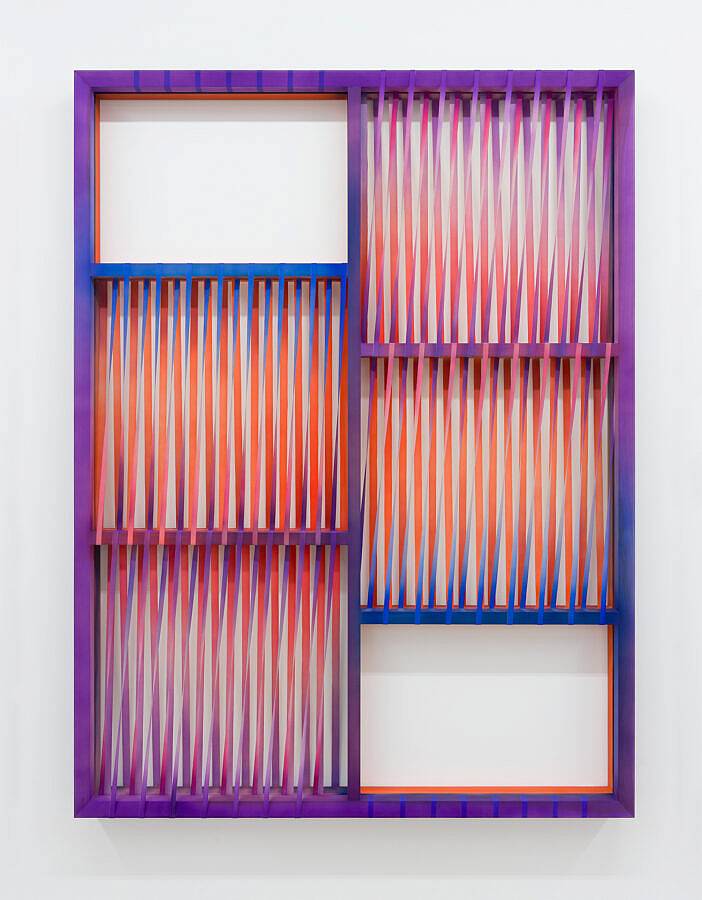
Do you consider collaboration an essential aspect of creating?
For me, absolutely. I think of collaboration along similar terms as building communities and sharing support, knowledge, skills, and resources. When I was a student, I tried to learn everything I could so that I could be self-sufficient. I learned how to build, how to light and photograph my paintings, and taught myself many processes that I wanted and needed to use to function as an artist. I had to do this so that I could function and keep making my work. My friends were doing similar things (teaching themselves skills/acquiring material knowledge) and we were able to share skills and barter favors. I really value collaboration.
I continue to find opportunities to share support and knowledge in an expansive way to learn, develop, work, and live. One of the most important things I have realized, that being an artist allows me to do, is learn about whatever I want. I thrive from learning from others, whether they are other artists, musicians, physicists, my family.. I’m trying to always learn.
When I was a student, I spent a lot of time in the printmaking studio. Printmakers helped me see the value in sharing space, time, hands, labor, and ideas.
Can you speak on your experimentation with form?
Experimentation is at the core of what I do and why I do it. I want to make something I haven’t seen before, and I want to make something I can predict in a sense but that truly escapes me in visualizing the form it takes when I call it ‘done’.
I think of my work and processes as analogous to a scientific experiment, where there are a set of questions we/I simply do not know the answers to. That is the whole point of the experiment- to let a series of actions play out in order to see what the result is. That is what artmaking is for me. I don’t know what the experiment is going to result in, and this is a huge space of learning. Process and experimentation have always been really important to me, and as a young art student, I learned a lot from the post-minimalist artists using soft materials, form, and positioning themselves via a feminist lens. These are works that age, expand, deteriorate, and shift. The instability and experimentation with materials was very generative for me to learn about.
I’m always asking myself: What can a painting be, in its form?
It can become a sculpture, as it is dimensional, it is an object. It can align with woodworking, since its main structural support is made of wood that must hold structural integrity. Speaking of structural integrity, a general understanding of applied physics will be needed so the thing doesn’t collapse on itself. Then there is the paint, which is chemistry when working with it as a material. Then, vision and perception are implicated since we can see the colors. This is a fraction of how I think about making paintings and the other artworks I make. It is an endless line of questioning, and I really love that.
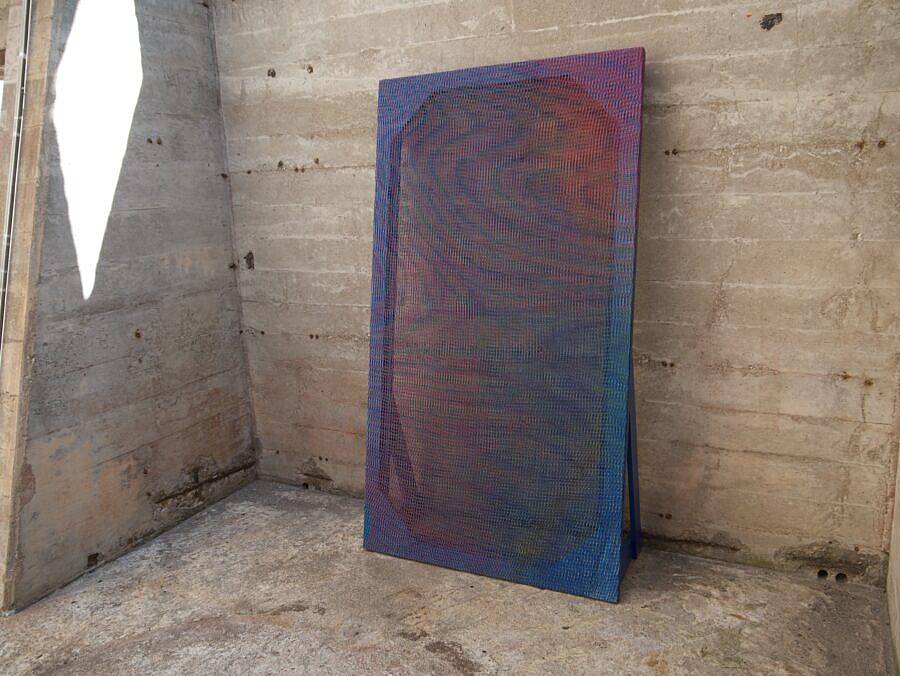
How important is the history of fibers in your work?
These histories, materials, and people are very important to me. We are surrounded by textiles, fibers, and related materials. We wear them, they protect us when sleeping and in weather, they exist on our skin, and they comfort us. For generations beyond my knowledge even, my family members have invested their time and skill making with fibers. It is really impressive work. I have inherited many of these fibers made by family members over the generations and live with them.
Fibers are also historically from the earth and have been used for their strength along with their capabilities to be flexible and adaptable. From textiles, I’ve learned that flexibility and adaptability are serious strengths, of course in material and building applications, and also to learn better ways for me to live.
Do you think of space and architecture when making your work, or is it more so conceived in its own private setting?
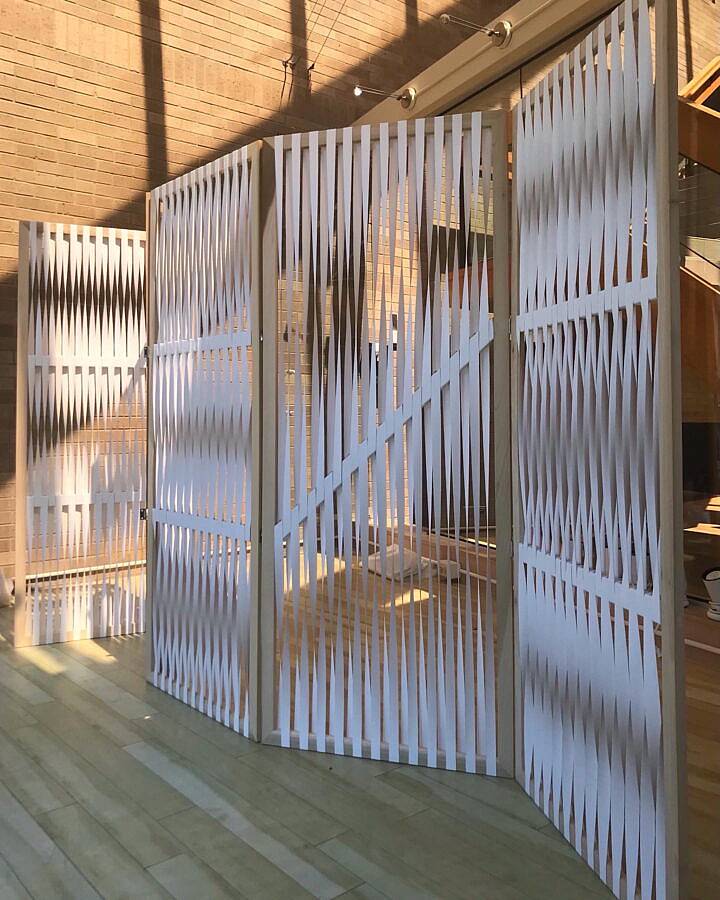
I absolutely consider space and architecture, even when making a painting that hangs on a wall.
I started becoming interested in space and specifically architecture when I began traveling more often, and in particular traveling for the purpose of following my art practice and opportunities. After grad school, I re-located across the world and had an incredibly productive challenge of, ‘how to keep making my art’? I’m always intentionally challenging myself often, and I knew I did not want my existing work to travel with me, to remain in a logical lineage that followed the same lines of questioning where my previous studio was located. I wanted my work to be informed by where it was created. This was how I began establishing site-responsive installation as one of the facets of my work.
Even with the paintings, space and architecture inform the work. I find it to be so exciting. When making paintings, I place them at different locations in the studio, usually surrounding windows and at different times of day. I can then see how the sunlight and the material forms of the painting interact with properties of light. This informs the color application to the work. This might sound like a bit of a stretch, but it’s like an observational painting for me. I create this physical form/object, place it around, observe what it looks like, and then make decisions on how to paint it. Context is everything, and it is how I learn so much.
How do you see your work evolving in parallel to things that are going on around you right now?
To make, to move, to think critically, and share these movements is how I’m able to engage and communicate with others in this world. Since I was a kid, I understood the power and agency behind the act of making a drawing. To be a maker, to be an artist, requires a sensitivity and modes of empathy. These are so fulfilling and so challenging on a daily basis.
Does your environment influence your work?
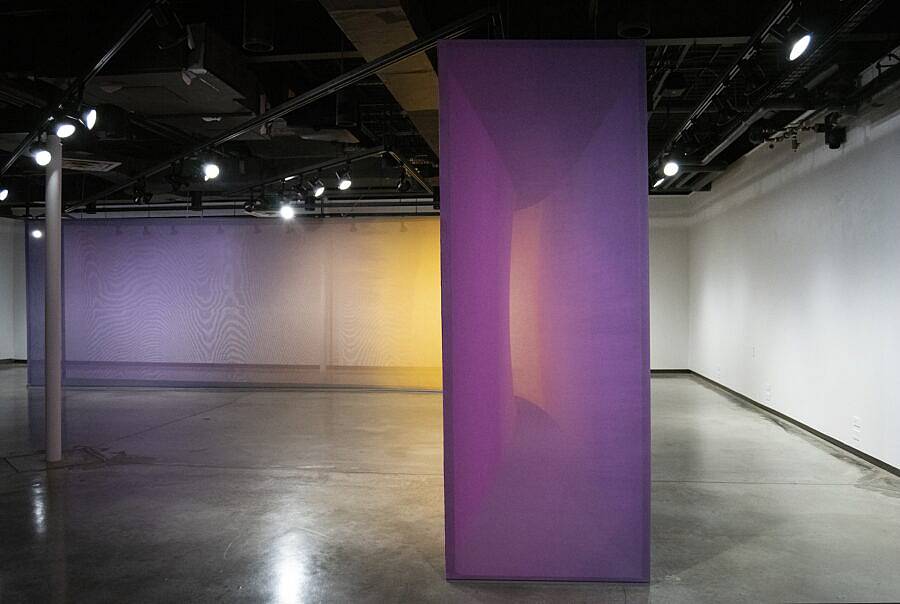
Absolutely, and it depends on my surrounding environment. I make my work to help me better understand my place in it (geographically, spatially, and otherwise). I understand that nothing is actually stable or true or static or complete. Everything shifts, bends, absorbs, exerts, learns from, and is a part of, its environment.
To be alive is to be porous.
Do you think your work takes on different contexts when shown in different areas of the world?
Yes, and I find that so exciting because it is meaningful. This is in line with the previous question, too. The work is not stable, in its physical form and its meaning. Everything is contextual.
What was the last show you saw that stuck out to you?
I just visited “On Loss and Absence: Textiles of Mourning and Survival” at the Art Institute of Chicago recently and was quite moved for a number of reasons. It was exciting to see a show of work from the collection, organized by contemporary artists with such material sensitivities. The works span time and space, which was really moving, all with overarching questions of ‘what it is to be alive’ aligned with questions of how textiles function in very practical and intimate ways that have helped us deal with questions of mortality and existence.
Can you tell us a memory of someone interacting with your work that frequently crosses your mind?
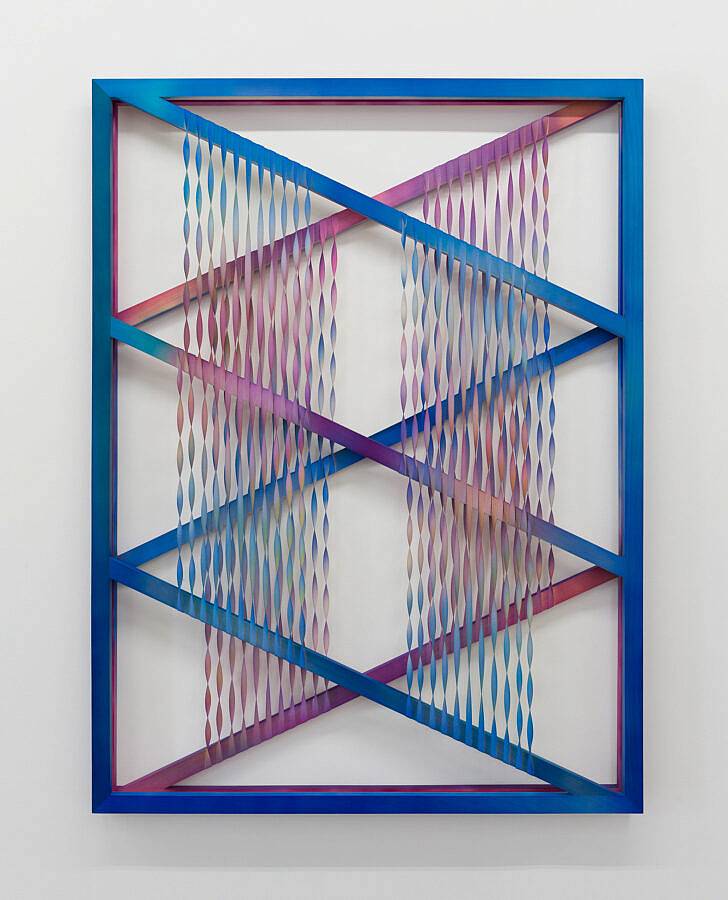
Years ago, I was installing a textile installation within an architectural structure outdoors at an abandoned mental health facility in Minnesota. Historically speaking, it is a very important place within the context of the intersections of wellness and architecture. At the time, the no-longer-functioning location and sites were being used for artist residencies. The day I was installing, a father and daughter came up to me while I was working and watched with curiosity. The young daughter must have been around 5 years old. She took in the work as an experience. She moved around the structure and the fabric and was noticing the shifty light/shadow/color overlaps that were happening thanks to the bright sun cast across us all that afternoon. They stayed with me for a while, looking at the work. They never really asked me “what is this, and what is this about?”. It was so refreshing. One of the many reasons I love to work in non-traditional art-space settings is that there can be a barrier that is removed in terms of accessibility for a viewer and the work. They didn’t even need to name this as “Art”. It was time-based and involved their sensory experiences.
Interview conducted and edited by Liam Owings