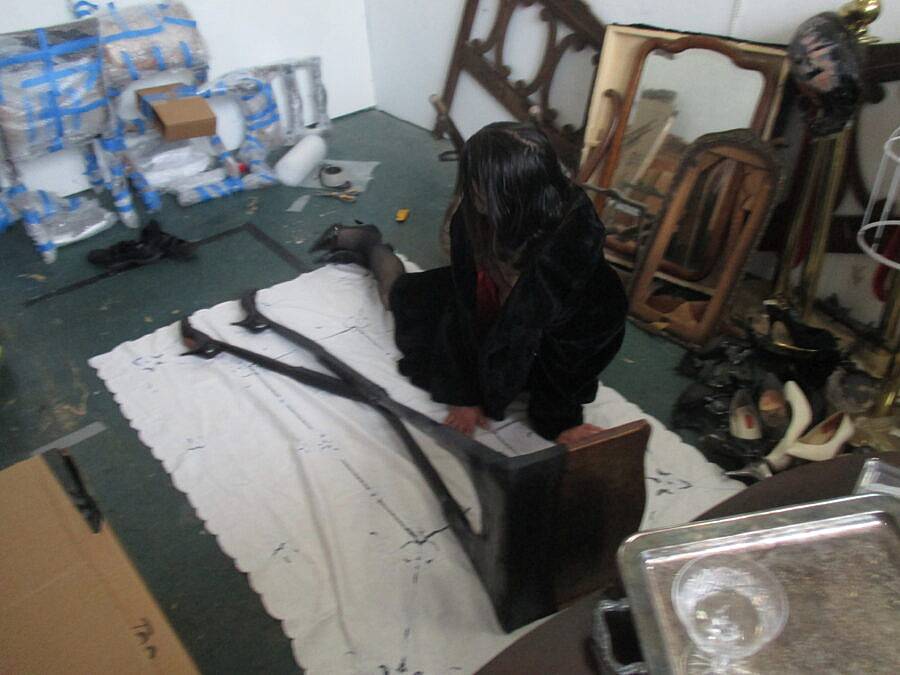
Tell us a bit about who you are and what you do.
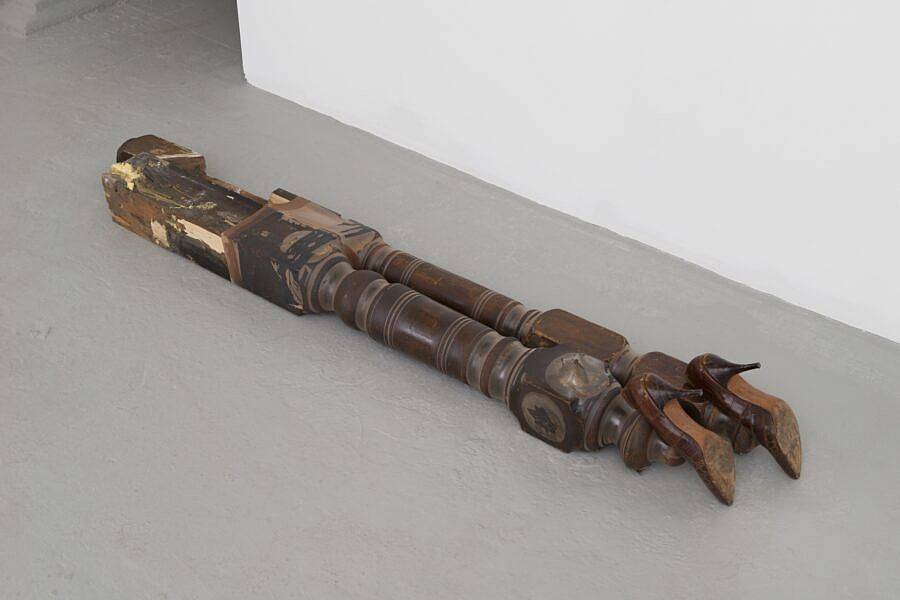
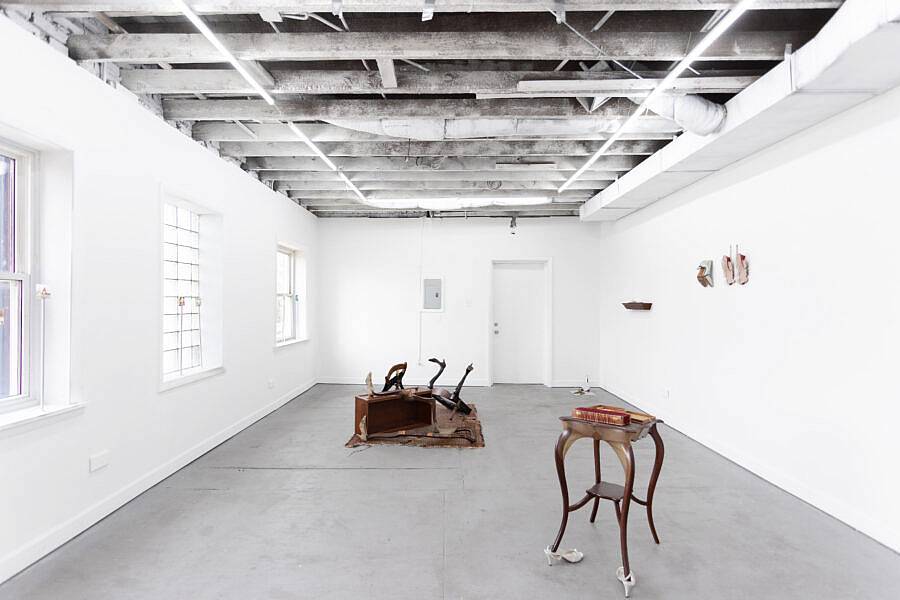
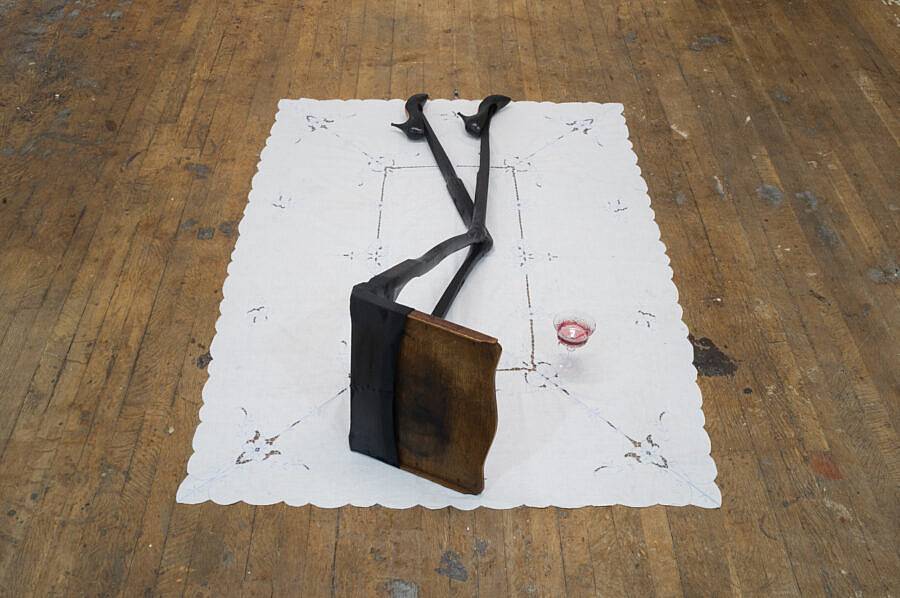
My name is Christopher, and I’m an artist in New York. I make sculptures out of furniture, shoes, and other things I find on auction websites, Craigslist, or the street. Broadly speaking, my work is about the relationship between viewer and art-object, and trying to find ways to reverse that gaze to talk about violence, performance and abjection. I’ve always been really obsessed with representations of beautiful, doomed women (Mulholland Drive, Duchamp’s Étant donnés, Black Swan, Salomé, Courtney Love throwing her compact mirror at Madonna, etc, etc…) and it’s kind of hard for me to say whether my relationship to these images is subversive, or if it’s just reifying the prevailing cultural fascination with gendered violence. I identify with my sculptures, but I’m also responsible for placing them in such precarious situations. The sculptures themselves are obviously meant to depict victims of some sort, but I like to think that, by forcing the viewer to look, I can give the object a little bit of agency, thus victimizing or objectifying the viewer, too. I guess “what I do” is make sculptures to work through these concerns and my own complicated relationship to being seen.
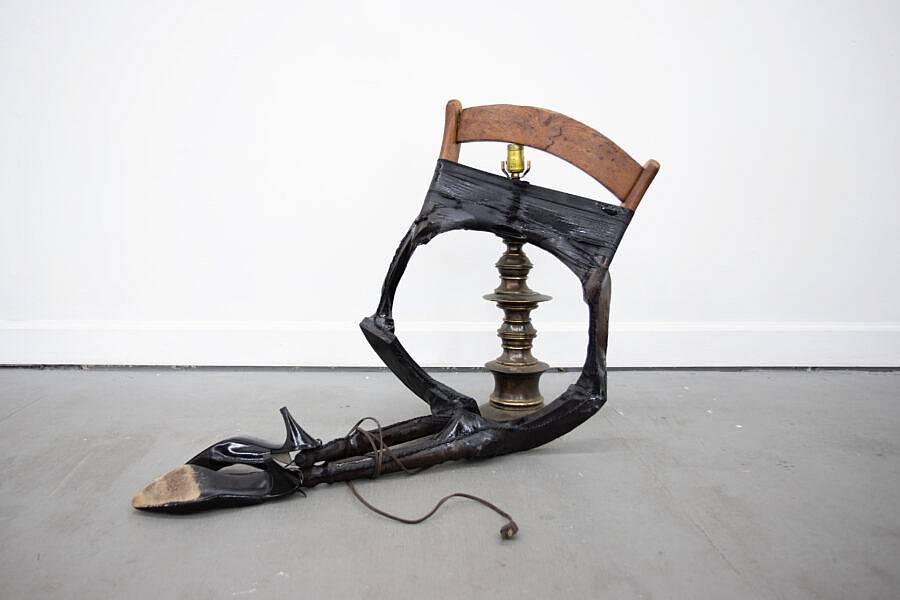
Is there a moment you look back on as being formative to your identity as an artist?
Honestly, watching Lady Gaga perform “Paparazzi” at the 2009 VMAs on TV when I was 12. If you haven’t seen it, it basically culminates in this moment where Gaga is stumbling down this runway at the center of the stage towards the audience while wailing the final chorus, and she starts just gushing blood, and she’s rubbing her hands in it and falling to her knees and making these really insane faces. Then she starts screaming, “No! Please! Stop!” as her backup dancers rig her to a cord, which suspends her above the stage, and she pretends to be dead, dangling over the crowd with blood all over her face as an orchestral outro full of flashing camera sounds plays. It’s so crazy. Gaga, when faced with performing on the biggest stage of her career at that point, stages her own murder. She understands what her function is (as a star, as a performer, as a woman) and gives the audience what we really want, to watch her bleed out. I remember really vividly what it felt like to watch this airing live, and to hear the moment where the audience’s cheers morph into this deep groan when she starts bleeding, then back into thunderous applause by the moment of her death. There’s this feeling that the audience is shocked by bearing witness to a part of their desire that has been repressed, and that being confronted with that desire is also an act of violence in itself. I’ve returned to this performance pretty constantly since it happened because it kind of fundamentally altered my brain chemistry. I think it planted the seeds of a lot of the concerns that have continued to haunt my life and practice since, like the ability of the performer or art-object to reflect violence by depicting it, and also that dying is kind of the most glamorous thing you can do.
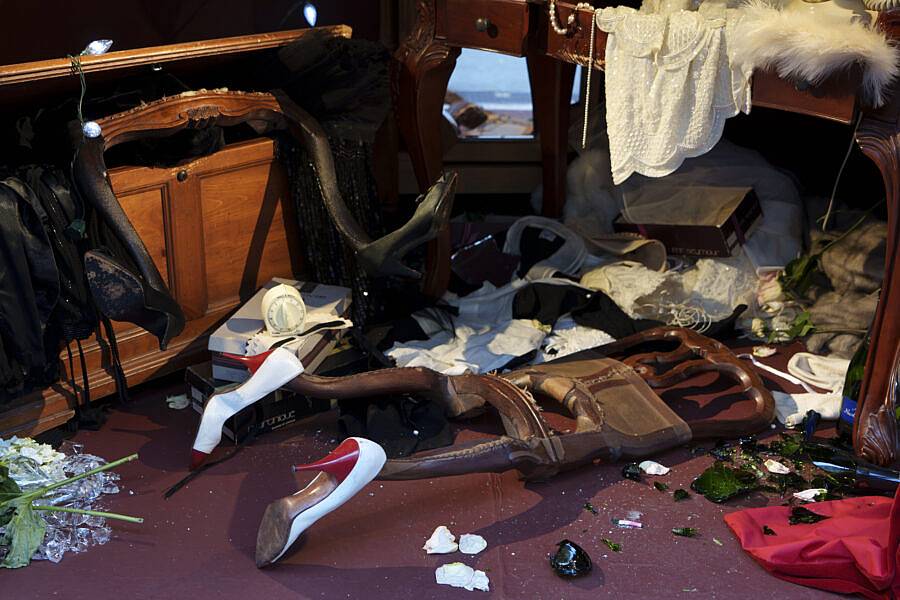
What influences play a central role in your work?
Hans Bellmer’s Poupée photographs have had a really big influence on the work that I make. I’m very moved by the mutability of the figures’ bodies, and how unclear it is whether they are being re-constructed or de-constructed. I think my favorite thing about those images, though, is that a lot of them are positioned within this kind of quotidian domestic space, and framed in such a way that brings attention to the camera, or to the person behind the camera – there’s the implication of the visible object being observed by the invisible subject, whose hand is directly involved in the image’s composition. All of the elements of the image become loaded with narrative information and it creates this impression that what you’re seeing isn’t even necessarily an artwork, it could just be a record or a document. This has really informed the ways that I think and speak about the idea of “Christopher Gambino” and its relationship to the work that I make, and my feelings about ephemera. Other artists who have influenced me include Pierre Molinier, Bob Fosse, Doris Salcedo, Senga Nengudi, Jean Genet, Mike Kelley, and Greer Lankton.
Do you begin a piece with a mental image, a composition plan, a mood, atmosphere, or a state of mind that you want to evoke?
No. I usually start with a chair.
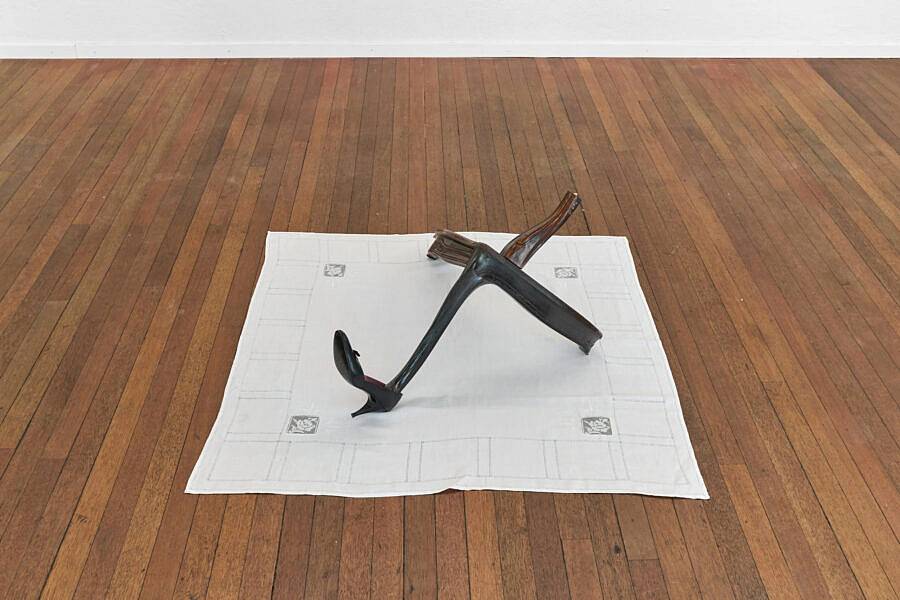
What is your studio or workspace like? (Feel free to share images!) Do you have rituals to settle into the space?
My studio is so fucked up. I work with found objects and collect really indiscriminately, so there’s just stuff everywhere. I’m also kind of bird-brained so I forget things exist if I can’t see them, so there are just, like, shoes and hand mirrors and broken furniture all over the floor. My studio is in a truly decrepit former office building under a highway and next to a famously cancerous creek in Brooklyn. Earlier today, I was packing a piece and literally the biggest spider I’ve ever seen in my life crawled out of the box. I kind of like it though. I think it makes sense that I make my work in Silent Hill, basically. Lately, when I get to the studio, I’ve been putting on this one pair of black faux crocodile pumps to try to get in character. I just kind of feel like there’s a power imbalance between me and the work if I’m in a flat. By the time this interview gets published, though, I’ll probably be moving into my new studio at a certain MFA program in New England, so you’ll have to ask me this again in a couple of months now that I’m institutionally validated.

What do you listen to when you’re in your studio?
Showtunes…
The human form that is present in your work is (almost) always femme. Tell us about what drew you towards this form initially; has your relationship to it shifted through your career?
Boy stuff is literally none of my business. Like honestly, it would be so weird if I were making really butch work. The experience I’m making work about is ultimately a response to my own identification with and attraction to these images and archetypes, and (I think) a pretty quintessentially feminine relationship to visibility. But also, is the form necessarily “femme?” Like, is she “femme,” or is she just in a heel? Is MY form “femme,” by that metric? That’s not rhetorical, please sound off in the comments about whether you guys think my form is femme or not.
This past winter, I was acting in a short film that a friend of mine was directing. I was playing this teenager who, for various reasons, is in a sexual relationship with her grandfather. It’s a long story and I’m not getting into it right now. Anyway, after running through this one scene where I’m physically underneath the actor playing my grandfather, the director was like, “That was good, but do you think you could be even more pathetic?” And I was like, “Um, yes?” So we just kept doing takes of this scene that are increasingly infantilising and humiliating while there are multiple giant cameras pointed at me and I can see this big image of my face on this monitor in the corner while I’m literally pretending to have sex with my grandfather. It was so psychologically damaging but also weirdly affirming: the knowledge that there was now this un-expungable record of me doing something insanely depraved but also looking extremely gorgeous – entering this canon of feminine abjection that I’m so indebted to. I’m no Isabelle Adjani, but I think my performance was pretty compelling. I realized after take one million of that scene that this is like, kind of exactly what I’m making work about: the performance of femininity, the performance of victimhood, the tension between subject and object, and the irresistible allure of total self-annihilation. I felt like one of my sculptures, trapped in this infinitely looping denouement, and becoming increasingly aware of the distance between my actual body and its image, and the tension between my body and the way it is perceived, being directed by people with power over me to be more broken and more perverted while they watched.
Anyway, I feel like the form is femme because, like, duh?
Who are the artists/creatives/musicians that you have been inspired by lately?
I don’t think I’m really inspired by her, but I want it on record that I am recently obsessed with Ethel Cain and I need to get in touch. If anyone has Ethel Cain’s email address, please let me know.
How do you see your work evolving in parallel to things that are going on around you right now?
My work is dictated by the kinds of materials I have access to, so there’s an element of it that is a pretty direct response to my immediate environment. I’m working with materials that have been thrown away or broken, or have, for whatever reason, failed to retain their value as commodities or their practical functions. I’m really just picking off crumbs from estate sales after people’s grandparents die, and people’s grandparents seemed to really love those weird anachronistic neo-Victorian and Regency revival slop styles, mostly from the 50s-80s. I actually started working with furniture in the first place because I felt really drawn to the haunting quality of the slippages in time that are present in these objects, and the uncanniness and essential failure of this source material has been a big part of how I conceive of and speak about my work. It’s not lost on me that this is a very finite resource, and that, with the next generation of dead grandparents, a new set of styles, codes and markers will become associated with old people trash instead. My sculpture practice is relatively young, so I don’t know what it will look like when the materials I have access to shift, or what social, economic and cultural influences will be present in the materials for me to respond to at that point. I was joking a while ago that, in like 50 years, all of my work will be made out of fake Mid-Century modern from Wayfair.
Are there any areas, techniques, or materials that you’re interested in exploring further in your work?
One of these days I will finally figure out how to use a drill.
Could you share some recent, current, or upcoming projects you’re working on?
I have a duo show with my friend and frequent collaborator, Marie Segolene, currently on view at Pangée in Montréal that I’m very excited about. We’ve been researching “victim souls,” which is a concept in Christian mysticism where, within a community, there’s a person who is, for some reason, able to collect and take on the suffering of those around them, physically manifesting the symptoms of various illnesses and injuries, sometimes developing stigmata and experiencing ecstatic visions. Victim souls are almost always women, bed-ridden and infirm, and unable to be functional members of society. When a woman is designated a victim soul, though, her suffering becomes productive: her function in society is now to suffer. I’m very interested in the voyeuristic relationship that these communities have to these women who are often literally on their deathbeds, and in the ultimately theatrical nature that extreme suffering can take on.
What do you collect?
I have a perfume collection. In general, I gravitate towards powdery smells and animalic smells. Lately, I’ve been reaching for Marlou Ambilux (smells like dirty panties), Filigree & Shadow Maggie’s Last Party (smells like a crime scene), and Rogue Perfumery Flos Mortis (smells like tuberose). My favorites in the collection are my vintage bottles of Margiela Lipstick On and Lady Gaga Fame, which were both gifts from my partner, painter Jonathan Leib.
I also collect dolls. My favorite doll is Chemise, who is a Licca-chan I bought on eBay in 2024 who is most certainly ensouled. I take her out with me pretty often, especially if I’m spending the day by myself. I took her to see the Duchamp show at MoMA and she loved it!
Interviewed by Seth Nguyen.