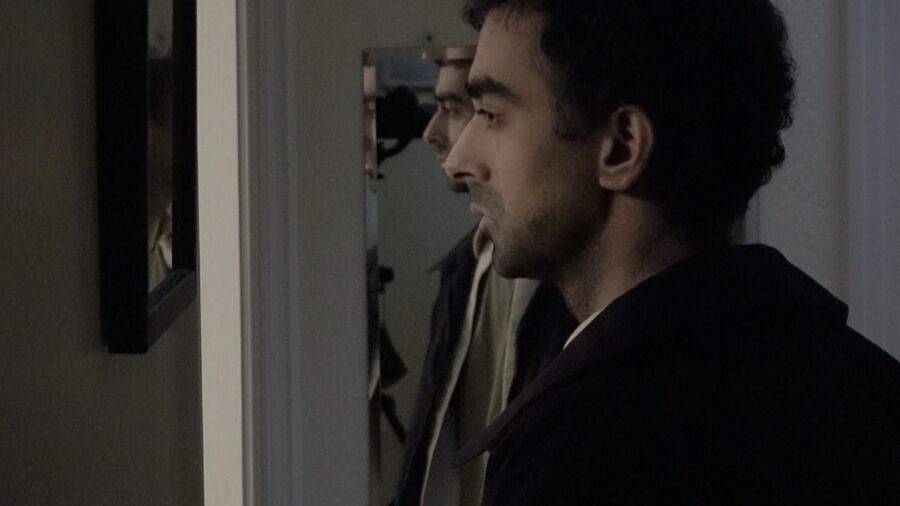
Are there any influences that are core to your work?
I’m constantly thinking about artworks, literature, and films, but to describe them as “influences” evokes a contextualist tendency in how we read artist’s practices, which is not necessarily a bad thing, but it can lead to distorted understandings of how these things work. It might shroud the possibility that being attacked by spontaneous creativity could be a more important determinant of artworks. We don’t have a great vocabulary for that.
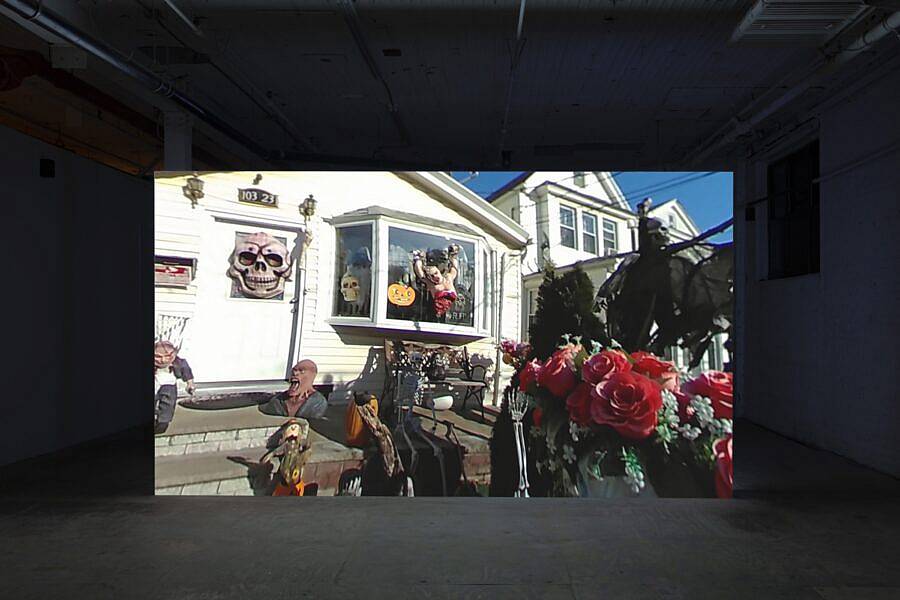
It’s easier to talk about my earlier work, like Mourning in advance (2019), because I knew less when I made it: Ruscha’s Every Building on the Sunset Strip (1966) and Bertolucci’s The Conformist (1970) guided me towards seriality and architecture; Jordan Wolfson’s Raspberry Poser (2011) and Cyprien Gaillard’s Nightlife (2015) informed how I scored the piece; Wolfson’s piece, Zlatko Bourek and Pavao Štalter’s Wiener Blut (2014), and Gregory Kalliche’s Undark (2018) influenced my animation process. Gaillard’s piece and my friend Kamron Hazel’s undergrad thesis were evocative in their use of light; Carissa Rodriguez’ The Maid (2018) probably had something to do with the way I sometimes orbit enigmatic objects; the monkey spirits in the opening of Apichatpong Weerasethakul’s Uncle Boonmee (2010) were a model for using visual effects in more serious art contexts. I should also note my collage sensibility developed through encounters outside fine art, with footwork, rap, and chutney production techniques. Lastly, Mourning marks the petering-out of an identifiable focus on white supremacy, militarism, and digital culture, and foreshadows a turn to broader concerns e.g. life, modernity, and form; however, anyone who’s thought seriously about the former set of “particular” concerns knows how quickly they open up into the latter.
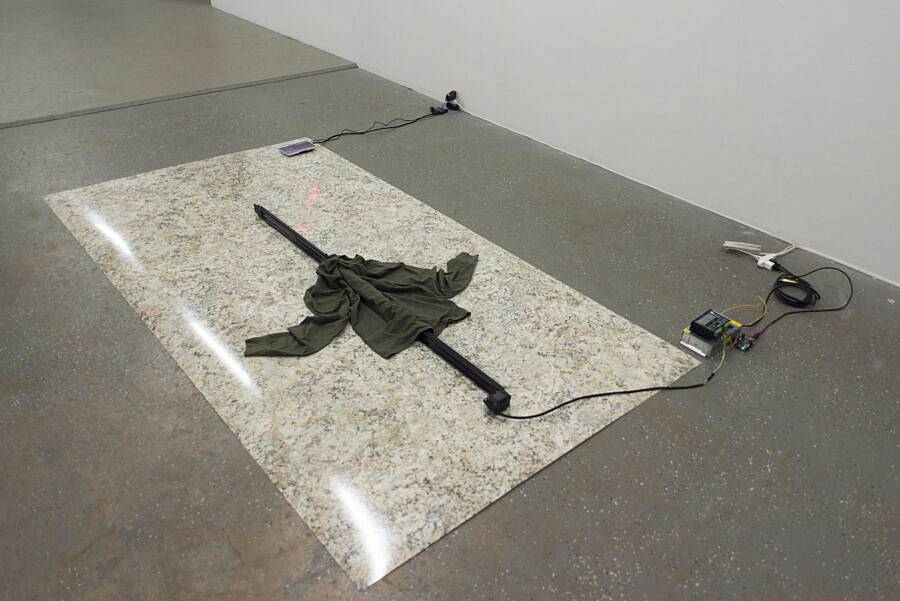
I made Mourning while working on a show with Raza Kazmi, so his film The Animal Has Memory but No Memories (2019) and mine are cousins. I knew I wanted to collaborate with him after I saw his sculpture at the now-closed project space 891 N. Main. The piece was a tee shirt on a single-rail linear motor—it evoked a visceral feeling of having one’s spine slowly compressed, achieving real horror in a few moves.
Mourning is nearly seven years old, and is different from what I do now, but it’s a good starting point in part because it was succeeded by a series of decisions not to do things: I’ve almost entirely phased out the use of appropriated video, and my interest in having the work point directly at “extreme” aspects of culture quickly tapered in part because the referent overshadows the art, although the constitutive character of excessive violence to modernity is still an interest that spans my work in more and less oblique ways, and is at the forefront of my writing.
I almost never use voiceover; I’ve mostly stopped using 3D animation because I’ll never be as good as Jessica Wilson is at it. In drawing, I’ve mostly phased out figuration. And I’ve decided to have the work not be certain things: not research, not documentary, not dreamscape, not postmodern forest of mirrors, etc. There are also zones that the work treads in and out of, like “entertainment.”
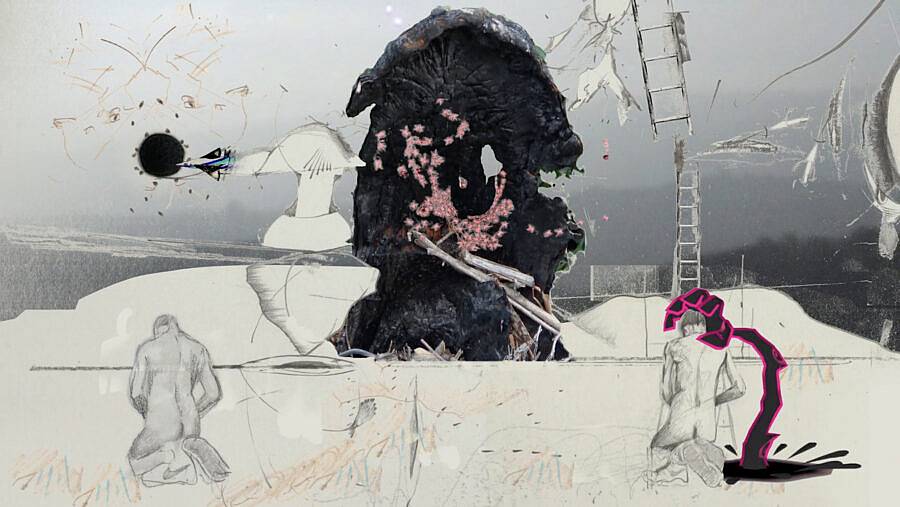
Works that I would consider more “current”—say from the past two and a half years—are the outcome of this process I’ve glossed above. Today, it’s all my own footage, it’s quieted down, it might point outward but not in the manner of references to texts or events. It’s simplified according to the following criteria: I wanted to reduce—or, if possible, remove—everything that didn’t feel like art. So, now I make drawings, and I walk around, without much of a plan, and shoot footage of the world, and then I edit, sequence, animate (sometimes), and score it.
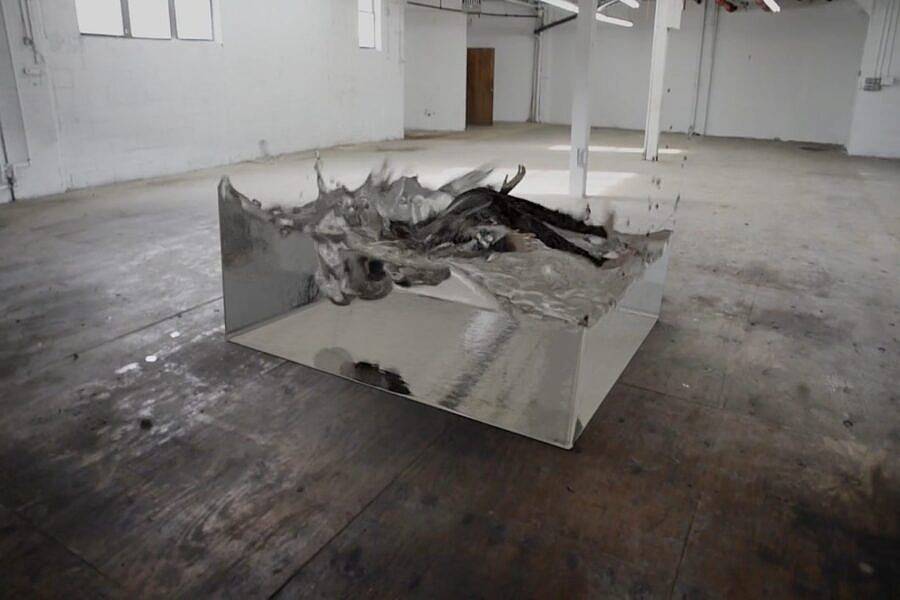
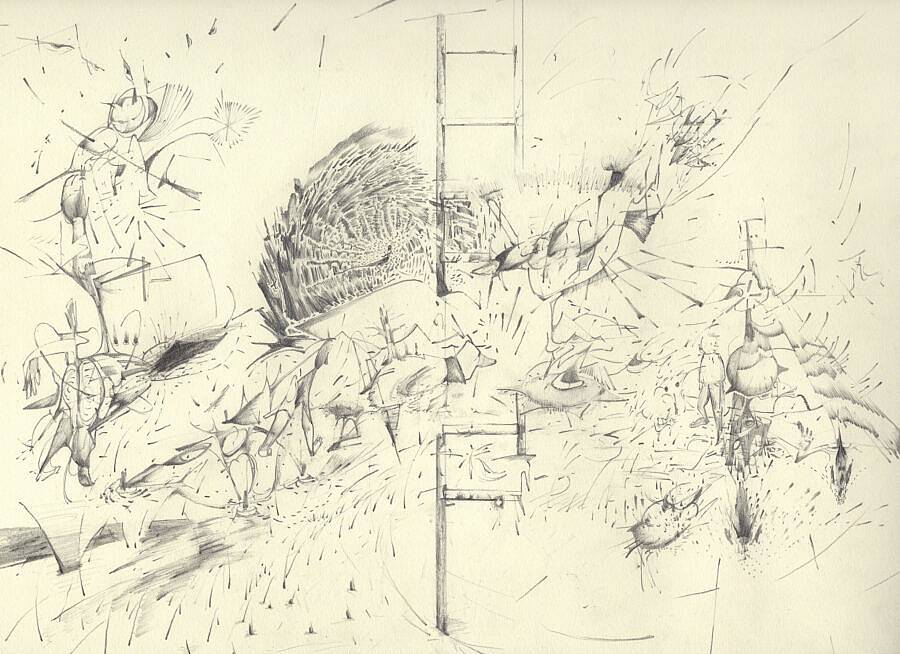
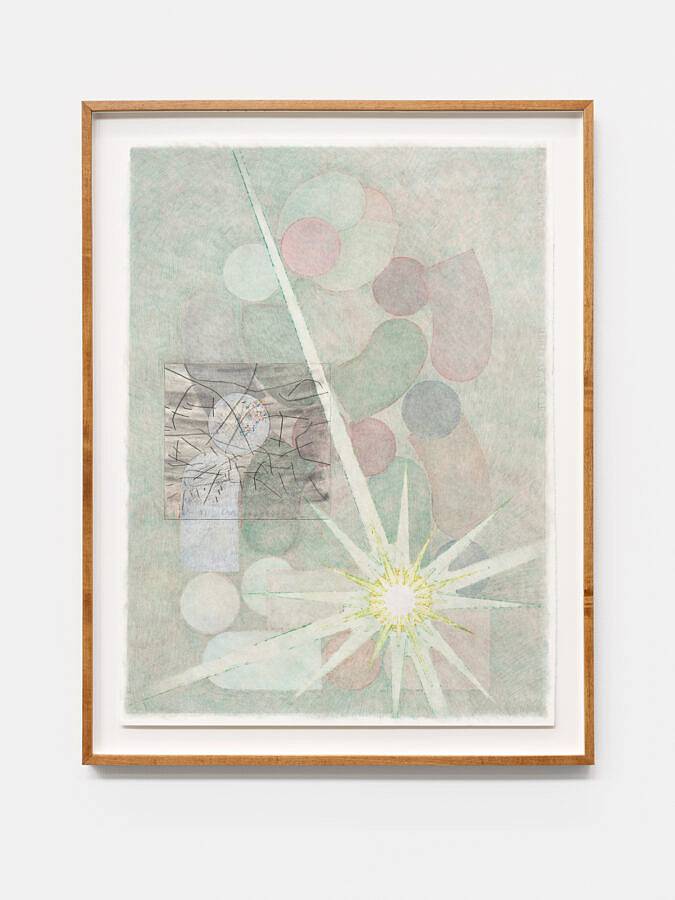
Drawing is a separate track. At first, I looked at Eric Beltz, Mirko Ilić, and SoiL Thornton. I drew the figure and did perspective studies. But my attention was on myself, and my conviction that making a good drawing was almost impossible, so when it did happen, it was a miracle for which I was not responsible, it came from somewhere else, it could not be replicated. The ratio of “failure” to “success” at this time was lopsided; stacks of false starts accumulated in corners of the studio (eventually I started using them in animations because thinking of them as life/time wasted became too painful). Eventually, I began to grasp the capaciousness of drawing by looking at individual works by Gordon Matta-Clark, Acconci, Lee Bontecou, and Paul Thek in Drawing from the Modern: 1975–2005. I started reading essays in monographs: Tuymans, DeFeo, oversized plates from the Ajantha caves—it seemed sensible to look at painting to think about drawing; it never occurred to me to parse out their differences. Now, I look at the Augsburg Book of Miracles, Goya, Cézanne, de Chirico, Reinhardt, Martin, Guston, Whitten, Pettibon—almost an embarrassingly canon list. But only recently have I begun to be able to really see this stuff.
My temperament also articulates itself in the work. Michel Serres introduced me to the idea of volume-versus-payoff with his quip against phenomenology: “Why such high technology, for so little?” It’s a judgment that doesn’t say there’s nothing there, but that what’s there may not be worth our limited amount of time. If I’m ever going to get anywhere, I need to be, to a degree, impatient, discerning, guarded, careful, and “on”—which runs against the notion of a meandering, contemplative journey toward a less alienated state, or whatever notions people have about this kind of work, which may come from a kind of middle-class romantic anticapitalism that permeates ideas about art and life.
How were you introduced to the mediums that you work with?
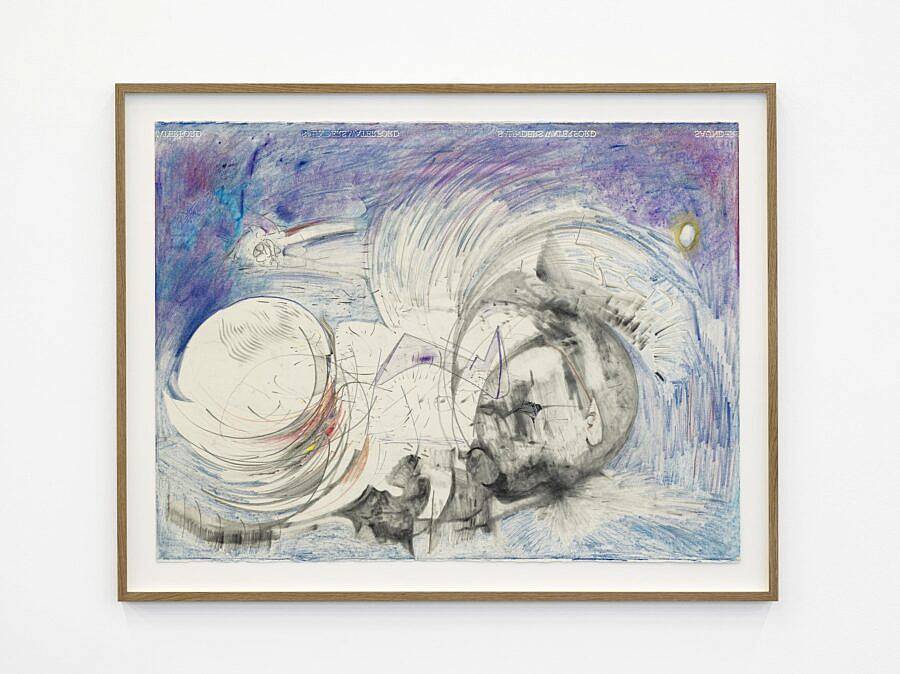
I came to drawing by being thrust, barreling forward into the architecture of graphemes. Scrawling is how we adjudicate and commensurate incommensurable experience—marking is still a twofold act of accounting and threatening. This informs my nascent suspicion that drawing may not be a good thing to do. It’s a counterintuitive position for someone like me to have, but at a certain point, you have to overlook a lot to presume its innocence. Derrida links racism with a “fascination for form.” How many artists would identify with this exact fascination? Almost all of them, I think. This contributes to my objection to the idea that artists can enrich other fields; the artist-to-psychoanalyst pivot has recently been discussed in this way. My endorsement for why society should accommodate art is: So it can’t cause damage elsewhere!
In undergrad, I was nondisciplinary, but I liked sculpture the best, until I did a residency where Michael Jones McKean panned my sculptures so hard I immediately switched to video. The first video I showed in New York was You can’t turn me away (2018). Its positive reception made it clear that this was the best medium for me. My favorite artists at the time were sculptors—Cathy Wilkes, Michael E. Smith, Ajay Kurian—and to a degree I wanted to transpose into video their techniques of concatenating ordinary objects in enigmatic ways through attention to the seams between say, a piece of linen and a mannequin, a laser and a taxidermied bird, or a sock puppet and a paper chain. But instead, I had a media library of songs and found footage, a few cameras, some texts, and much more facility with software than physical material. Video was a basin in which all this could coagulate.
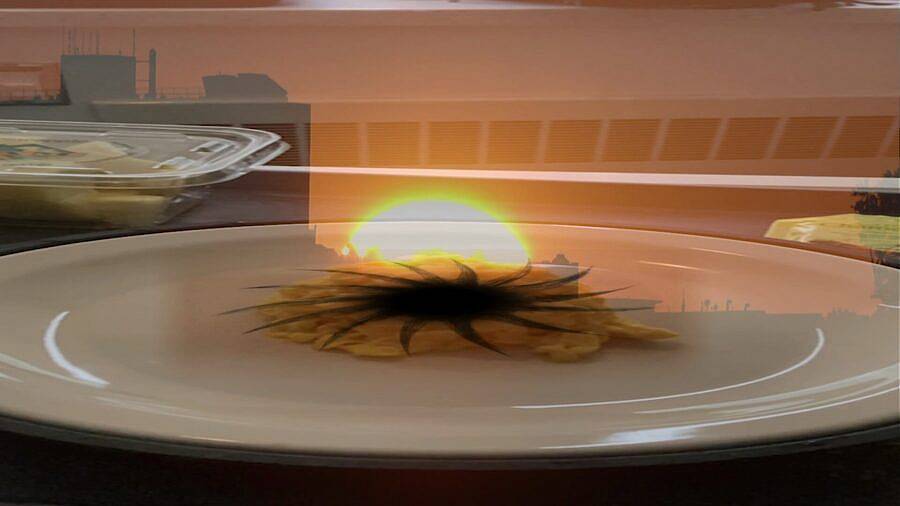
It was easy to leave sculpture behind because I hate thinking about storage, transportation, access to specialized vendors or facilities, and “material tests.” I resist the idea that art means secret recipes developed by special people. There are real issues with the figuration of the artist that lies downstream from practices staked on bespoke material processes that are guarded like intellectual property. I wouldn’t go as far as Benjamin did when he said that this sort of thing leads to “the processing of data in a Fascist sense,” but what I’m saying isn’t unrelated to that comment. One of the first pieces of criticism I ever wrote was about a show of this kind of work, curated by the granddaughter of an Israeli arms magnate, Shlomo Zabludowicz, whose company had, in addition to supplying the IDF, sold to the apartheid regime in South Africa and Pinochet’s junta in the 70s and 80s. Hayden Dunham’s work had an alchemic R&D quality, Ivana Bašić’s gnarled figures looked like corpses, so I read the artworks as expressing the real violence that was the exhibition’s condition of possibility. I was never able to publish it.
Does your work with video influence the way you work with a physical medium?
I’ve outgrown the idea that everything I do should add up to a neat, communicable synthesis. Drawing and video have things in common but they’re obvious. One difference I’ve had to overcome is how when drawing, my cognition is synced up with the activity. A lot of aspects of video are desynced, like waiting for things to render, muscling through frame-by-frame stabilization, learning new software techniques. If you add trying to find money to achieve a certain gloss, the art part is shrinking with every step. Doing away with as much of that as possible has made making videos feel closer to drawing.
Overall, I have reservations about the notion that interdisciplinarity should be sought out and explored in scholarship and exhibitions, and used as a frame for pedagogy. I value disciplinary siloes, both in art and the humanities. So, while I like how my drawings and videos hang together somewhat unreconciled on the wall, I’m thinking about problems specific to each in a relatively bounded manner.
What have you read recently that has influenced what you’ve explored in your practice?
First on my mind are musical compositions: Laetitia Sonami’s collaborations with Melody Sumner Carnahan, collected in Dangerous Women: Early Works 1985-2005. I hope someone asks me for an example of how to begin an artwork so I can direct them to “What Happened.” Whenever it crosses my mind, I have to stop what I’m doing and drop into this landscape and relive a common experience of being betrayed, disintegrating, and then condensing into something malformed, steely, and new.
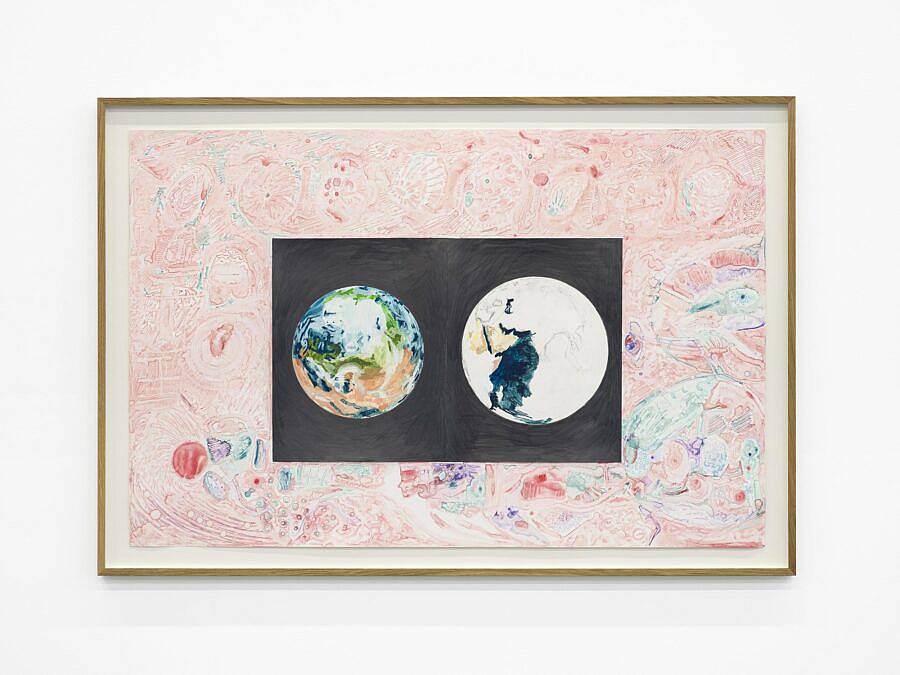
I enjoyed seeing de Chirico’s symbolic inventory transposed in Hebdomeros (1929), and his racial fixations are more transparently presented in his writing than his paintings, for instance, when he describes a black painter positively and seems almost to identify with him. To my knowledge this motif hasn’t really been analyzed other than in a brief aside in a catalogue essay in which it is speculated that bananas and other “exotic” fruits appeared in de Chirico’s paintings in response to the “very strong shock provoked by Italy’s colonial venture.”
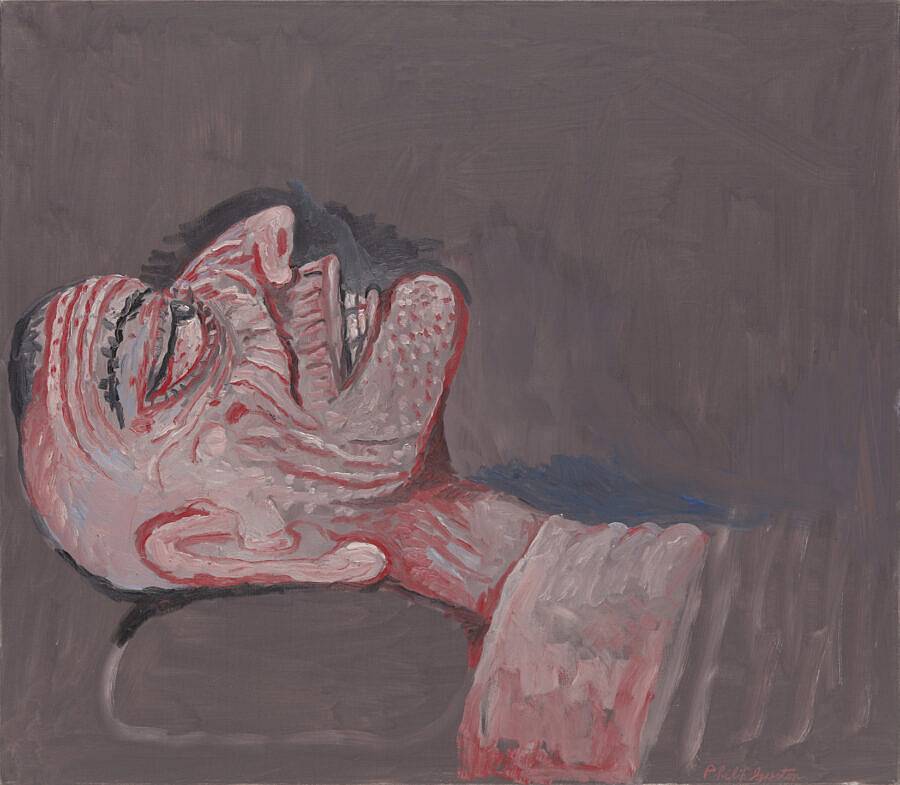
Ross Feld’s Guston in Time (2003), reads late Guston through duration, mortality, and flesh—a heuristic that Feld arrived at after battling lymphoma at twenty-nine. Feld describes Guston eating a fatty beef sandwich right after his first heart attack, and like Feld, I thought, “really? Why?” It may represent a denial of death; however, East Coker-Tse (1979) suggests some comprehension of his proximity to the unknowable threshold. The smear of darker pigment above the figure’s mouth looks like the death rattle. In 1968, Guston described Soutine’s Landscape with House (1934) as ingurgitated: “It’s just a house and trees, but it’s so mysterious and so inner. So inward, you know. It’s as if he ate up the building or squashed the building.” Not only did Guston love to cook and eat, he reached for eating as simile and content—in other words, involved in the operations of reading and making paintings. I can’t know why he bought and ate the sandwich, but in light of that, it feels like a rational decision to remain who he was: a painter, oriented by ideals rather than the fact of fleshy expiration. This is a bit confusing because eating is often thought of as a basal need. He died eating ice cream. Having some sense of what Feld went through—chemotherapy punishes the GI tract (Janice in The Sopranos: “another toothpick”)—he encounters Guston’s masses as his binary opposite. Only a shadow could enter these substantial works, and reveal them to be ephemeral phantoms.
Alice Notley’s molecular motifs in Being Reflected Upon (2024), convey an awareness brought to surface by breast cancer, that one is becoming, has always been, dust—a fact that people instrumentalize for all kinds of purposes; what makes Notley interesting is that she concedes almost nothing to it. Nothing’s cheap, cheapened, or esteemed—which is another way of cheapening something—by it.
In addition to your studio practice, you also teach, lecture, and write criticism. Do these areas of your work intersect with one another or do they live independently of each other?
If I can get students to accept that they won’t really be able to advance unless they’re willing to do more than what is being asked of them, then the humanities is very teachable. Art is more mercurial; the idea of “rigor” in art quickly becomes a fetish. Hard work solves some problems in art but not most. I’ve become agnostic on whether or not it can be taught. It can be taught around, which is what schools do, but the thing itself? One might have to walk that path alone.
Criticism comes with certain responsibilities that art doesn’t have—it needs to make sense, it needs to be logical, and it needs to be in good faith. And criticism should be grounded in basic left-wing principles: it should be opposed to the idea of natural hierarchy, it should demystify and demythologize, and it should be staked in the notion that we have the capacity to use our critical faculties to act in a relatively rational manner to reorganize social forms in order to expand the condition of human dignity at the expense of no group, as much as possible, without hubristically imagining that we can transgress untranscendable ecological limits. (These principles provide a path for criticism; they likely do not lead to or through democracy or secularism and probably skirt around or transcend them).
Plenty of people try to do something like criticism without this grounding; it ends up being something else, maybe commentary, maybe ressentiment with intellectual stylings. If this sounds dogmatic, that’s fine, but a lot of approaches by all kinds of people fit this mold that are not on their face politically motivated. For instance, questions like “what kinds of things are sayable or knowable about a work of art?” or “how have artistic subjectivities been formed?” meet this criteria, because the more general queries that they correspond to are important questions for the left to ask.
Anyway, I can’t hold art to this standard—my whole experience with it has led me to understand it as anarchic—it can be made by anyone for any reason. If it is successful, things like motivation and authorship don’t matter very much. This instability can provoke consternation among various groups, including artists, who would rather exit art and be guests in philosophy or the social sciences, and are often applauded for doing so, particularly by curators and academics.
For me, the tension between art’s guilty strangeness, and criticism’s implicit utopianism (and I mean this in an ordinary way, in the sense that the answer to the question “why bother” is self-evident) is personally propulsive, and maybe this registers a more general propulsive relationship between art and criticism.
How do you manage tending to the variety of responsibilities in the work you do? How do you mitigate burnout or exhaustion?
Art problems are so small that they aren’t problems. I’ve had two high-risk leukemias in two years. The government has divested from medical research and is highly motivated to punish the sick and the poor. It’s a matter of proportion.
Interviewed by Luca Lotruglio.