Tell us a little bit about yourself and what you do.
On the far side of the Moon, there is a crater named Olivier with a 69 km diameter. There was once a French artist named Olivier O. Olivier. On Urban Dictionary, there was a user called “The Real Olivier” who posted on my birthday, saying, “Olivier is a total handsome hunk of a sweetheart and does some rambling here and there with some nihilistic outviews.” There is an Olivier who, according to Wikipedia, was the prince of the archangels. Olivier is also a salad.
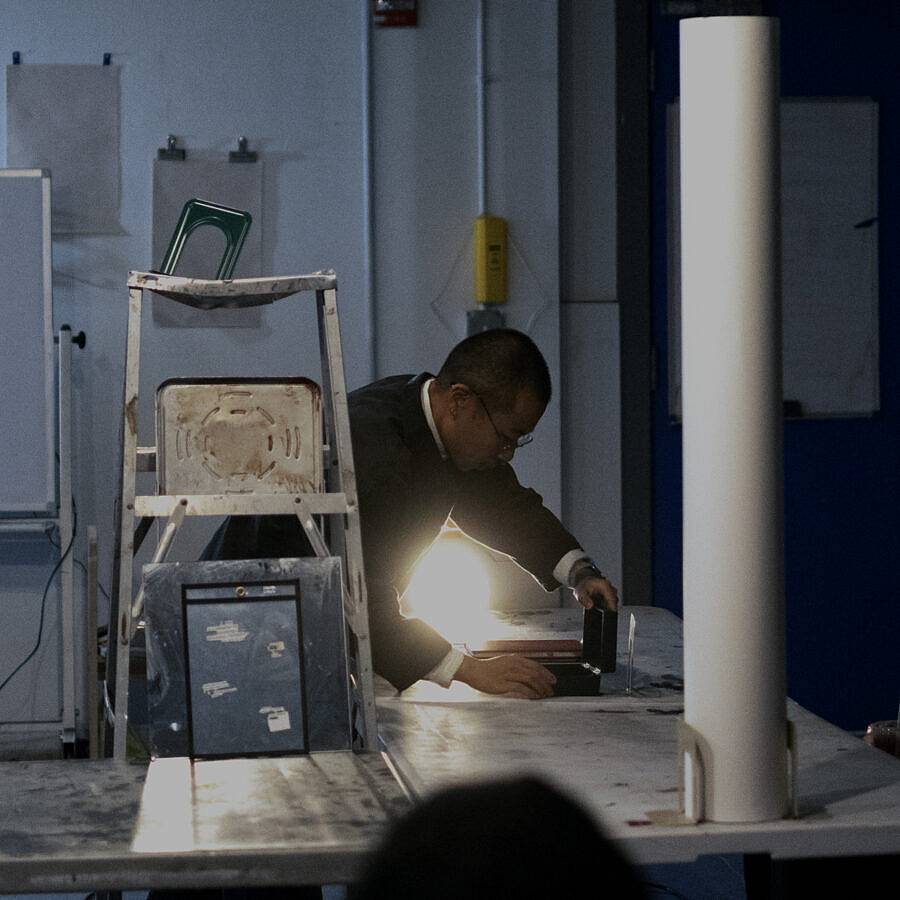
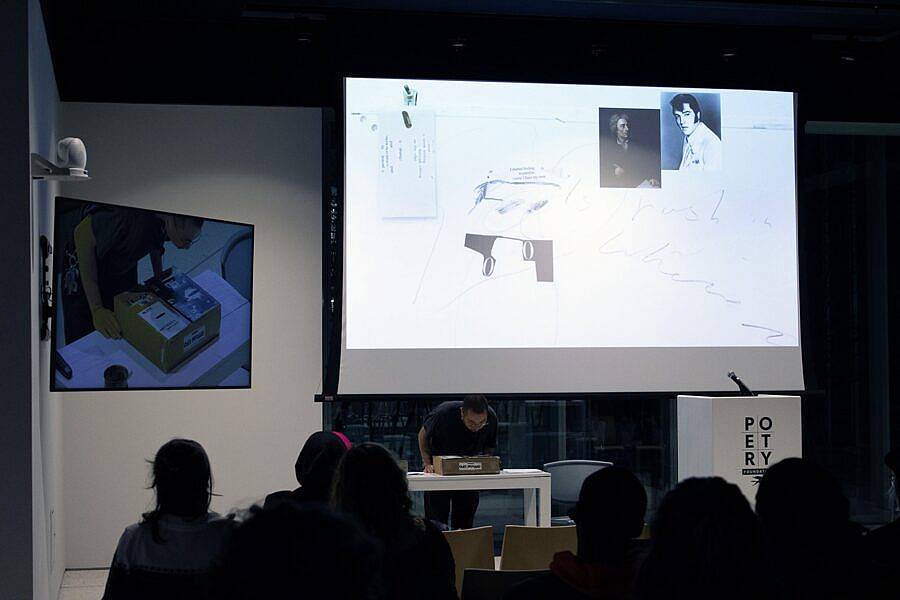
Anyway, I am none of these Oliviers; I am just all lowercase olivier — I use they/them pronouns because of the two “i”s in olivier. I am an artist and a pessimist. I like “languaging” and toying with objects. I am a big fan of pterosaurs. I am a Hongkonger living and working in Chicago. I work as an archivist, cataloguer, adjunct assistant professor, and artist assistant. I run a speculative UFO archive. I collect books and toys. I make text-based work — drawings, lectures, publications, installations, poetics, sculptural shelves, correspondences, videos, research, and speculative writings, random objects, etc.
Do you have any opinions on the amount of work being produced by artists in this current climate? How do you deal with this yourself?
When I see “climate,” I think of how much I used to sweat, and all I used to think of was stillness to minimise sweat. Moving to the States, I sweat so much less, other than in the summer — but it’s so brief! Plus, after top surgery, I sweat so much less. Seriously, being in a climate where I am not sticky from sweat 24/7, and having a body that regulates its temperature much more easily, probably makes more mental and emotional space for me to make work. Being under a different political climate also allows me to learn to be adaptive and find ways to play with (against) the structure.
Do you think it’s important as an artist to have a relationship with the Internet? If so, what might this look like?
I don’t think it’s important, as an artist, to have a relationship with the internet, but as a person living right now with the internet, the relationship is already there, and the relationship status should be radical and critical. This relationship should be conscious and, hopefully, once in a while, be adjusted accordingly.
Is it ever helpful to make diagrams or write? How do you know when it reaches the point where that becomes the work itself?
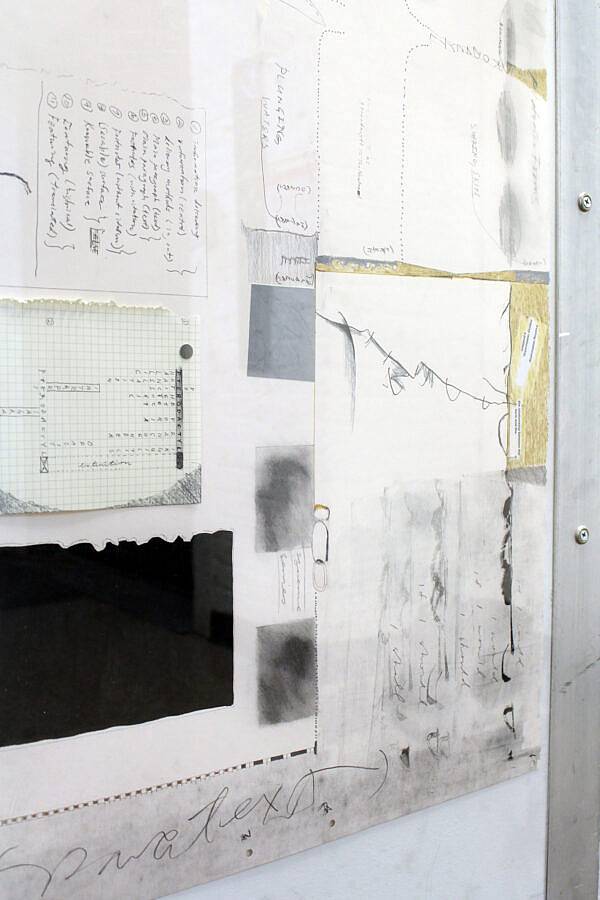
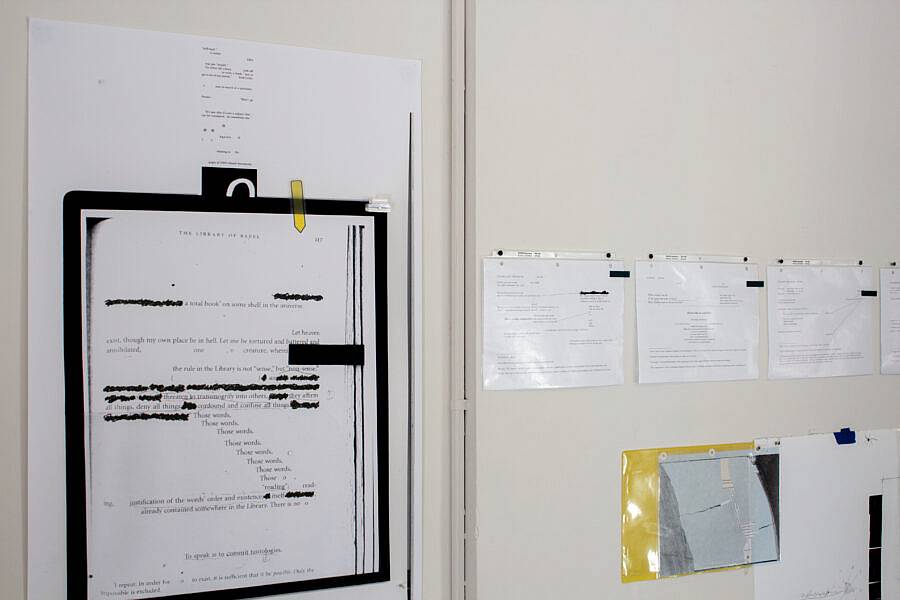
I did an installation called Para- : First (primary?) diagram of the third study of the third thing in 2023. It was a site-responsive piece with a bunch of drawings, a bunch of diagrams, some small sculptural moments, and a big print of a poetry-diagram. At the time I was thinking about the prefix “para-” and how diagrams function as themselves:
(below 2 points are my texts are selected from Para-)
- Diagram is inherently not a pure form because it acts as a totality for something else (a main text?), or as a supplement to them. It always points to. (Obviously a diagram can be on its own, orphaned, points to itself, indicating there should/could/would be more.)
1.1 Supplér = to supplement, =to substitute for (Derrida) –> ‘supplement’ is paradoxical. (see also absence)
- Diagram itself cannot be a totality because of its fundamentals.
2.1 When a diagram ends…when does a diagram ends, what is omitted? Omission is a conclusion- casted away; to chart the shape of the gap, instead of naming or identifying a gap (of…).
I still have so much to go back to from this project. I was heavily interested in calling myself “para-” instead of “trans-,” because “para-ness” is more aligned with how I feel and am. I love diagrams the way I love lectures — they are these promising formal deliverables, and through artists playing with them, they become these amazing playgrounds for non-linear reading, knowledge-constructing, shared playtime, contradictory claims, tautological promises, forever-rearranging text-based work that demands rereading. Amy Sillman has a great piece of writing called “Notes on the Diagram”. Johanna Drucker’s book Diagrammatic writing is a good one too.
Is there any source material you find extremely relevant to your practice right now?
Maurice Blanchot’s The Space of Literature is my biggest source material right now; it’s like a bible to me. It took me one year to actually read the whole book. A lot of books are great source materials, but Blanchot’s extremity of relevance often pushes me to a point where I need to close the book and take a break from it.
How does science come into play?
It’s hard to not think about “being scientific” because we live in logic and reason. But it’s not really about science, but about borrowing the structure of it, I think. Breaking logic and reason is quite poetic — as long as it is not stepping into a no-no dangerous extremist zone. I am thinking of Borges’s “On Exactitude in Science”. Edging science until the collapse is doomed to happen. Then we look at the ruins and our own ridiculousness like a lucid madman. I guess my practice deals with the rhetoric of science, the language of precision, categorisation, measuring, etc. My work destabilises and questions itself, being uncertain and ultimately — which is what I want — to self-annihilate textually. It would be nice to be an absurdist. I like calling this act of mine “write myself off” (kill myself off).
Do you think of space and architecture when making your work, or is it more so conceived in its own private setting?
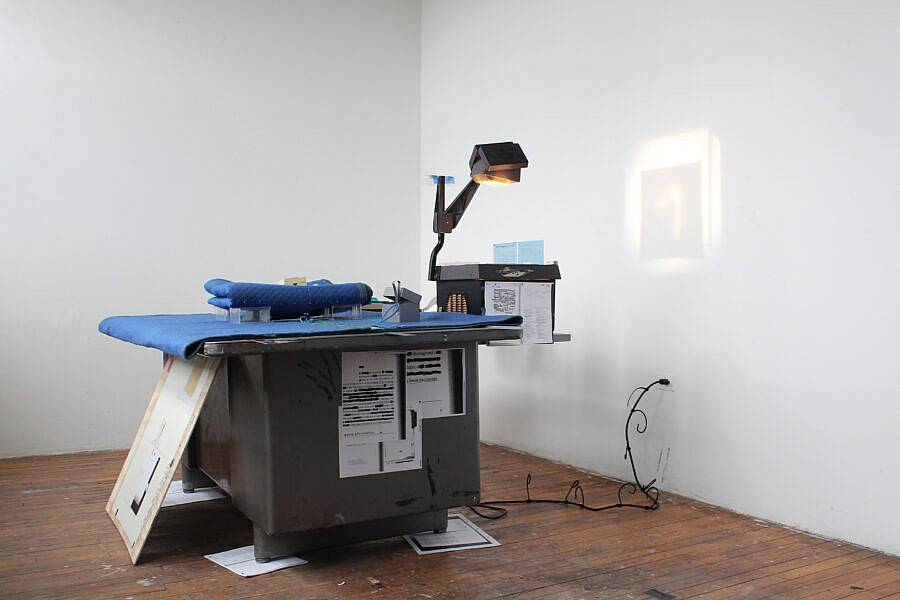
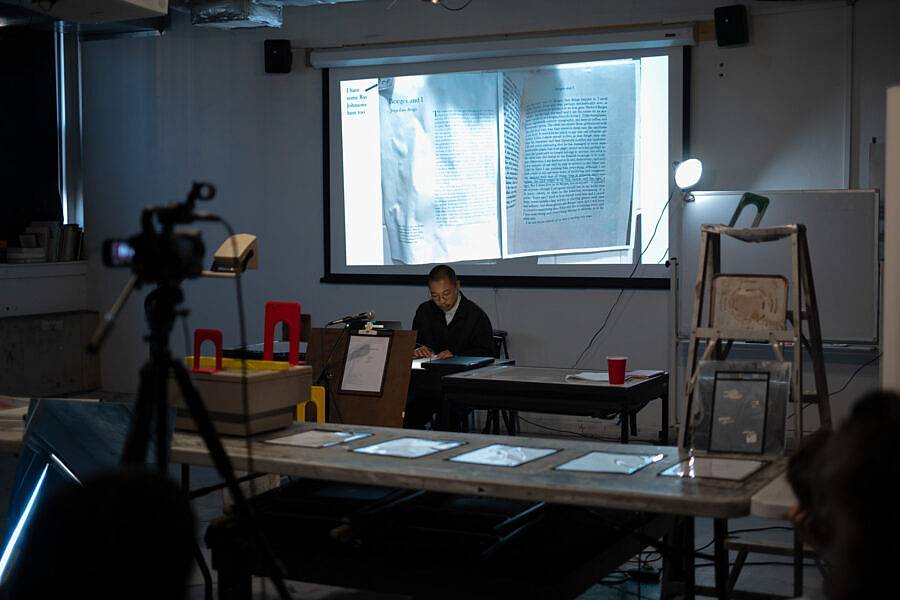
If I am thinking of my installations, sculptural works, and lectures, my works are quite site-responsive, so yes, I think of space and architecture. They might be even site-dependent.
I think about making my work not “occupying” the space; the space isn’t displaying or showing my work. My work isn’t just being chop-chop-ready to look at by the space assuming its role being a supporting background. I spend a lot of time allowing the space to be itself. Making my work share the environment with the objects (including texts) that were already there. I like saying my practice is making objects “happy.” I like considering who/what else (objects, things, other art, etc.) are there with my work. It’s a big playground. How can my objects enjoy their time there? Did they bring a little snack to share? My friend and MA cohort Bronwyn Kuehler once said my work isn’t inviting because they are so busy playing with each other and having fun with themselves; the audience is there allowed to sit in to learn how they play.
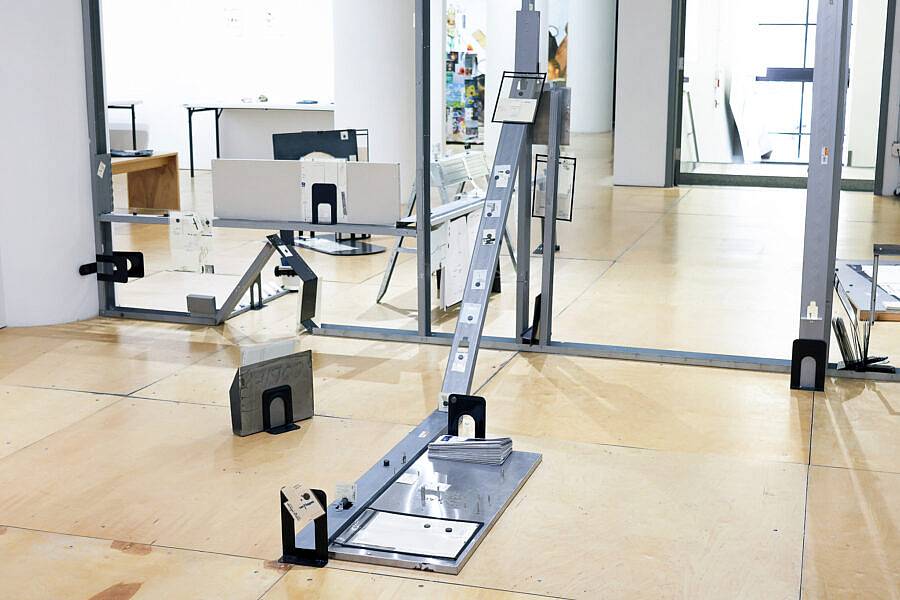
I actually do think so much about the where of the objects. A very important part of my life is working in libraries and archives, seeing what bookends do when they aren’t bookending. I remember walking around during lunch break and encountering bookends “in the wild,” and I greeted them, thinking, oh nice, they are on break too. Another interesting moment was seeing a bookend constantly have one job: holding a door. Does that bookend bookend if it’s never bookending? If you take a bookend outside of their habitat, would they be scared? I remember confessing to my grad school advisor Laurie Jo Reynolds that I don’t run a circus; the objects (bookends specifically, in that conversation’s context) aren’t trying to make people look at them and entertain them. They do not have a function for the audience. I won’t be bringing my bookends to a white cube. My duty is to make the bookends happy. And this is very space-dependent — habitat-dependent, I guess.
Do you consider the space your work exists in as a necessity to the work itself?
Very much so. I don’t think my works come into themselves without the spaces they were offered to be in. I prefer having access to the installation site or gallery or whatever “final destination” for at least 78 hours. So I can just sit there, looking and taking photos of the ceilings, painted shut panels on walls, mistiled floor, if the door knob is magnetic or not, exit logos, fire alarms, how slanted is the gap of the door to the wall, if I stand here can I see through into the next room, if I look over there, is my view blocked by something, if I sit down on this toilet, what object should be in front of my sight…
Usually I bring in a bunch of my ongoing things at the studio, scatter them out at the site, then I can start building my work, disrupting myself, leaving and coming back, bringing more stuff in, lying down next to my work, doing a still life drawing of my work, taking things down. And then finally saying, OK, this is the work now.
At the same time, I make a lot of work “without destination.” Sometimes they function independently, like the sutures* I make. But I also consider the texts I sutured as the work itself; their space, their shared space with other texts, is the paper and the lamination. When these sutures are installed in specific ways in installations, that’s when I feel like they are “a work” or “part of a work”. Then, they come down and go back into the studio, a work of itself but also a source material. Very often, after I scan them, the scans themselves become something else, work into something else, and become “another work” or part of another work.
*Sutures are what I call my physically cut-up text-based work on paper, usually laminated, usually in stripes or letter-size paper.
A lot of what you produce works in tandem as video, installation, sculpture, and more. It can easily fit into more than one box. Is there any particular form that attracts you most?
It’s like the question where someone asks me, “What’s your medium?” I usually just hope a friend is next to me and helps me tell the person instead… I don’t know if there is any particular form that attracts me most. Maybe the forms that break out from the form of itself attract me most, actually. Something that is confusing but seductive attracts me. Something coy and alluring. Something that is vulnerable — they don’t have to be honest. Something is slippery but not using it as trickery. Something witty but not cocky. Something that has self-awareness. Something that very much questions itself but not woe-is-me. Something that is very much forming… still forming… something that was never a form. Something able to have the momentum to maintain its formlessness attracts me a lot. It cannot be dead.
What was the last show you saw that stuck out to you?
Not really a show I last saw, but I think about how the pterosaurs are scattered across the Field Museum a lot. Some are flying above the main lobby, some are standing next to benches. Some are flying above the stairs, leading you up the stairs to the big pterosaur, the Quetzalcoatlus. And then there is the empty sky dome in the men’s room in the basement! In my brain, I link these moments up with walking down/up the stairs and seeing O’Keeffe’s Sky above Clouds IV (1965) at the Art Institute.
Do you think collaboration is important and/or inherent to being an artist?
For me, it is important. Not necessarily inherent.
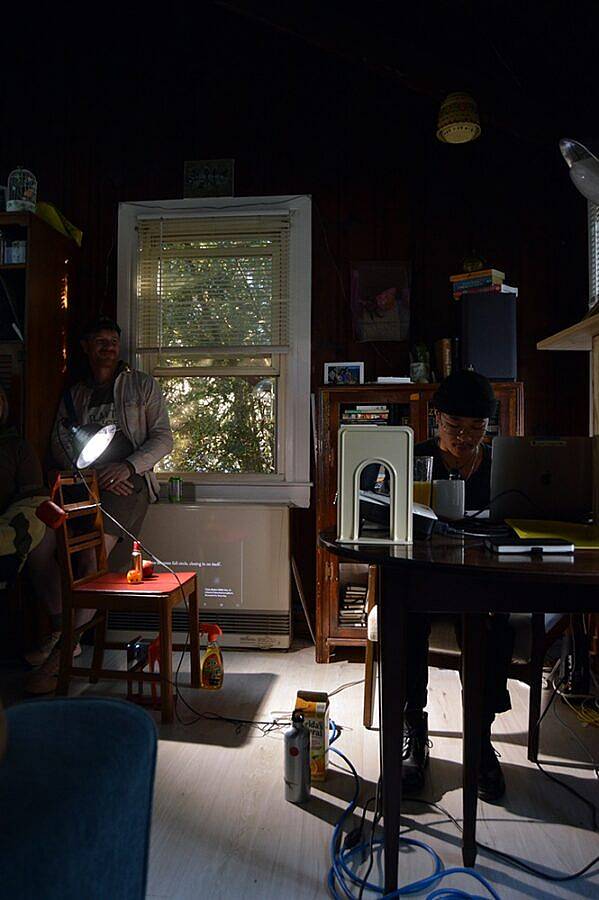
A piece I am thinking of is Coming 2020 (2019), which I did with my late friend Baxter Koziol. It was a piece literally born through an examination of our intertwinement and a performance that celebrated our friendship and care and best wishes for each other.
I think about collaborations a lot, specifically two-people collaborations. I think collaboration is making space to care for each other intellectually and emotionally. I didn’t grow up being close to anyone, so I never really had playmates. I played and play alone with my objects often. So collaboration is such a pleasurable and treasured friendship-time. I like building relationships through my excuses for “collaborations.” I like parallel-play too as collaborations. It doesn’t have to be an immediate back and forth. I have a handful of penpals and e-penpals too, where we share and respond to each other’s work. Those collaborations are very important to me. Responding to each other in non-traditional “communicative” ways might be the most energising thing for me. Even though I wish we got selected so we actually get to make the work, planning an exhibition together with my friend Max Guy is a beautiful collaboration. When a collaboration feels good and/or is going well, it feels like a multi-people sport activity. I made weird ping pong bats with my friend and MFA cohort Sheldon Till-Campbell once, and we played ping pong on a table saw — this sort of collaboration is literally sports, I guess. It didn’t lead to “a work,” but it allowed me to learn from him by playing together. My friend Sonia Cheng and I have an on-going collaborative piece, which is my funeral. The execution is all up to her; the work right now is spreadsheets and albums of screenshots.
I think collaboration opens up a space where the two can return over and over again, that is for each other — perhaps that is how I think about friendships that are prioritising having time-space to play and learn with each other.
Is art supposed to be fun?
I think “fun” is a tricky word… I like the word “toying” a lot. It is similar to “playing” but without too much of the relationship to “fun.” I think making is toying; toying is a way of making work. I am worried that “fun” becomes a measuring tool for the success of the work/the show/the art… etc. Toying is more like not knowing how to play, but approaching with curiosity and possibility. The person who is toying isn’t trying to play or learn, but contemplating, circling back, lingering, dwelling, lamenting, considering, pondering, soaking up whatever is on their hands and minds.
But maybe in general, “art” is supposed to be “fun,” because “fun” has ties to playfulness, which I think is a radical way to question and to interrogate any topic.
Is there a specific goal you’re working to accomplish right now?
Right now, I am working on a sculptural-object-shelf piece for a show at Co-Prosperity in January. But I don’t know about goals, to be honest — maybe a pleasant death? Maybe to finish reading all my to-read books? Maybe to replay Fallout: New Vegas? Maybe to make a new syllabus? I want to teach a course on Os. Maybe to finally find a country I can stay in? I get overwhelmed by the idea of “goals” and “to accomplish”; actually, I was talking about — not having New Year goals — with my friend Chu yesterday. To-do lists, though… I like those. I don’t make grocery shopping lists. I do have a wish that I am trying to make it real. I have done two lectures on pterodactyls; I hope to make an exhibition that centres on my big collections of pterodactyls, the writings, diagrams, drawings, videos…and another lecture about them.
Can you tell us a memory of someone interacting with your work that frequently crosses your mind?
Nate Young’s dog, puppy at the time, Chippy, hopped over and climbed under different apparatus in my installation. So gracefully and perfectly, sniffing at the stuff I wanted people to notice. It was very adorable, and I got very envious right away because I realised my cat will never get to interact with my work since my works are all site-responsive. I can’t just bring art home for her. But I am having a solo exhibition later this year that sort of centres my cat — names, languages, misidentifying, Hong Kong immigration and diaspora, her Hong Kong, British, and American lineage and heritage… so I need to figure out how to show her the exhibition, so she can see the work!
Interview conducted and edited by Liam Owings