Tell us a little bit about yourself and what you do.
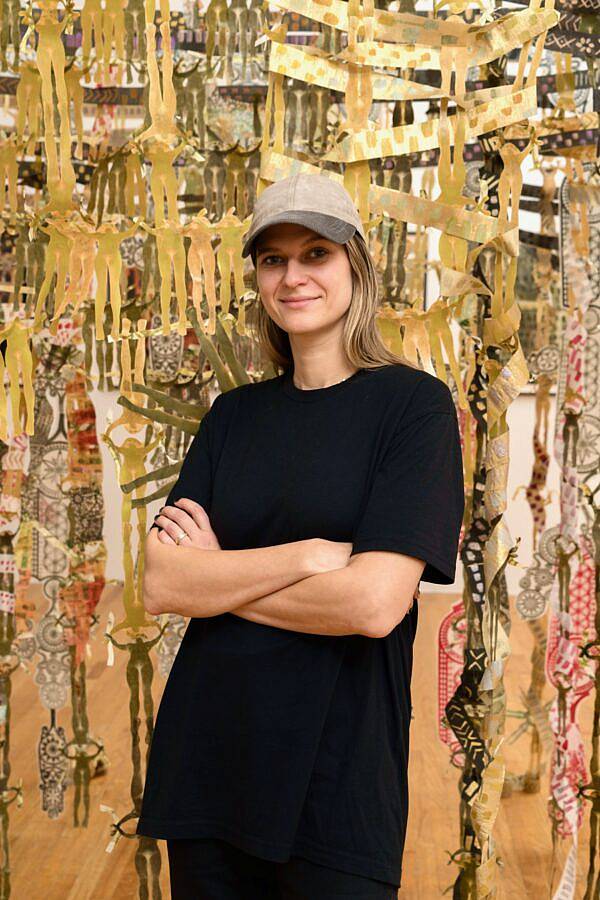
I grew up in an artist family and have been creating for as long as I can remember. It’s never really been a choice, more like a need. Making art is how I make sense of the world, how I process, connect, and exist. It’s not something I do – it’s something I live.
Can you tell us a memory of someone interacting with your work that frequently crosses your mind?
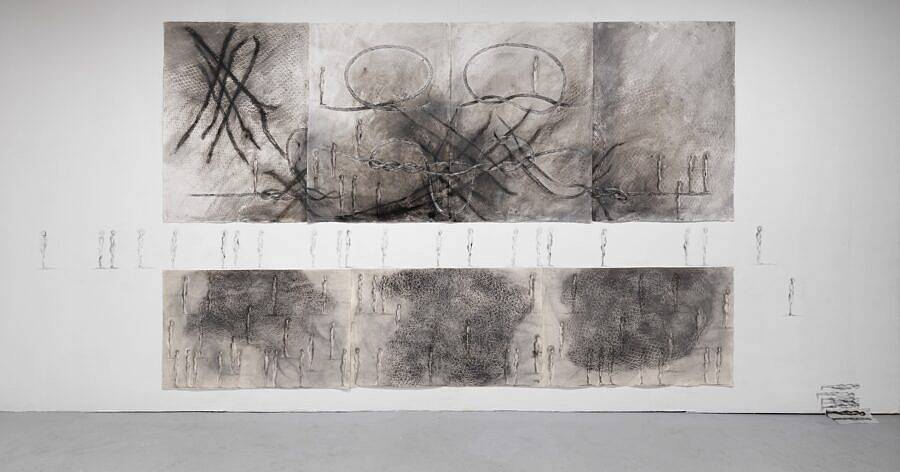
One interaction that stands out to me happened at the end of my first semester of graduate school at SAIC. At the time, I was creating abstract ceramic objects combined with cut-out monotypes on paper, all scattered across the studio floor resembling an imaginary ocean floor. I wasn’t totally sure where it was going or what the final form would be. One day, my advisor, Candida Alvarez, stopped by my studio, looked around, and said, “Monika, it seems like you’re using all these materials as a way to draw in space.” It sounds so simple but that observation completely broke open my mind in all directions. Suddenly, what I was doing made total sense – everything I had laid out on the floor was expansive, exploratory. Drawing in space. I think about that moment often. For me, seeing everything as a drawing turns my fears into freedom and play.
Some of your works have taken on a direct relationship with the body as a form. Do you consider all of your work to have a similar approach?
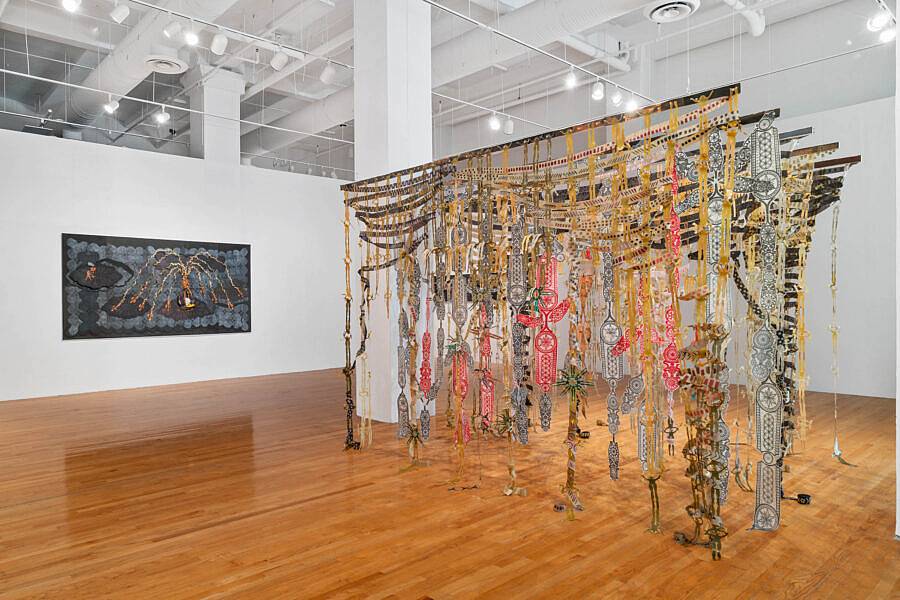
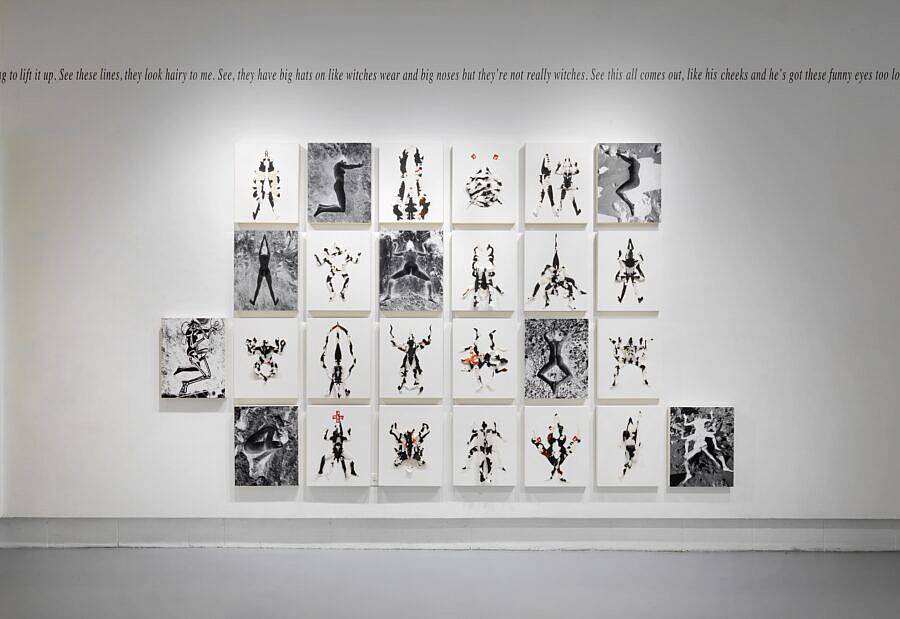
My paper textiles and other mixed media works, do reference the body as a form, a symbol, or even a kind of sigil. I’m drawn to the body’s symmetry, and how that symmetry lets you repeat a design, mirror an image, and create a visually balanced, rhythmic pattern. I often use my own body as a starting point simply because it’s readily available and I have full rights to it. It also just feels honest, because it’s the physical vehicle through which I navigate the world. The end result of the patterns becomes so abstracted that I don’t feel fully identified with it any longer. It’s not just about my identity but it’s about our identity within our bodies, our relationship to the external world and even the feminine aspects within each of us. Sometimes, I’m using my body in a more direct way, like a kind of self-portrait, and that shows up in different mediums too. So the approach is never quite the same – it shifts depending on the work. While I reference the body frequently, the how and why is constantly evolving.
Do you find it important to reference the history and origin of paper?
My love for working on paper definitely comes from my printmaking background. I studied printmaking in undergrad, and because of that, I’ve experimented with pretty much every type of paper I could get my hands on, from different Japanese papers to traditional printmaking papers, and even making my own from all kinds of pulp. I’m drawn to it because it’s so versatile – you can mold it, shape it, treat it, combine it with other materials, and it can take on so many different forms and functions. It’s such a natural material, too. It wants to be touched, it almost feels like an extension of the body.

Is there anything you’ve read recently that’s inspiring your work right now?
I’m usually working on a couple of different bodies of work at the same time as a way to avoid burnout and keep things interesting. Recently, I was reading Waking the Witch by Pam Grossman – a book about the legends and history of witches, women, magic, and power – which inspired me to revisit a series of self portraits I started a couple of years ago, where I depict myself as an Alkonost; a woman-headed bird from Slavic folklore. These half-woman, half-bird creatures show up in lots of different cultures under names like Sirin, Harpies, Kinnara, and Gamayun. There’s something intriguing, personal, kind of embarrassing, and uncanny about these pieces. Maybe because they still feel so fresh and raw. I haven’t really shown any of those works to anyone yet, but I’m excited to see where they go and what kind of narrative unfolds within them.
Are there other mediums you find yourself interested in wanting to explore?
Yes! Over the past few years I’ve been wanting to create a large mixed media body of work that brings together photography, printmaking, and collage, at the biggest scale I’ve done so far. I’ve been slowly chipping away at it, building different parts over time. The work relates to the cookie-cutter Soviet apartment blocks I grew up in Lithuania. I’ve also been thinking about adding metal sculptures to go along with it. It would definitely involve working with some materials and processes I haven’t used before, which I think would push me in exciting ways. Right now, I’m on the lookout for opportunities such as grants and residencies that could give me a good intro to this way of working. This summer, I’ll be trying out small scale metal casting at ACRE Residency to see how I like it and how the work translates into that medium.
Is there a clear shift when your works expand into installations?
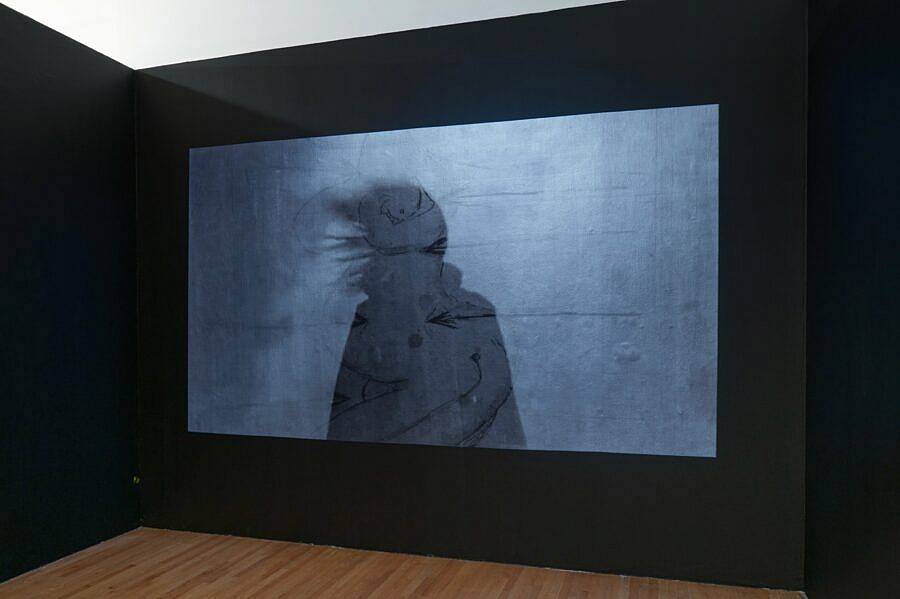
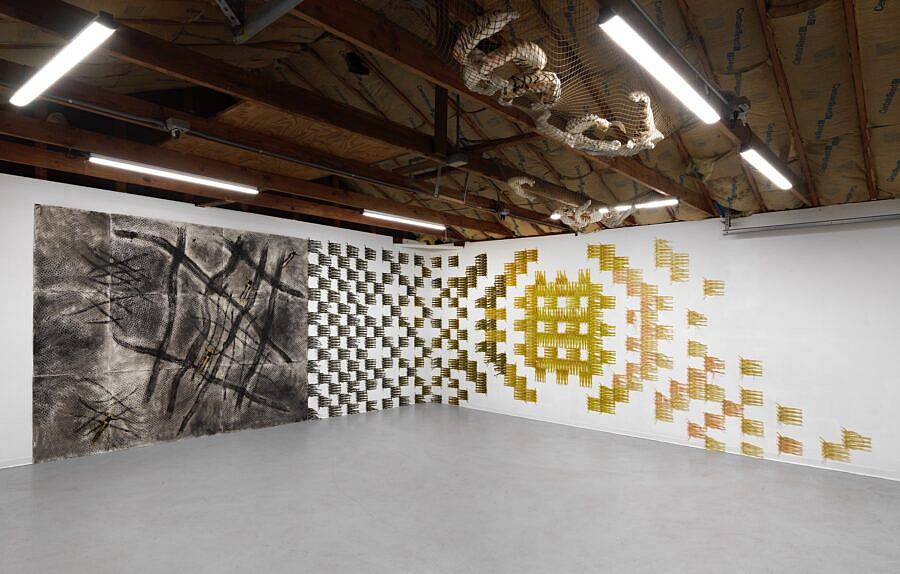
Yes, if a piece wants to become an installation, it lets me know. Sometimes it happens quickly, sometimes it takes a while for me to figure out what it wants to be, but that’s part of the fun. It talks, I listen. When I’m deep into a series or even a single piece, it becomes all-consuming. Once I shift into installation mode, I start thinking about space, architecture, and how the viewer will experience the work. It’s that drawing in space mode – I become a kind of curator, thinking through all the different aspects and limitations of both the space and the work. Another thing that happens is I get a chance to step back and see my work differently. I revisit older pieces and start pulling threads and weaving ideas from the past into the new work. There are certain elements that are consistent throughout my work but I also try to resist falling into a safe set of stylistic rules or motifs, and instead try to push myself into choices that I wouldn’t normally make, using previous knowledge and experience about my own visual language, but adding something new, to let those building blocks continue to grow. What I love about installation, compared to something like a photo, painting, or print, is that the final form doesn’t ever have to be “set in stone”. The work has a never ending chance at life to always morph into something else.
How does architecture and space become an important consideration to your installation? Does the body play a part as well?
I love responding to and creating spaces. Usually, the architecture or the environment itself that sparks the idea for how I craft an installation. The real challenge and excitement of creating a sculptural installation for a specific space is that no matter how much I try to plan it in the studio creating smaller scale prototypes, I never really know what the final shape will be until I’m actually in the gallery, activating the materials in the space.
What can you tell us about how you work?
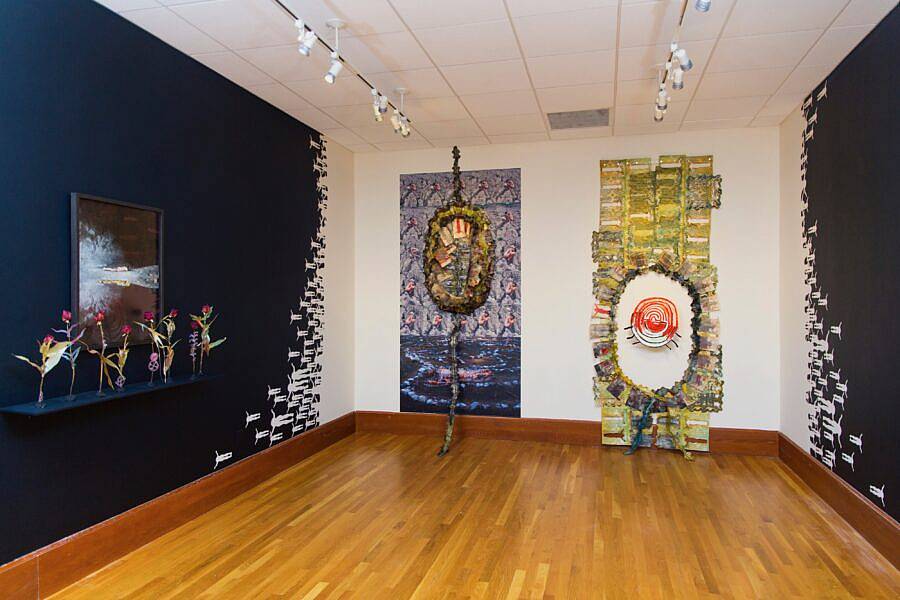
I work fast, intuitively, and very physically. I work on the floor because that way I broaden my playground that’s not limited to some table. I don’t often sketch, I figure my pieces out as I work. The works tend to go through a lot of changes, and the works can take many different forms until I settle on something that I find interesting. When I’m printing, my process is intentionally quick, printing layer after layer and making decisions as I pull each print. There is something about the speed of printing that makes my prints look fresh and not overworked or overanalyzed. I cut, rip, glue, and collage prints and drawings but only after everything has been scattered across the floor and moved around a hundred times. I’m looking for the connections that catch my eye. I spend a lot of time just observing, challenging myself to find new relationships and meanings within the work. What really works for me is taking breaks and letting pieces sit in the studio, sometimes in a dark corner where I don’t look at them for weeks or even months in order to come back to them with fresh eyes later. That way I feel less attached to what I was doing before and am able to make pretty drastic decisions in how I can rework them. I am never precious about my works, I don’t mind them rolling around the dirty studio floor, or my cats running through them or even myself constantly stepping on them and leaving sneaker imprints. I like when my material becomes a little used and bruised. My work is like a visual index of what I believe in and what I’m interested in. Each body of work grows from the last, organically and intuitively like writing a new chapter in an ongoing book.
Can you speak on the importance of accessibility and community in the Chicago artworld?
The work being made in Chicago is incredibly strong and conceptually rich. In my opinion, the art community here is very supportive of each other and feels less driven by the market, since it doesn’t really exist in the same way it does in New York or LA. In a way, that’s an advantage, it’s about real support and friendship rather than competition, and the artist-run spaces really are the lifeblood of the community. It’s the kind of environment that makes space for slowness in making art, for developing ideas over time, and for genuine personal growth.
Are there any quotes you find yourself revisiting?
Back in high school, I read Diane Arbus’s biography by Patricia Bosworth, and I’ve loved this quote ever since: “I really believe there are things nobody would see if I didn’t photograph them”.
The way I have always interpreted this quote is that art isn’t about what you see, it’s about what you make others see. It’s about showing people your unique lens on the world. Every time you create you’re inviting others to step into your perspective, see through your eyes, feel what you feel.
What’s the best show you’ve been to this year?
The most powerful show I saw this year was “Women at War”, curated by Monika Fabijanska at Chicago Cultural Center. The show featured works from 12 contemporary women artists currently working in Ukraine, giving a platform to women as narrators of history and exploring gendered perspectives on war. The works were so instinctual, raw, gut-wrenching, and brought me to tears.
Do you ever feel like your work is responding to something happening in the world around you?
Absolutely, yes. My work is always influenced by what’s going on around me, both in my own daily life and in the world at large. My anxiety, sadness, joy – it all feeds into the work. It’s how I process things and pour it all into what I’m making. But it’s never direct or literal, it’s not about one specific event or moment. Instead, it helps me create my own world, a kind of space where all those feelings can live and shift into something else.
How do you find your work changing right now?
My work is always changing, and the way I think about it is constantly shifting too. It’s usually a few steps ahead of me, I’m just here trying to keep up and understand it over time. One of my most recent realizations came after my solo show at Glass Curtain Gallery, where I showed monoprints I originally made because I wanted to imagine what zooming into a textile would look like. But over time, I started seeing them as a series of nonlinear abstractions that reflect the fluidity of language. I realized it’s probably me working through my own trauma around being bilingual – English is my second language, which I had to learn when I was twelve, and I never really feel like I have full control over either language I utilize. I intended for the pieces to be seen as parts of a whole, like pieces in a visual puzzle with interconnected meanings. Later, I realized it’s really about pointing out the invisibility of systems – where I’m making something abstract, like information, language, or memory, into something physical and tangible. Materially, the work is also shifting. It’s starting to ask for more structure, more physical layering, not just collage, but something that’s being built.
What is something that you’ve always wanted to do and are working towards achieving?
I’ve always dreamed of having my own printshop and a big barn studio, ideally tucked away in the woods of Michigan. One day, hopefully. A girl can dream!
What is one of the bigger challenges you and/or other artists are struggling with these days and how do you see it developing?
One of the big challenges for me as an artist these days is figuring out how to rely less on social media for opportunities. At this point social media does more harm to our mental health than the benefits it offers for self-promotion. The constant flood of images is starting to skew how we experience art, everything is about how it looks in a photo. Sure, most things look good on a flat screen, but you can only truly feel the work when you see it in person. Another thing I struggle with is finding a life/work balance and financial stability to be able to have a family and still afford and have time for my practice. We live in such a fast-paced environment that feels like it only accelerates every year. I have a real problem with how little value is placed on the slowness of making art, on developing ideas, and allowing for personal growth. That kind of time and care deserves a lot more respect.
Interview edited and conducted by Liam Owings