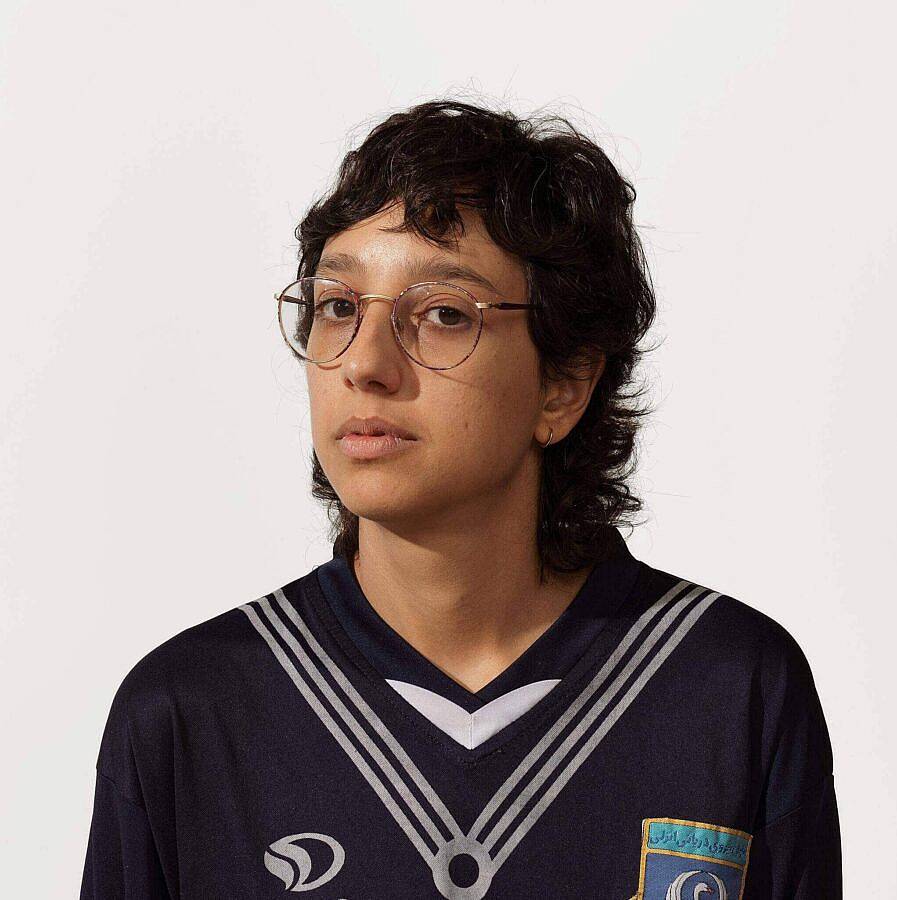
Tell us a bit about who you are and what you do.
I’m an artist who moved to Chicago nine years ago from Tehran to study performance art. I was crazy about performance back then. (I think I still am.) But coming to a new country made me feel insecure about being on stage. So I ended up doing desktop performances. I started performing by hiding behind my computer and thinking about my desktop, and the way I interact with it, as an extension of my body. That opened a new door for me, leading me into new media. Since then my practice has expanded into video performance, VJing, interactive installations, and kinetic sculptures.
What is currently haunting or driving your practice?
AAh! What’s haunting me is the time we’re living in. It’s scary! The speed at which things are changing politically, technologically, and socially feels overwhelming. I think a lot about how fear shapes our behavior, how technology mediates our relationships with each other, and how quickly things we take for granted disappear. Those anxieties inevitably find their way into my work.
What’s your rule for using nostalgia without bathing in it?
I’ve actually been thinking about nostalgia a lot lately. We usually associate it with a distant past, something covered in the dust of memory. But lately I’ve found myself feeling nostalgic for things that happened only a few years ago.
I recently went back to a bar I used to love and immediately thought, This place used to be cool and now it sucks.
I think we’re becoming nostalgic for a world that existed only a short time ago. I miss the time before there was fear of ICE while walking through our neighborhoods, before the U.S. attacked Iran, before the massacres in Iran, before the rise of the radical right across the world, and before genocide and catastrophe being live-streamed on our phones.
Life feels like it’s deteriorating at such a speed that we’ll soon miss things we had only a few years ago.
So the short answer is: I’m not bathing in nostalgia. I’m drowning in it.
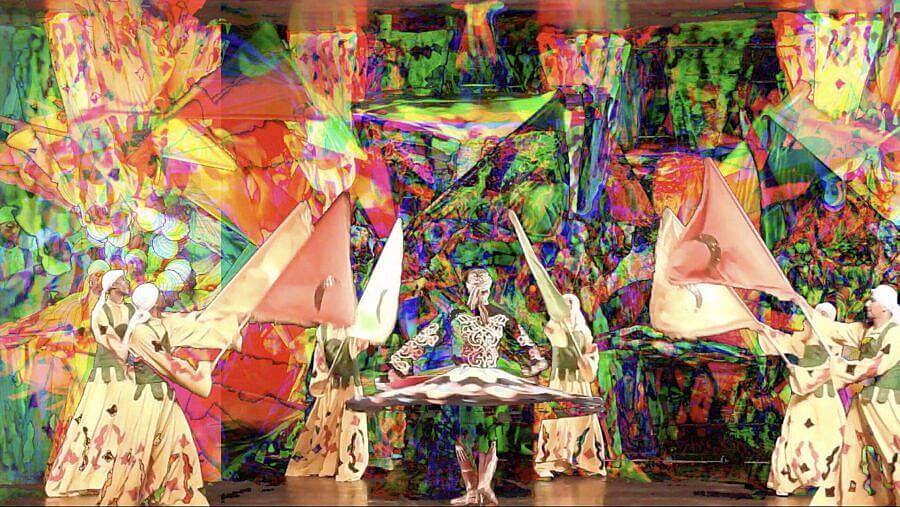
Tell us about your work as a VJ. What do you love about realtime video performance?
My VJ career had a funny start. I got my first gig just a few weeks before the 2020 lockdown, so that career didn’t last very long. For the next two years I mostly projected visuals onto my living room wall for friends. Eventually I reconnected with people, venues, artists, and labels, and started performing again.
I love how immediate VJing is. You’re making decisions in real time, responding to music, the audience, and the atmosphere. It feels playful and freeing in a way.
I also owe a lot to James Connolly. I was introduced to VJing through his class at SAIC. Beyond introducing me to his own practice and the work of many incredible Chicago artists, he gave me the technical tools that made it possible for me to enter that world.
Who would you ideally like to collaborate with? What makes a good collaborator?
I’d collaborate with anyone. (If you’re reading this and you’re interested, reach out!)
I never approach collaborators with a specific objective in mind. The fun is in not knowing where something is going to end up. Building something together means allowing the work to surprise both of you.
Also, I’m an empiricist. I think almost everything is worth trying at least once.
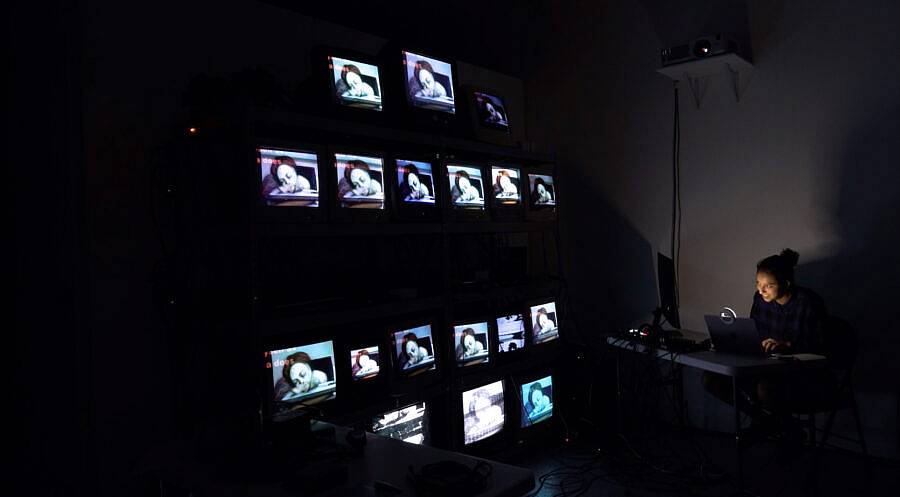
Do you begin a work with a mental image, a composition plan, a mood, atmosphere, or a state of mind that you want to evoke?
Usually it begins with a question or a contradiction rather than an image. I get obsessed with an interaction, a behavior, or a technological situation, and then I start building. The visual language comes later. I’m more interested in creating situations than illustrating ideas. A lot of my work comes from experimenting and seeing where something unexpected leads.
Your recent show at Chicago Artist Coalition, homeward (un)bound, includes three mechanized sculptures. How do your sculptural/installation works and your performance relate to each other?
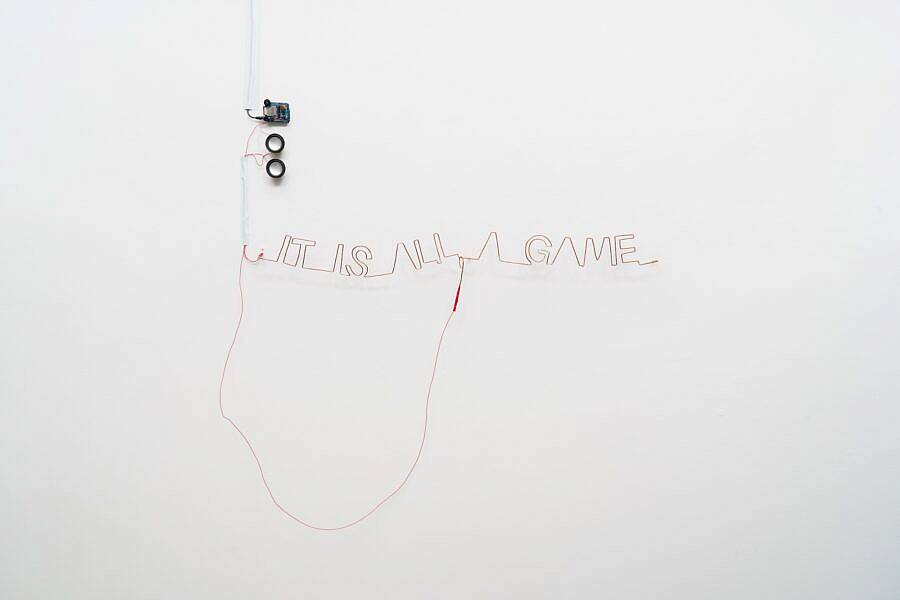
My approach to building those sculptures came from an urge to make objects that would perform instead of me. I wanted them not just to be kinetic objects but to have bodies, personalities, and performative qualities of their own, so they could carry some of my anxieties for me. In that sense, all of those works are extensions of my performance practice. They’re performers just as much as I am.
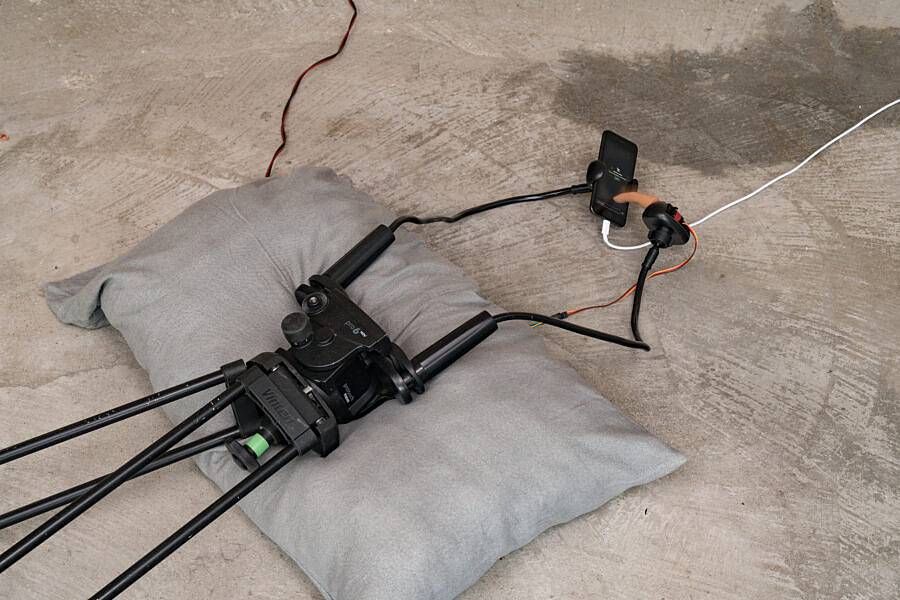
_________ (untitled) | 2025 | mixed media (iphone, tripod, silicone finger, motor, arduino, wires, iphone charger) | approx. 75 x 30 x 10 in. Photo by Robert Chase Heishman.
Can you share a reaction to your work that lingers with you?
I really enjoy when people get confused by my work. At my exhibition at Chicago Artists Coalition, three of the works were interactive. People would stop in front of the fourth piece, and start bending over, waving their hands, and moving around to see if anything would happen. I loved watching that.
Something similar often happens after my performances. People come up to me and ask whether what they saw was real.
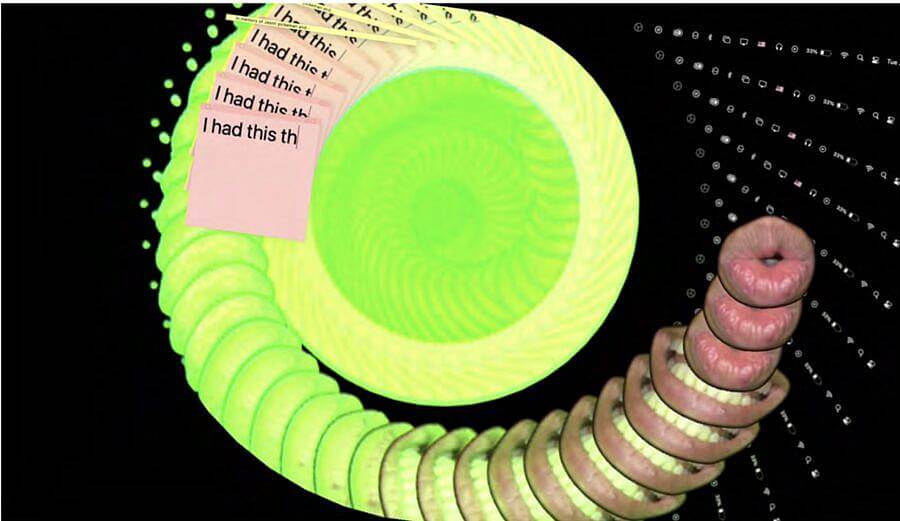
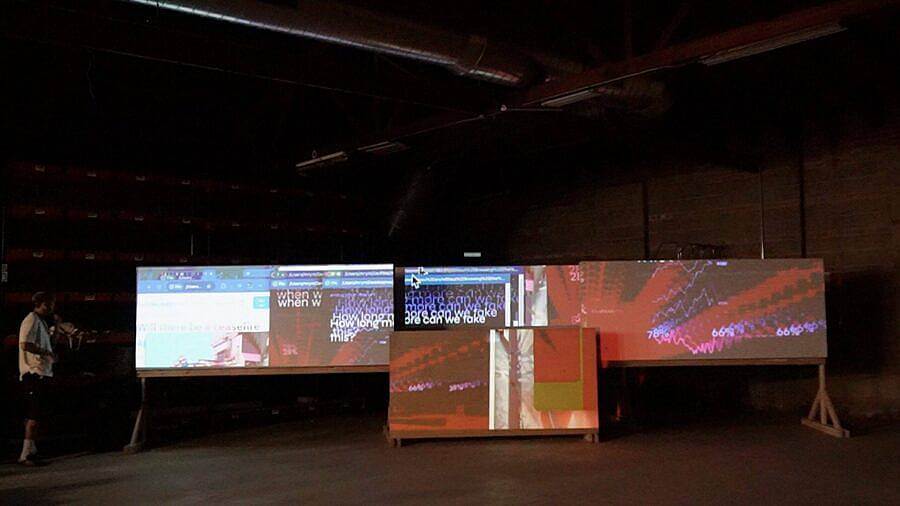
In my last performance, I began by trying to play a calming YouTube video, but the internet was painfully slow. Eventually the video loaded, and the work gradually shifted into this uncanny space where it addressed the longest nationwide internet shutdown in history, the 80 day shutdown in Iran. Afterwards, several people asked whether the technical problems at the beginning had been planned.
I love that uncertainty. It allows me to say things indirectly and leaves room for people to construct their own meaning.
How do you see your work evolving in parallel to things that are going on around you?
I think my work is becoming more direct. It’s getting darker, faster and yet slower, funnier… and tackier. The world has become increasingly absurd, and I find myself responding to that absurdity rather than trying to escape it. Politics increasingly feels like a badly written reality TV show where the stakes are real. So I’m becoming more interested in embracing that confusion.
What was the last exhibition you saw that stuck out to you?
Strangely, no exhibition immediately comes to mind. For me, theater has almost always had a stronger impact than exhibitions.
The last thing I saw was a performance by Jibz Cameron at the Logan Center. Besides her hilarious performance, there was a technical issue where her lavalier microphone stopped working halfway through the show. She had no choice but to embrace it and improvise, and the show took an hour more to finish!
I love that about performance. It can be messy, intense, and completely unpredictable. You leave thinking, What the hell did I just see?
What do you collect?
I collect digital artifacts, from memes to glitches I come across in the wild. The Iranian internet isn’t really being archived anywhere, so I try to save as much of it as I can. I also collect home videos from Iran that people uploaded to YouTube years ago. They’re ordinary moments that were never meant to become historical documents, but they accidentally have. They preserve fragments of everyday life that might otherwise disappear.
Interviewed by Seth Nguyen. Artist portrait by Robert Chase Heishman for Bob.mov.