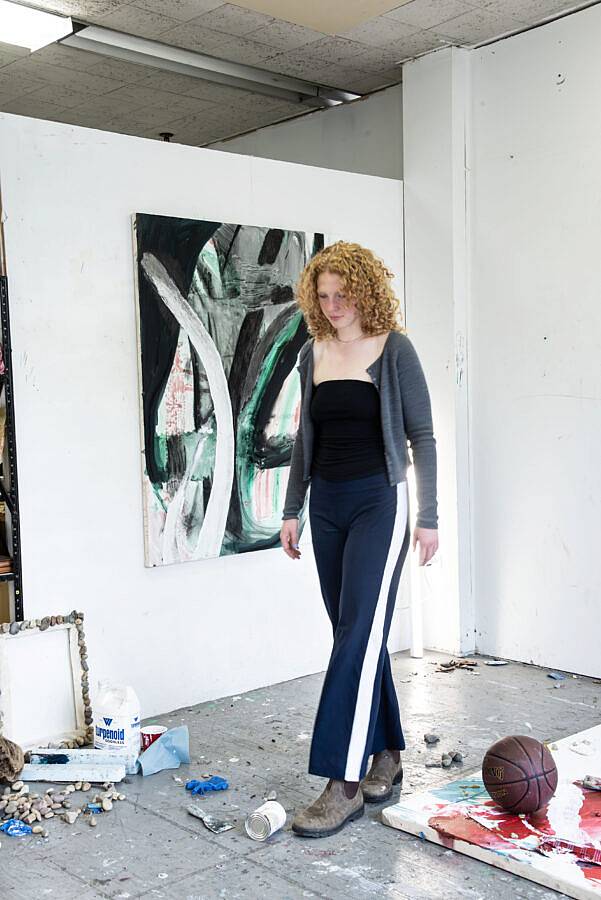
Tell us a little bit about yourself and what you do
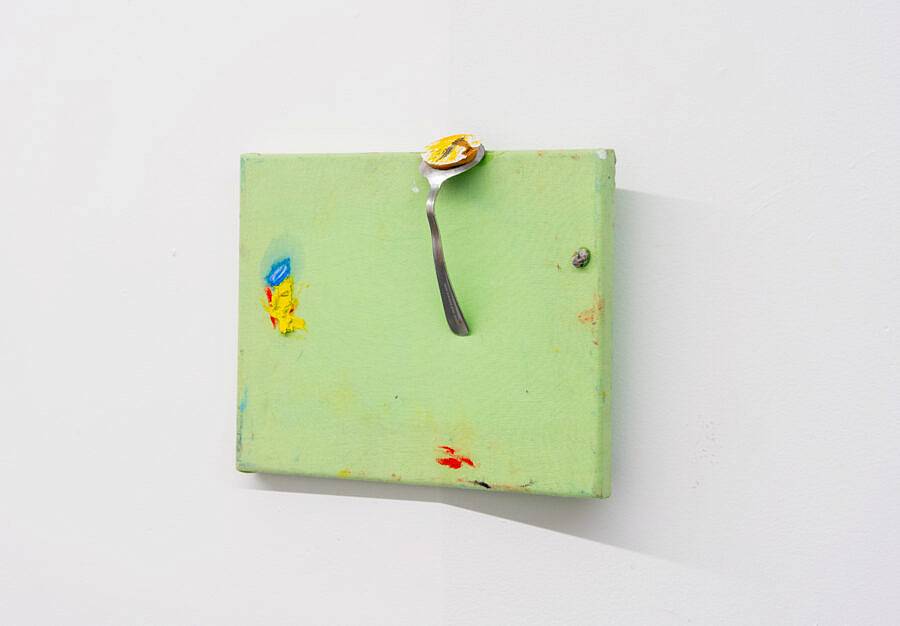
I am from New Jersey and now live and work in Chicago. My practice is grounded within painting, collage, improvisation, and sport-playing. I also work with children and teach. The experience of being around children has definitely folded back into the practice. Kids are continuously open, challenging, and responsive, all of which are traits that I admire and try to embody myself. Like many artists, I collect things. Usually things like rainwater, rocks, almonds forgotten in my pocket, my roommate’s spoon, a favorite shirt, potatoes. I try to pick up on the intelligence in the things that surround me and that stick around. I want to create a space where seemingly disparate marks, objects, and touches reveal their subtle or not-so-subtle relationships with one another. If the work can feel like the turning over of a rock, in which you discover there are bugs and dirt that live underneath that rock, and were always there but you didn’t actually notice until you flipped the rock over; that’s a good thing. Stumbling across. Often, the paintings take on sculptural qualities, and similarly, I often go around tripping on my own feet, but rarely completely hit the ground. I love ABBA.
Can you speak on the ephemerality some of your paintings take on when using organic materials that face inevitable expiration?
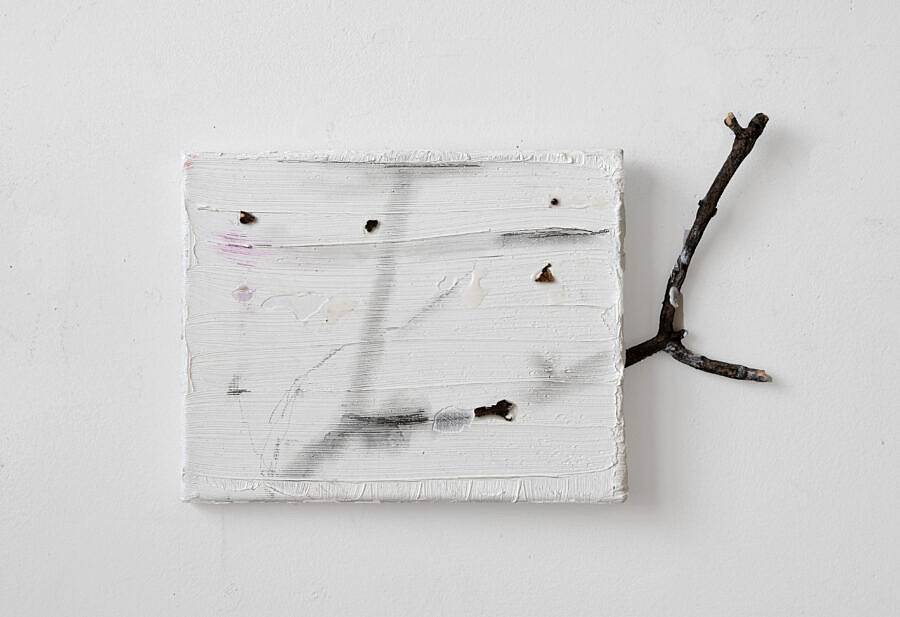
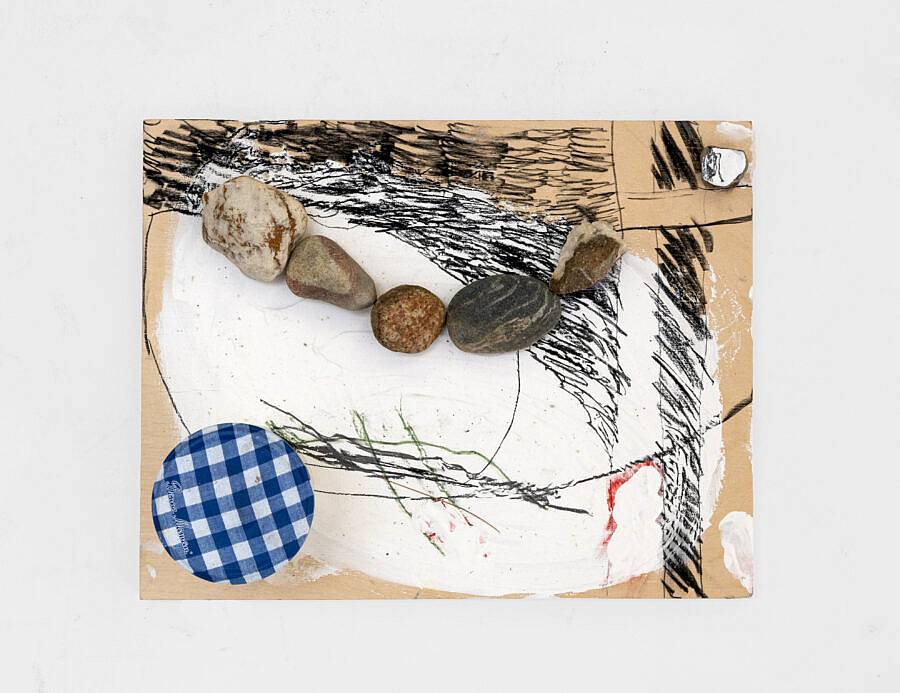
I often use or adhere materials into my paintings like rocks, shells, branches, or food and their scraps. Almonds, dried orange peels, cookies, moldy tuna, or a donut that I might’ve left out for too long. A sprouting potato, hot bacon grease that dissolved plastic cups into compelling shapes. Food of course expires the fastest. I work back into a lot of paintings after they’re complete. I like to see the beginning and ending of material and how it changes in the interim. I am very open to being wrong about when a painting is completed. I don’t mind if my materials expire, crack, rot, transform, or fall off the surface of a painting entirely; I can always put it back, and I appreciate the mutability of physical form.
I am trying to find different possibilities, various uses from an object’s intended purpose. That might mean using traditional painting mediums in a non-archival way by layering and mixing, or learning by a haphazard play – dried banana peels make excellent drawings, DUM DUMs can be glued together to create a jumprope, and rocks do in fact bounce when wrapped in thousands of rubber bands. I am looking for alternate routes, an unlocked-back-door, or passages that will lead me somewhere exciting, but I want chosen material to remain direct and knowable. We can feel that a rock is heavy and gum is sticky. The ephemerality and expiration in some of the paintings let me become a part of the passage of time more intimately.
How do you find yourself sourcing materials?
I collect objects that exist already throughout my day-to-day life, and collage them back into and onto the painting surface. It’s important that what I’m sourcing is already folded into my routines, I don’t go out searching for things but I do look around the kitchen or the alley or my car for my stuff. A lot of the time I’m collecting food scraps because a lot of the time I’m eating. I’ve started to include objects into the paintings only in the last few years, but now my friends and others gift me detritus they find on the ground or elsewhere. It’s really beautiful, this thread of relationships that form from that kind of exchange, through a passing on. There’s something simple but touching when someone says ‘oh hey I found this thing, thought of you, here you go.’
I like to get lost, intentionally. I walk around a familiar area, but attempt to move slower, paying attention in an attuned way. When you get lost, or when in a new place, your senses can be heightened, becoming more receptive to the colors and lights and sounds around you. I like to come across material in a similar fashion, reattuning myself to that which makes up my life.
Do you find yourself working within a set of rules and constraints?
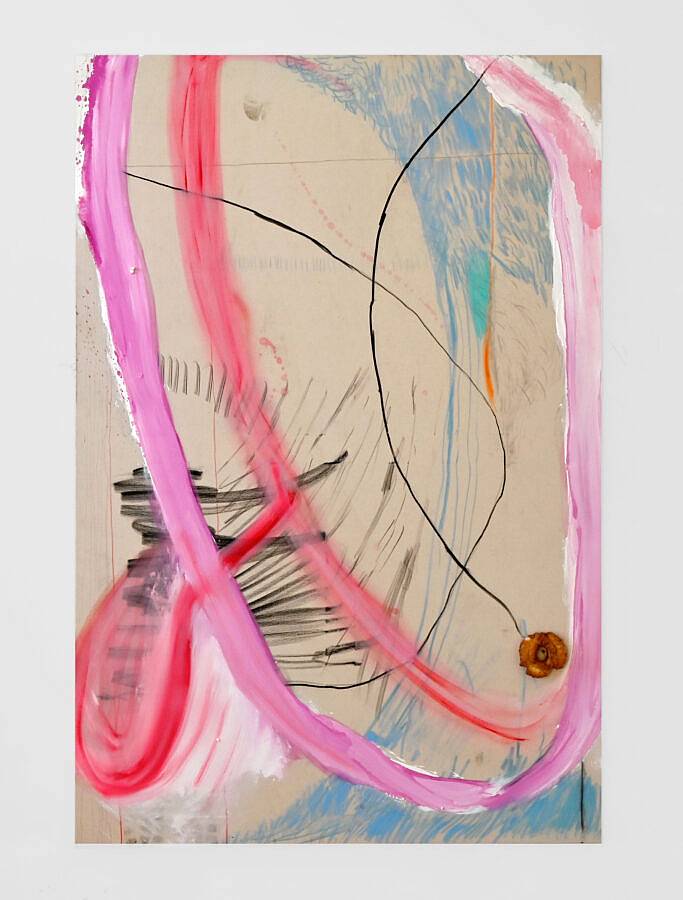
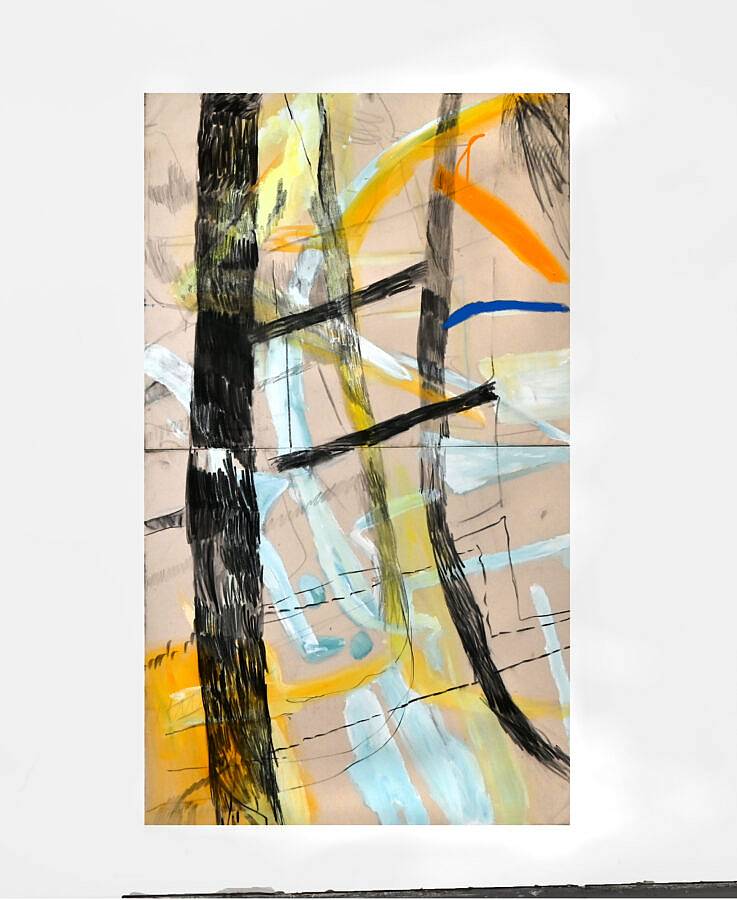
I’m deeply interested in the figure-ground relationship within painting, as a place of contact and collision which attracts me most. I played basketball growing up and briefly in college before pursuing art academically, so I’m intimately familiar with the experience of being an actual figure on the ground moving around within a rectangle. In a basketball game, there are players and moments, starting and stopping and interrupting one another which create the pace and pulse of the game. Shifting and flowing into each other, there’s a lot of embodied anticipation around trying to know what the best next move is. A lot of how I approach painting has to do with the limitations of my body and the boundaries of the rectangle. Figure ground is #1. I collect only what I can carry or transport on my own, my reach becomes a measurement. The objects involved must already be a part of my life, and I do not go out seeking them. There must be a synthesis between object and image that still allows for movement. Grossness is allowed.
Is there any source material you find extremely relevant to your practice right now?
Stones, branches, round objects, tinfoil balls, rubberband balls, things that shrink, donuts, the sensation of falling and jumping, gravity, phases of the moon, game boards as containers, dinner.
Do you ever find your work operating in the realm of sculpture?
Last month, I was working at a camp for elementary students and one came across a discovery that was quite beautiful. Six years old and as he was picking up things from the ground, he paused and said “Oh, this is just like drawing but with objects.” I think my work pivots between 2-D and 3-D, but ultimately I am thinking through the language and logics of painting. But I will use a rock to make a heavy mark just as I would with a brush and pressure from my body.
Can you walk us through your process when first entering the studio?
I pace and eat and it’s very hot in the summer so I am sweating a lot of the time. I am kicking the rocks in my studio around so I don’t fall.
What’s your favorite color and why?
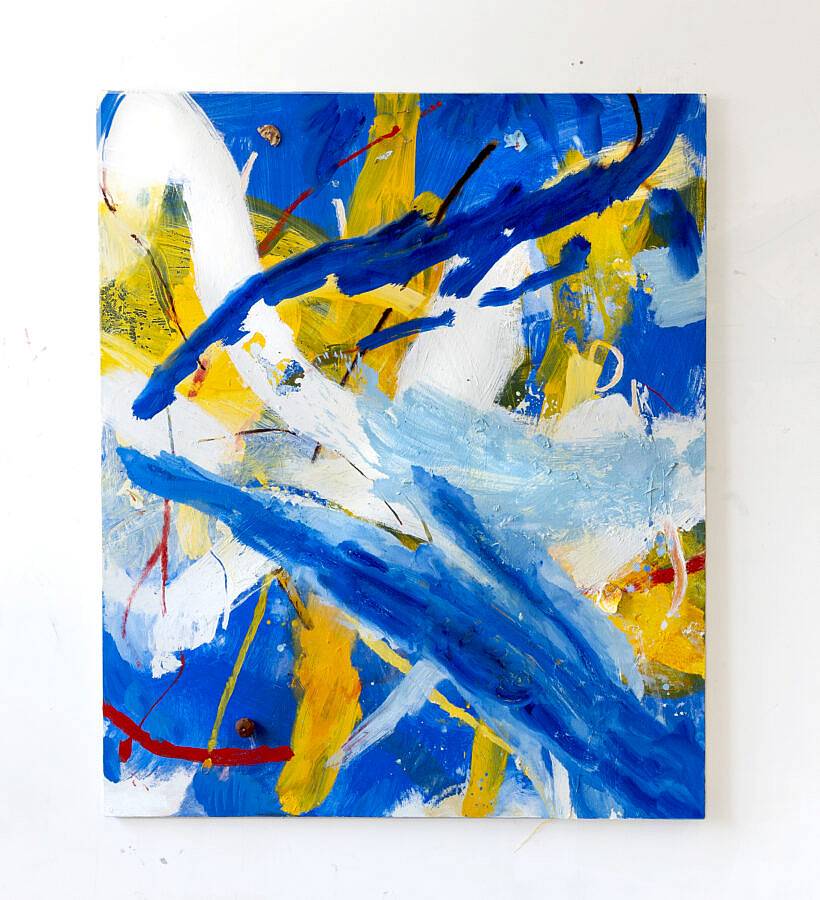
I don’t have a favorite color, though I do like colors in relation or proximity to other colors – I want my eye to move around. I am a kinetic person and I like when color and light push me around.
Do you often remember your dreams?
Yes, and they frequently wake me up in the middle of the night.
Who are some of your biggest influences?
Elizabeth Murray, Dana DeGiulio, Susan Rothenberg, Daniel Spoerri, my mom, Tony Feher, Devin T. Mays, working with kids– seeing the ways they remain open to the world no matter what, Sarah Strong, my roommates, Dawn Staley, past mentors and teachers like Gaylen Gerber, Richard Hull, Michelle Grabner, Frank Piatek, Rebecca Sack, Charles Browning, daily routines, aging.
Do you think collaboration is important and/or inherent to being an artist?
I think collaboration is inherent to being a human being. Our world is relational, and we are in constant negotiation and connection with our inner experience as well as that with others, the external world, our histories, and our futures. However, my relationship with these things is mutable, I wake up and respond to what shows up everyday. Life is changing, so I think we’re in collaboration with whatever is showing up in front of us all the time. Being an artist for me gets folded into this, I am continuously learning from others and my environment, and vice versa. Nothing occurs within a vacuum.
Can you tell us a memory of someone interacting with your work that frequently crosses your mind?
During my thesis in graduate school, Eugenia Cheng, an abstract mathematician, gave me the most exciting feedback on my paintings. She said she wasn’t sure of which plane she was standing on- whether the ground the viewer stood on was the X or Y plane. She described the paintings as having a skewed perspective that caused her own sense of physical orientation to pivot and shift. I come back to that memory frequently.
Interview conducted and edited by Liam Owings