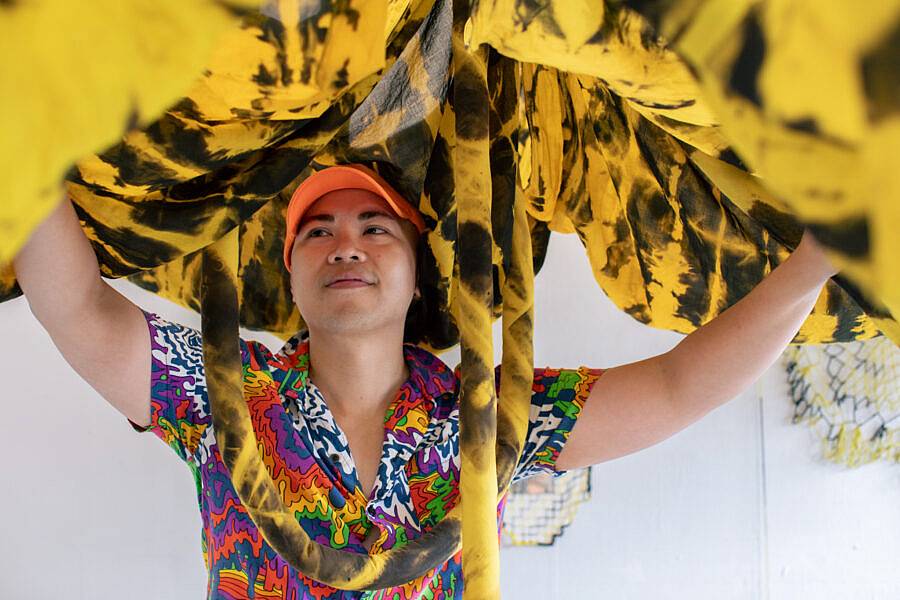
What are some recent, upcoming or current projects you are working on?
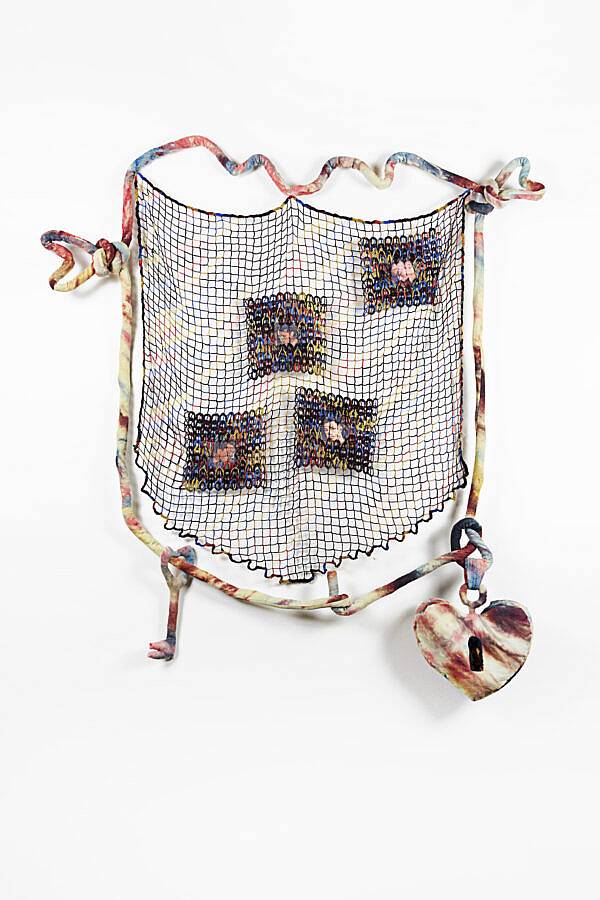
I was busy in the fall with three solo shows working on a particular series that meshes the subversion of textile history and racial stereotypes in gay pornography. The body of work is informed by the history of a craft technique, filet lace, and a gay porn superstar from the late 1990s-2000s, Brandon Lee. Filet lace was introduced to the Philippines via Spanish missionaries and then later adapted for American soldiers stationed in the islands to bring back home as a souvenir. Brandon Lee is a Filipino-American who created a racially ambiguous persona to alter perceptions of Asian American men in pornography.
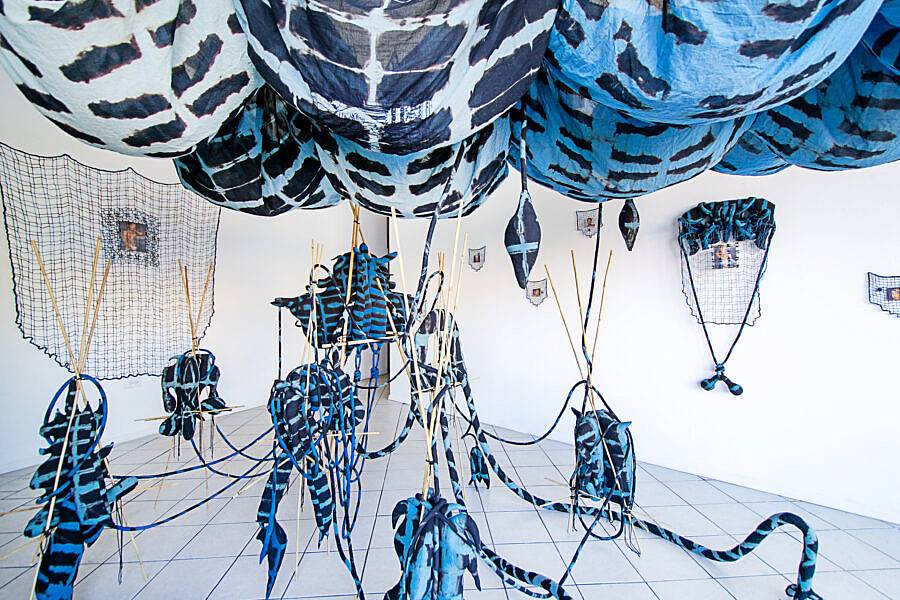
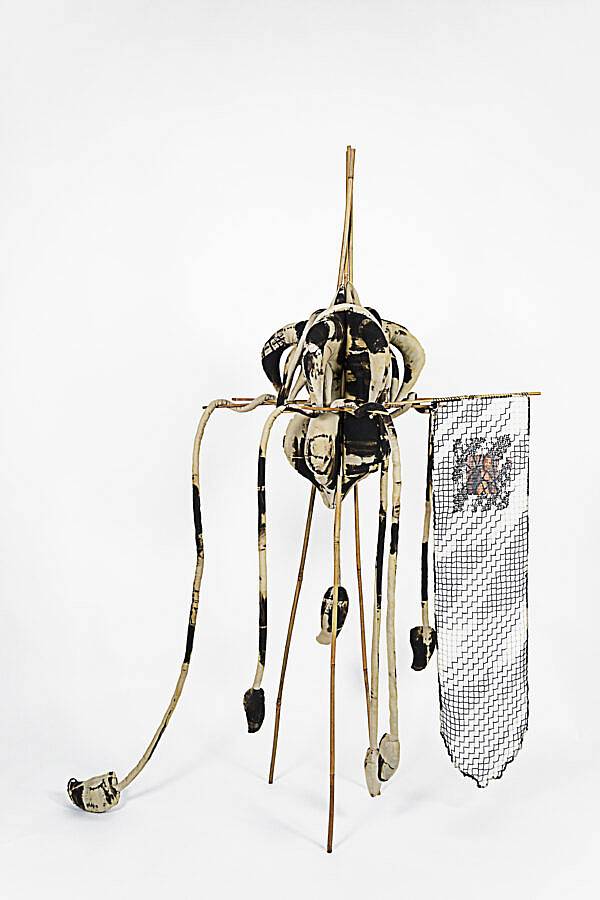
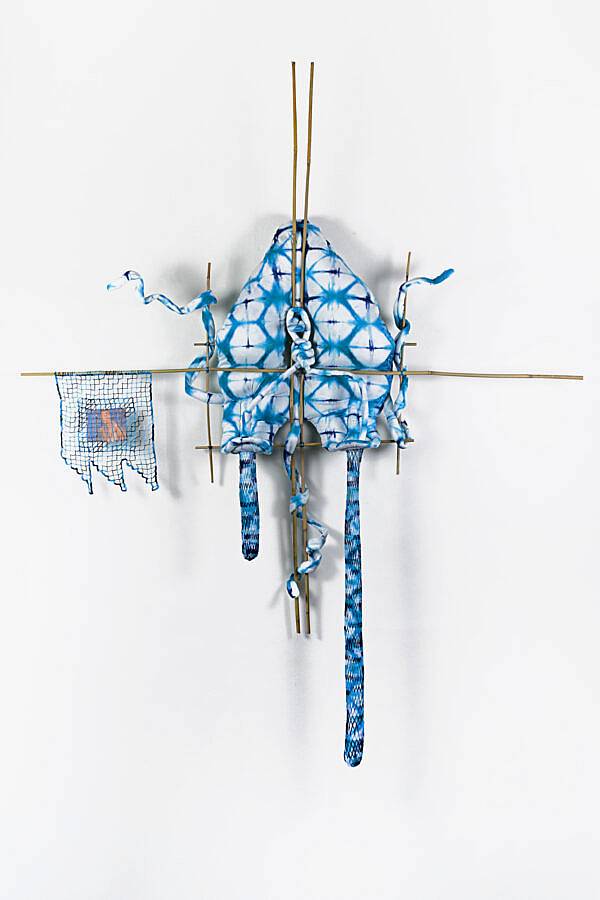
This series combines filet lace with free-standing soft sculptures supported by bamboo structures. Filet lace is an open-work textile using netting as its base for an embroidered image or pattern. Whereas in my work I embroider a blank square where an image of Brandon Lee is imprinted within the fiber using dye sublimation. This is a printing process where the dye is turned into a gaseous state, through heat and pressure, to penetrate the fiber with an image. This process is a metaphor for shapeshifting and code switching. The patterns for the soft sculptures are developed from Brandon Lee’s sex scenes, where his body is bifurcated to render new abstract forms. The bamboo structures are inspired by fishing nets, where complex bamboo configurations are attached using lashing knots to frame the nets.
I would say I am at the tail end of this series.
Your fiber installations can sometimes appear to be quite enveloping. Do you consider the specifics of the intended space when it’s time for their activation?
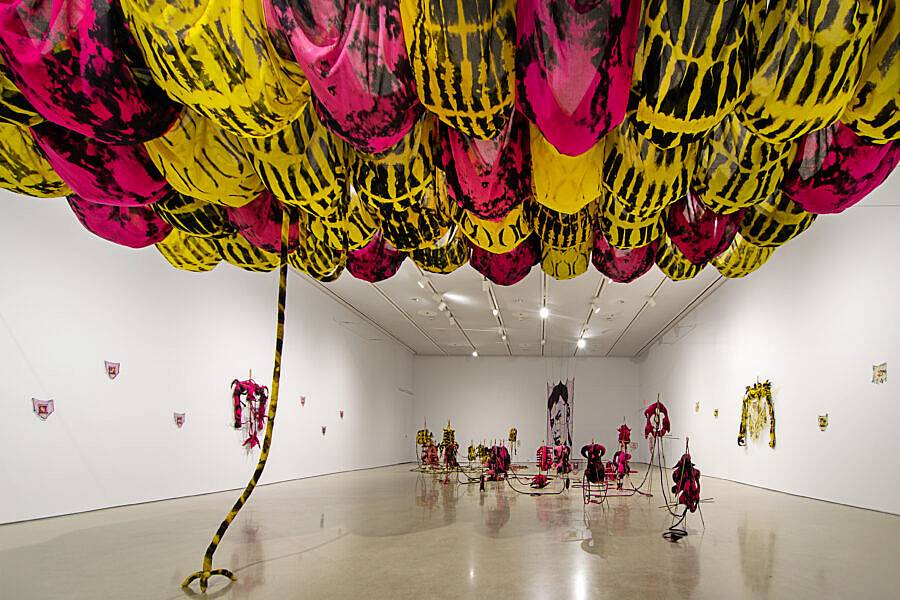
Yes, I work with the possibilities of a given space and solve the installation logistics ahead of time, but of course things change during the onsite install, which is part of the process. The recent installations I wanted to pace and choreograph the viewer’s experience in terms of being initially constricted and dominated by a looming diaphanous fabric on the ceiling, but then released through the experience of being close to body-sized sculptures and looking closely at intricate lace work.
Your work seems to take many forms, from sculpture to performance-activated garments. Do you maintain a set of self-imposed guidelines within your practice as a kind of language to follow along? Or does it manifest itself more naturally?
It depends on the series and what it asks for. Sometimes it’s as simple as working with a particular number. For example, I worked on a series based on a specific issue from a queer publication from the 1960s on an obscenity case that was seized by the FBI. Each sculpture represents a page from the magazine and gave myself a rule of scanning and printing each page on one yard of fabric and using that as my main component for each piece. For performance, it’s a gut feeling if I think the work needs to be more embodied through some type of movement, then I work on a particular garment that highlights, extends, and sometimes even restricts movements.
How long have you been teaching and what is the most important part of it for you?
Gosh, I haven’t even thought about that. I started teaching in 2014 when I was still in Vancouver and really loved it since. For me I get to see students grow leaps and bounds with how they approach their work and how they talk about it, sometimes within one semester. It’s important and satisfying seeing them progress, have confidence in their work, and possess the ability to freely express how they perceive the world.
Fibers have a deep history as a material. Can you tell us how your relationship with fibers began?
I was taught by relatives when I was a kid, specifically embroidery, to keep me focused and quiet. I was a very hyper kid asking too many questions. Then later on my dear mom-in-law taught me how to use the sewing machine in my 20s. But I never thought that this was going to be part of my practice as I went to a more traditional fine arts program in my undergrad. It was more in grad school that I began exploring the potential of fiber both in its multiple histories, how it is perceived in the art world, and how it can take up space and at the same time be folded or compressed. I’m compelled by how fibers can be so ubiquitous, we touch it every day, yet still have an edge because its perspective is coming from the margins.
Do you consider this relationship to be something that you’ll never cease to learn from and explore?
There is always something new, or at least new to me, to dive into. Even with one technique, it can take me to many directions all at once. From learning variations within a technique and then the historical attachments to it are endless and wonderfully excessive. Which can be daunting and overwhelming, but curiosity and stubbornness gets me there first and by then I’m too much in the thick of things to go back. At the moment, I am reacquainting myself with the single bed knitting machine and making samples almost every day. My partner sometimes needs to pry me out of it because I’m completely spellbound.
How has your work evolved over time?
I feel like I am doing little tiny steps in each series, oscillating between figurative and abstraction. I would say it has gotten more technical as I want to always unlock a new level where I can dwell in the fine details for a while before knowing what it is. I’m not wedded to a particular tool or technique, so I’m always wide-eyed. Conceptually, it has gotten a bit wilder entangling a technique or multiple techniques as a way to investigate how history is written and how queer narratives counter that.
Do you consider collaboration an important part of making?
Yes, as hard-nosed as I can get about how my work should be, collaboration helps me to soften up and see how someone else can approach the same idea. I have been collaborating with Sara Jimenez since 2012, we primarily do performance work together formerly under the guise of Tatlo, which is now just called Sara and Jade. This helps me get out of my own head and work with someone else who has a different set of skills and concerns, but we always figure it out as a team every single time. There’s a lot of trust and faith. When I go back to my own work I don’t feel as restrained, maybe because of all that physical work we do together. We don’t do it as often, but when we have a chance, something is always unleashed.
What are you really excited about right now?
I am thrilled about my upcoming sabbatical, which starts this fall. I have always worked since my late teens, so having more than a year off to linger and play is exciting! I also received a grant from the Illinois Arts Council, which is great timing as I will allow myself to spend days experimenting without worrying about constraints. I hope to travel to the Philippines as well. While I plan to conduct research, my primary goal is to return and reconnect with the place where I was born. I left the Philippines at the age of seven and haven’t been back since. Also purchased tickets to the quarter finals of the US Open this year, I’m a big tennis fan and used to play competitively, I’m thrilled to soak it all up and see the pros up close!
In regards to your making, what is something that you’ve always wanted to do and are working towards achieving it?
Three things. I haven’t had time to finish a large-scale filet lace that is 10 x 32 feet, so hopefully get that done. I just got an electric spinning wheel and plan to spin my own yarn from places I grew up or have lived, specifically interested in combining banana fibers from the Philippines, camel hair from United Arab Emirates, west coast Canadian Gotland sheep wool and/or alpaca fleece, and Midwest American Merino wool. And always wanted to grow my own natural dye garden! Maybe a field of goldenrod and indigo?
Interview conducted and edited by Liam Owings